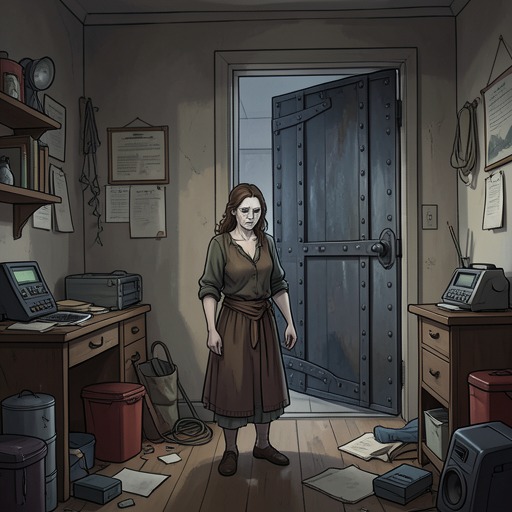
Joan Gilling's suicide attempt in New York
The Bell JarJoan Gilling’s suicide attempt in New York is disclosed retrospectively during her stay in the same hospital as Esther Greenwood. Joan says she had read about Esther, travelled to New York hoping it would be easier to kill herself there, and attempted suicide while staying with an old college roommate. Her parents found her and took her home. The account connects the two women’s crises without making their experiences interchangeable: Esther recognizes a possible likeness, while Joan’s explanation also shows how loneliness, limited money, and a lack of somewhere else to go shaped her circumstances.
Background and Disclosure
Joan’s attempt is not narrated as a scene in New York. It reaches Esther through conversation after Joan has arrived at the hospital and told her, “I read about you.” Esther initially wonders whether Joan chose a room there as a joke, since its furnishings mirror her own room, and admits that she had known Joan only at a cool distance. The parallel rooms make the women’s proximity tangible before Joan explains the history that brought her there.
Joan says she learned about Esther from accounts of her life, though not the circumstances in which Esther was found. She gathered her money and took the first plane to New York. When Esther asks why, Joan answers that she thought it would be easier to kill herself there. Her explanation establishes the attempt as a crisis pursued away from home, but the account does not specify a broader motive or describe every stage of the journey.
The Attempt and Its Discovery
Joan’s account makes clear that the attempt took place after she reached New York and went to stay with her former college roommate. She says she had little money and could think of nowhere else to stay. The roommate wrote to Joan’s parents because she was acting strangely; Joan’s father then flew to New York and brought her back. The account identifies the attempt’s setting, the practical circumstances around Joan’s stay, and the family intervention that ended her time in the city, without supplying a fuller chronology or explanation of what preceded the crisis.
The Means and Its Aftermath
Joan gives Esther a concise physical account of what she did: she put her fists through her roommate’s window. The action is presented as the attempt itself, but the narration does not describe the immediate scene in New York or add an account of how the injuries were treated there. Instead, Joan shows Esther the marks on her wrists during their later conversation at the hospital. That delayed disclosure shifts the episode from an unseen past crisis into a present exchange between the women, where the evidence of the attempt is visible but its full circumstances remain limited to Joan’s own explanation.
The intervention that brought the attempt to an end came from Joan’s family. Her roommate contacted her parents because Joan was behaving in a way that seemed unusual; her father flew to New York and took her home. Joan’s account therefore moves from her isolation in the city to a return organized by others, without stating how she experienced that return or what happened immediately afterward. When Esther says Joan is all right now, Joan answers uncertainly and turns the question back toward Esther. The exchange leaves recovery unresolved rather than treating the rescue as proof that the crisis has passed.
Significance and Limits of the Account
Joan’s attempt is related through a retrospective conversation, not shown directly in New York. That choice keeps the reader close to the facts Joan shares while preserving what the scene cannot establish: the narrative does not supply a complete chronology, explain every cause of her crisis, or describe the immediate aftermath of the attempt. Instead, its consequences emerge in the circumstances Joan recounts—her former roommate’s concern, her parents’ intervention, and her return home—and in the evidence of the event she later shows Esther.
The exchange also makes the attempt part of the novel’s carefully qualified parallel between the women. Joan travelled to New York after reading about Esther, yet Esther had known her only at a distance; now the corresponding rooms at the hospital and Joan’s account bring them into unexpected closeness. Esther recognizes that they may have something in common, but Joan’s uncertain response when asked whether she is all right resists a simple conclusion that rescue settled the crisis. Her question back to Esther leaves both women’s condition open, making the disclosure a moment of recognition without collapsing their separate experiences into one.