Joan's Suicide
The Bell JarJoan Gilling’s suicide is reported to Esther Greenwood at Belsize after Joan misses her curfew following a permitted trip to a movie alone. Doctor Quinn finds Esther in the night and again at frost-gray dawn; only then does she disclose that an orderly found Joan hanged in the woods by frozen ponds. The scene makes the death’s force depend on its arrival as news: a missing person becomes a body, and uncertainty gives way to a fact that Esther can barely speak.
The Search at Belsize
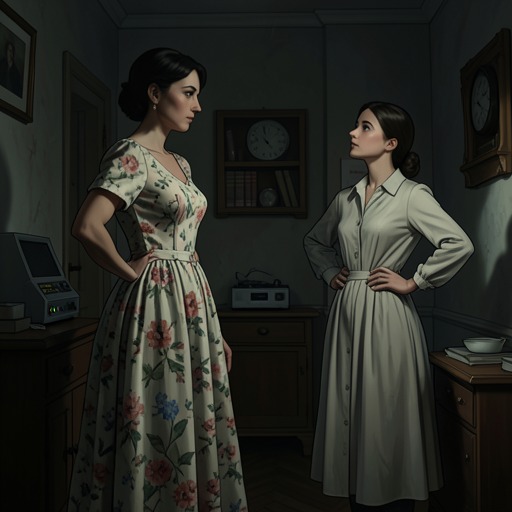
Doctor Quinn comes to Esther’s bedside after Joan has returned to live at Belsize, where she still has unusually broad town privileges. Quinn asks whether Esther knows where Joan is. Esther, unsure how much Joan may have told her after their trip to the Emergency Ward, briefly fears that she will be blamed for Joan’s return to the asylum. She says she will do what she can, but when pressed, she answers coldly that she does not know and asks whether Joan is in her room. Her response registers a sudden wish to separate herself from Joan rather than an ability to explain her disappearance.
The circumstances sharpen the uncertainty: Joan had permission to go to a movie in town, but it is well past Belsize’s curfew and she has not come back. Doctor Quinn confirms that Joan went alone, then asks where she might spend the night. The questions establish what Esther can and cannot tell the staff; they do not supply a motive for Joan’s absence or disclose what she did after leaving. The narrative holds the event at this threshold between a routine failure to return and a potentially grave discovery.
The Announcement
Doctor Quinn lingers in Esther’s room as though looking for a clue, then leaves without an answer. Esther turns out the light and tries to sleep. Joan’s smiling face floats before her, bodiless like the Cheshire cat; Esther thinks she hears Joan’s voice in the dark before recognizing the sound as wind moving through the asylum trees. The image does not explain Joan’s fate, but it places Esther in an interval of apprehension in which memory and the night’s ordinary sounds seem to blur.
A tap wakes Esther in the frost-gray dawn. This time she opens the door herself. Doctor Quinn stands there, her figure seeming smudged, and says that Joan has been found. Esther asks where. Quinn answers: in the woods, by the frozen ponds. The news reaches Esther in fragments; she opens her mouth but cannot speak. When she asks whether Joan is dead, Quinn confirms that she is and says she is afraid Joan has hanged herself.
The order of disclosure is central to the scene. First comes the passive phrase that Joan has been found, then a location, and only after Esther’s broken question the confirmation of death and its manner. Esther notices that Quinn’s passive wording slows her blood: the grammar withholds the finder and the act even as it announces the result. An orderly coming to work has discovered Joan. The first report leaves Esther briefly suspended between recovery and death; the final sentence ends that uncertainty.
Esther and Joan
The scene links Joan’s death to Esther through proximity and estrangement rather than through an established explanation of Joan’s motives. Esther has recently shared an Emergency Ward trip with Joan, and she is the person Doctor Quinn approaches for possible information. Yet Esther’s first response is to disassociate herself from Joan, and her cold denial leaves her with no account of where Joan might have gone. Their closeness does not make Esther an interpreter of the suicide: the narrative gives no explanation of Joan’s decision and no claim that Esther caused it.
The movement from Joan’s face appearing in the dark to Doctor Quinn’s dawn announcement gives Esther’s apprehension a precise narrative shape. The imagined, smiling face is not proof or premonition; it is a brief nocturnal image, followed by an external report that supplies the truth Esther does not know. The gap matters. Esther cannot turn the image into an explanation, and the news arrives from the asylum’s staff, mediated by the orderly who found Joan and by Quinn who tells Esther.
Narrative Consequences
Joan’s death changes the status of the scene from a search for someone overdue to the announcement of a suicide. The frozen ponds and woods place the discovery within the asylum grounds, while the dawn visit brings the fact into Esther’s room and into the novel’s first-person account. The orderly’s ordinary arrival for work and the stark location make the discovery concrete without supplying further details about the hanging. The narrative does not describe the body or reconstruct the act; it stops at the report.
The news also closes off the question that had driven Esther’s exchange with Doctor Quinn: where Joan might be, and whether Esther might know. What follows in the novel begins under the weight of a death that has been stated plainly but not explained. Joan’s suicide is therefore both a decisive event in the plot and a deliberately bounded revelation. It confirms that she is dead and that she hanged herself, while leaving the reasons for her action outside the scene’s knowledge.