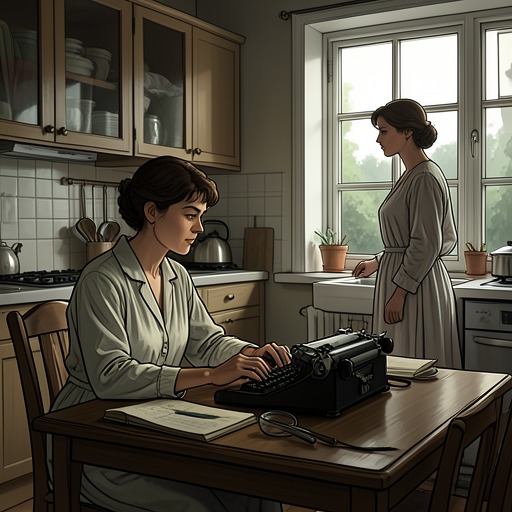
Philomena Guinea's private hospital
The Bell JarPhilomena Guinea's private hospital is both a refuge financed by a benefactor and a system that sorts patients by their apparent progress. Esther Greenwood arrives with her depression still enclosing her like the bell jar; the hospital offers rooms, doctors, grounds, and a path toward home, yet its locked doors, treatment corridors, and graded houses make recovery inseparable from institutional authority. The contrast between Doctor Gordon's traumatic electroshock and Doctor Nolan's later care gives the setting its central tension: the place can promise safety, but trust depends on how its power is used.
Arrival and Setting
After Esther's condition leaves her in a cramped city hospital ward, Philomena Guinea flies back to Boston and takes her to a private hospital with grounds, golf courses, and gardens. Guinea agrees to pay for her care as if Esther had a scholarship, until doctors she knows can make her well. Esther's mother says Esther should be grateful and that she has used almost all her money; Esther recognizes that without Guinea's help she might be in the large state hospital nearby. The transfer therefore brings real material security, but also makes Esther's treatment dependent on a benefactor and on the medical system that will decide whether she is well.
Esther's arrival does not lift the depression. As the family crosses a bridge, blue sky, sails, and gulls flash past like a postcard, but Esther closes her eyes and feels the bell jar's air gather around her. She later reflects that even a European ticket or a cruise would not have changed how she felt: the same sour air would have followed her. The hospital can change her surroundings without immediately changing the inward condition that makes every place feel sealed off.
The institution initially looks less like a prison than a country-club-like retreat. Sunlight falls in regular oblongs across shabby red carpets; fresh-cut grass sweetens the air; French doors open onto a bright lawn, and patients sit at card tables or in wicker chairs beside a grand piano. Esther nevertheless experiences the people as lifeless figures posed in a shop window. The ordinary, even genteel appearance of the grounds sits beside her knowledge that the place is full of people considered mentally ill, making the hospital's calm surface feel uncertain rather than reassuring.
Rooms, Wards, and Institutional Order
Esther has her own room in the main hospital, with a bed, bureau, closet, table, and chair. Its screened first-floor window has no bars and overlooks a wooded yard enclosed by a high red-brick wall. The wall's smooth inner face and the short drop to pine-needle-covered ground make the room seem physically different from the locked room at Doctor Gordon's hospital, but Esther still reads the enclosure as a limit. During the drive across the bridge she had wondered whether she could have jumped into the water; she suspects she would not have acted even if her mother and brother had not been beside her. Neither a possible escape nor a changed building ends the crisis.
The hospital's houses make recovery visible as a hierarchy. Belsize is the best house, associated with people returning to work, school, and home. Caplan is where Esther lives after entering the main building, and she fears a further fall from Belsize to Caplan, then Wymark, and finally the state institution next door if Doctor Nolan and Guinea give up on her. The sequence turns treatment into a map of possible futures: movement upward suggests improvement, while movement downward threatens the loss of private care and a more stigmatized institutional life.
Patients also measure one another through privileges and reports. Esther hears through the asylum grapevine that Joan has left Caplan and received walk, shopping, and town privileges. She gathers each report into a bitter heap even as she performs surface gladness, imagining Joan as the beaming double of her former self. The hospital's informal circulation of news makes progress something publicly legible among patients, not merely a private medical judgment.
Treatment and Medical Authority
Esther's first encounter with electroshock in this part of her story occurs under Doctor Gordon. Before it, his office and manner do little to make her feel understood: he twiddles a silver pencil and tells her that her mother says she is upset. Esther brings him the torn scraps of a letter to Doreen, but when he asks to speak with her mother, she worries he may have her locked up. She gathers the scraps so he cannot piece together her plan to run away and leaves his office without another word. Her fear of how the doctor might interpret her behavior precedes the treatment itself.
At the hospital, reassuring appearances give way to signs of confinement. A nurse tells Esther to wait in a living room where patients sit in summer clothes, and Esther first mistakes it for a seaside guest-house lounge. Later, as she follows Doctor Gordon upstairs, the carpet gives way to linoleum and a corridor of closed white doors. A woman shouts somewhere in the distance. A nurse with thick spectacles tells Esther that another patient believes she will jump from a window, but cannot because the windows are barred. In the bare room at the back of the house, Esther sees barred windows and keyholes on the doors, drawers, and closet. The setting that seemed open and domestic has a concealed architecture of locking and containment.
The procedure is performed with little preparation that Esther can experience as genuine reassurance. She lies on the bed; the nurse removes her watch and hairpins, while Doctor Gordon wheels in a machine. After grease is swabbed on her temples, he fits metal plates to either side of her head, fastens them with a strap that dents her forehead, and gives her a wire to bite. When the current comes, Esther feels herself seized and shaken; the machine shrills through blue flashes, and each flash brings a jolt she fears will break her bones. She wonders what terrible thing she has done. Afterwards, sitting with tomato juice in a small cocktail glass, she finds her watch fastened upside down and her hairpins unfamiliar. The changed placement of these ordinary objects registers her disorientation in the aftermath.
When Esther later tells Doctor Nolan about the machine, blue flashes, jolting, and noise, Nolan goes very still and tells her that this was a mistake: it is not supposed to be like that. Her response distinguishes the institution's treatment from the particular harm of Gordon's procedure. The narrative does not make the two doctors interchangeable; it shows how a patient's experience of the same broad intervention is shaped by its administration and by whether a doctor takes her account seriously.
Trust, Transfer, and the Return of Fear
Doctor Nolan is assigned to Esther when she enrolls in the main building. Esther is surprised that her psychiatrist is a woman, and initially wonders at her absence: after Esther is taken across the lawn to Caplan, strange men come to see her instead. Later, Nolan's judgment becomes central to how Esther understands the institution's promises. Belsize represents the prospect of returning to work, school, or home, and being transferred there might seem to confirm improvement. Yet when Esther is told she is moving, she insists she is not ready or well enough and cannot understand why Nolan has made the decision.
The transfer becomes a breach of confidence when Esther discovers that shock treatment is again expected. In a quiet alcove she curls under a blanket, distressed less by the treatment alone than by what she takes to be Nolan's treachery. She had trusted Nolan, told her everything, and believed her promise to warn her ahead of time if another treatment became necessary. Esther says she could have endured the fear if she had been told the night before and given time to compose herself. Her anger is therefore about control over the timing and knowledge of what will happen to her, as well as the procedure itself.
Nolan comes to the alcove, wipes Esther's face with a white handkerchief, hooks her arm through hers, and helps her up. They pass Joan, who ducks back into her room, then descend through a locked door into the basement corridors connecting the hospital buildings. The passage is a network of tiled tunnels, pipes, stretchers, and wheelchairs; Esther clings to Nolan's arm, and Nolan squeezes it encouragingly. At the green door marked Electrotherapy, Nolan waits while Esther hesitates. Esther finally says, “Let's get it over with,” and goes in. This time Miss Huey talks to her in a low, soothing voice while applying salve and fitting the electric buttons; she tells Esther she will be all right and asks her to bite down. Esther panics, bites, and darkness wipes her out. The second scene does not erase the first, but its accompaniment and Esther's decision to proceed mark a different relationship to the treatment.
Significance
The hospital's landscape and its institutional machinery remain in deliberate tension. Gardens, sunlight, a private room, and the possibility of returning home offer concrete alternatives to the city ward and state institution. At the same time, bars, locks, tiered houses, privileges, and tunnels organize patients' movement and status. Esther's account makes that order felt from inside: medical staff can name her condition and arrange her care, but she judges their actions through what they do to her body and whether they honor her trust.
The two electroshock episodes sharpen this distinction. Gordon's procedure leaves Esther frightened and disoriented, with an inverted watch and an enduring account of the blue flashes and jolts; Nolan recognizes that the experience was a mistake, yet Esther later experiences the prospect of another treatment as a betrayal when she is not warned. In the basement, Nolan's physical companionship and Miss Huey's soothing voice accompany Esther to the treatment room, but fear remains. The hospital is thus neither simply a haven nor simply a prison: it is a place whose promise of recovery depends on the same authority that can confine, classify, and treat its patients.