Valerie
The Bell JarValerie is a patient in the private psychiatric hospital where Esther Greenwood receives care, and an important counterpoint to Esther’s ideas about illness, treatment, and recovery. At first Esther mistakes Valerie’s composed appearance and ordinary interests for evidence that she does not belong in a psychiatric hospital; Valerie’s disclosure that she has had a lobotomy reveals how little can be inferred from the surface. Her steady presence makes the hospital’s distinctions between patients, treatments, and prospects for release visible without turning her into a simple emblem of recovery.
Introduction and First Impression
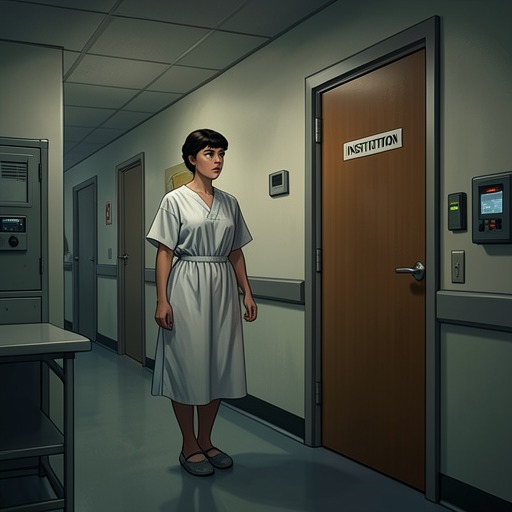
Esther first encounters Valerie in a shabby lounge after wandering away from her ward. Valerie sits in an armchair reading a magazine. Esther notices her round, pasty face, short black hair, and sporty brown shoes with fringed tongues and imitation acorns on the lace ends; the details remind Esther of a former Girl Scout leader. The lounge’s worn furniture and threadbare rug frame a scene far removed from the locked, clinical spaces Esther has just left, and Valerie’s unremarkable leisure makes the institution’s boundaries seem confusing.
Esther initially declines to answer when Valerie introduces herself and asks who she is. Later, she sits near Valerie and watches her read a battered copy of Vogue with intense attention. To Esther, Valerie could just as well be at a Girl Scout camp, and her concentration on the magazine seems to prove that nothing is wrong with her. Esther’s conclusion exposes her own uncertainty: she has begun to treat visible distress as the test of who counts as sick, while Valerie’s composed presence offers no such easy confirmation.
Treatment and Disclosure
Valerie’s first substantial exchange with Esther comes during Esther’s insulin treatment. Nurses inject Esther three times a day and, about an hour later, give her sugary fruit juice while watching her drink it. When Valerie recognizes what is happening, she tells Esther that she is on insulin and speaks from experience: she has had it herself and expects Esther eventually to have a reaction. The matter-of-fact warning makes Valerie a source of practical knowledge within a treatment routine that Esther is still trying to understand.
Valerie also tells Esther that she has had a lobotomy. Esther responds with awe and asks how she feels. Valerie says she feels fine and is no longer angry, explaining that before the operation she was always angry. She says she was previously at Wymark and is now at Caplan; she can go into town, shop, or see a movie, provided a nurse accompanies her. Her account links a major intervention to a reported change in her emotional life and to a limited expansion of her everyday activity. The permission is real but conditional: Valerie’s trips beyond the hospital remain nurse-supervised.
Her calmness thus has a history that Esther initially cannot see. The disclosure does not offer Esther an uncomplicated verdict on lobotomy or prove that Valerie’s experience is representative. Instead, Valerie describes her own state and the changes in what she is allowed to do, leaving the account specific to her while showing how treatment and institutional status shape ordinary life.
Esther’s Changing Understanding of the Hospital
Valerie’s presence belongs to a wider landscape that Esther reads and misreads as she moves through the hospital. Doctors gather on the lawn, and Esther jokes inwardly about their names, while patients elsewhere play badminton and golf. In the lounge, she finds Valerie absorbed in Vogue and cannot reconcile this familiar scene with her assumption that psychiatric patients must look visibly ill. Valerie’s everyday appearance complicates Esther’s effort to divide the hospital’s residents into the obviously sick and the apparently well.
The contrast also clarifies that the institution is not a single undifferentiated space. Esther has moved between hospitals and wards, notices differences in their facilities, and learns that Valerie has been at Wymark before arriving at Caplan. Valerie can now go into town only in a nurse-supervised group, a qualification that makes freedom a matter of degree rather than a clean divide between confinement and independence. Through this brief acquaintance, the hospital’s treatment classifications and permissions emerge as part of the patients’ lived circumstances, not merely administrative labels.
Relationship to Esther and Narrative Role
Valerie is not presented as a close companion or as the center of a sustained personal history. Her importance lies in the few direct encounters that alter Esther’s understanding: she knows the insulin routine, has undergone a lobotomy, describes her former anger, and names the limits of her present freedom. Esther’s attention to Valerie moves from visual scrutiny and disbelief toward astonishment at her composure. Valerie does not instruct Esther in a formal sense; rather, what she says gives Esther evidence that a patient’s outward calm can coexist with a consequential medical history.
Near the end of Esther’s stay, Valerie falls into step beside her in a small group walking under nurses’ supervision and says she has heard Esther is leaving. Esther answers that this will happen only if the doctors agree and that she has an interview the following day. The exchange places Valerie beside Esther at a moment when discharge is possible but not yet decided. It also echoes Valerie’s own account of conditional mobility: both women’s movements beyond the ward depend on medical judgment, though Esther is now approaching an interview about leaving.
Significance
Valerie’s role is brief but sharply defined by the difference between appearance and experience. Esther first reads her as too ordinary to be ill; Valerie’s disclosure of lobotomy and her account of anger, calm, and supervised outings expose the limits of that reading. The narrative gives Valerie a voice to describe her own treatment and its perceived effects, rather than leaving Esther to supply an explanation for her. At the same time, Valerie’s reported calm and increased access to town do not erase the institutional conditions surrounding her life. Her character therefore complicates Esther’s early assumptions without resolving the larger questions the hospital raises about treatment, recovery, or freedom.