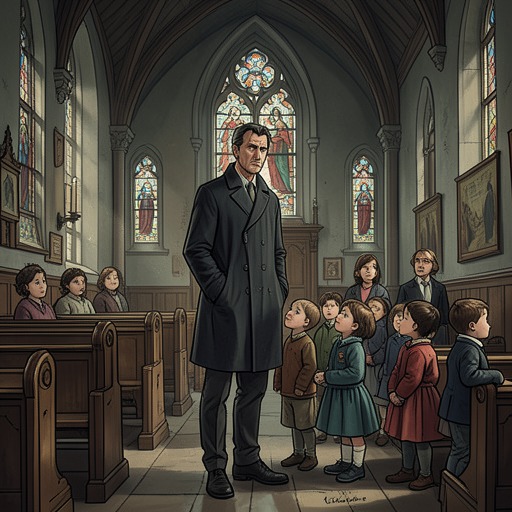
“There are no small parts, only small actors”
The Best Christmas Pageant Ever“There are no small parts, only small actors” is Mrs. Armstrong’s recurring maxim for the Christmas pageant. She presents it as a lesson in the importance of every participant, from the central roles to the smallest angel, even as the pageant’s attention to choosing Mary carefully exposes a tension between equal worth and unequal prominence.
Meaning and Use
Mrs. Armstrong gives the saying to the pageant cast while explaining rehearsals: the children must arrive on time, pay close attention, and understand that the leading parts include Mary, Joseph, the Wise Men, and the Angel of the Lord. She follows that list with the maxim, treating it as a familiar reminder about how the children should regard their roles.
When the narrator’s mother asks whether the children understand the saying, Mrs. Armstrong confidently says they do. The narrator later admits that the children do not really know what it means; to them, it is simply something Mrs. Armstrong always says. The narrator interprets it literally, guessing that shorter children must stand at the front of the angel choir so they can be seen.
The Mother’s Explanation
The narrator’s mother corrects that misunderstanding: the saying is not about the physical size or visibility of the performers. It means that every person in the pageant matters as much as every other, with even the littlest baby angel as important as Mary. Her explanation turns a rehearsals’ catchphrase into a principle of shared value within the production.
The narrator immediately tests that principle against the pageant’s practical hierarchy, suggesting that the explanation should be given to Alice Wendleken. The narrator points out that a pageant could go on without baby angels, but not without Mary. The mother rebukes the narrator for being cheeky, though she is not very angry because she recognizes the force of the observation.
Equality and the Central Role
Mrs. Armstrong’s own method makes the tension visible. She says that she always begins with Mary and tells the children that the choice must be made carefully because Mary was Jesus’ mother. The maxim therefore does not erase differences in narrative importance: Mary remains indispensable to the pageant’s telling of the Christmas story, while the saying insists that a less central performer is not thereby less worthy.
The expression’s significance lies in the gap between its clear ideal and the children’s difficulty applying it. The mother gives it an expansive meaning, but the narrator’s example shows how a production can depend more heavily on some roles than others. The saying asks the cast to distinguish a part’s prominence from a participant’s importance.