Christmas
The Best Christmas Pageant EverChristmas in the book is both a yearly religious observance and the occasion that breaks open a community’s habits. Its familiar pageant brings the Herdman family into the Church, where their unfamiliarity with the birth story and their unscripted-seeming presence change how the narrator and the audience understand a story they thought they already knew.
Annual Tradition and Familiar Script
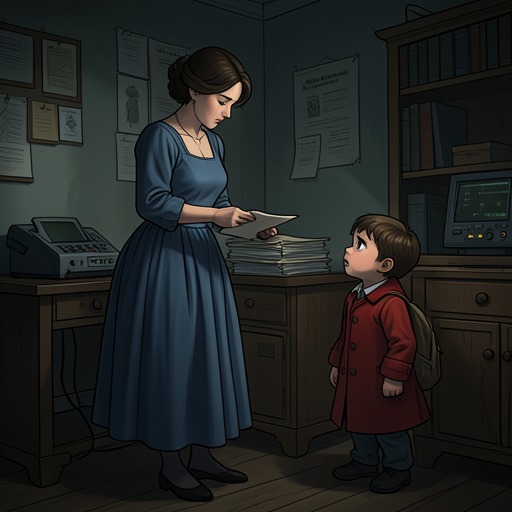
Christmas initially belongs to routine. The narrator’s Mother expects to have little to do with the pageant beyond making the narrator and Charlie participate and persuading the narrator’s Father to attend. He repeats that he has already seen the pageant; she counters that he has not seen that year’s version, in which Charlie is a shepherd. Her insistence captures the event’s place in family life: participation is customary, whether or not the children or their father are eager.
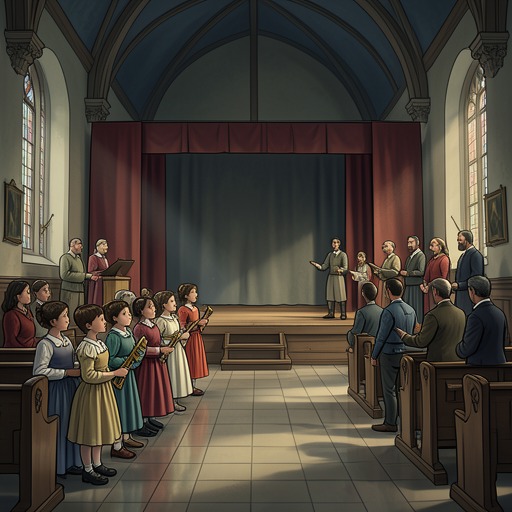
The production itself is described as standard in script, costumes, and casting. Primary-grade children are angels, intermediate-grade children shepherds, older boys the Wise Men, and Elmer Hopkins Joseph. Alice Wendleken has long played Mary, in part because she seems neat, intelligent, and holy to the adults around her. The remaining children form an angel choir arranged by height, with no expectation of polished singing. The performance’s predictable roles and modest abilities make it a local ritual more than a spectacle. Even its history of surprise is slight: the narrator recalls Mrs. Armstrong breaking her leg as the only unexpected occurrence.
The narrator’s Mother initially resists changing this arrangement. When her children suggest alternative entertainments, she insists that the pageant is a tradition and that she will not do anything different. This attachment is not simply to a polished religious production; the pageant is an established community practice, with roles already anticipated before the annual casting gathering. That predictability explains why the Herdman family is not considered as part of it until the children themselves become involved with the Church.
Christmas Brings the Herdman Family In
The book places Christmas at the point where the community’s judgment of the Herdman family meets the Church’s stated welcome. The narrator recalls that people had imagined the children ending up in the penitentiary until they became entangled with the Church, the narrator’s Mother, and the Christmas pageant. When the children raise their hands for major roles, the narrator’s Mother resolves to make the best pageant she can with them included. Reverend Hopkins answers objections by recalling the Christian principle of welcoming all children. Christmas thus becomes a test of whether the community’s habitual welcome extends to children it fears and dislikes.
The Herdman family’s participation also exposes how much the regular performers take for granted. They know the pageant’s sequence and chiefly need to learn their parts and places. The Herdman children, by contrast, know that Christmas is Jesus’ birthday but have not heard the surrounding story of the shepherds, Wise Men, star, stable, and crowded inn. Their lack of knowledge is connected to their circumstances: the narrator notes that their father had left without teaching them, their mother had given up trying, and the children’s access to books and television offered little chance of learning the story. The narrator’s Mother therefore begins by reading the account from the Bible rather than simply assigning stage positions.
Questions Reopen the Birth Story
As the reading proceeds, the Herdman children call out when the language confuses them. The narrator is surprised that children known for ignoring adults are watching and listening closely. Their responses are not conventional Bible-study comments: Imogene is appalled that there was no room even for Jesus, while Leroy asks why a baby was placed in a Manger and whether it was a bed in a barn. Imogene compares the improvised sleeping place with the time the family put Gladys in a bureau drawer. These details make the story’s material conditions—crowding, lack of a proper bed, and the need to care for a newborn—immediate rather than ceremonial.
For the narrator and the other regular participants, the reading is tedious because they already know the story and usually need only instructions about casting and positions. The Herdman children’s questions interrupt that familiarity. They respond to the birth not as a set of settled scenes but as a crisis involving a pregnant mother, a father who has not explained the situation, and a family without a place to stay. The questions do not change the story’s events; they shift attention toward the vulnerability that the pageant’s routine has made easy to overlook.
The Pageant’s Changed Meaning
Before the performance, the narrator’s Mother worries that the roles might collapse into a fight or that Mary might run away with the baby. At first, however, the evening seems to follow the usual pattern: angel wings poke other children, shepherds stumble over bathrobes, the spotlight sweeps across the stage, and the piano accompaniment is difficult to sing along with. The familiar disorder of the production makes the change that follows more striking.
When Imogene and Ralph appear, they do not push through the entrance as they usually might. They pause amid the candles and the full Church, looking to the narrator like displaced people waiting in an unfamiliar place. Imogene’s veil sits crookedly and Ralph’s hair sticks out around his ears. She carries the Baby Jesus doll over her shoulder, thumps its back twice, and then puts it in the Manger. Alice is startled by the gesture, but the narrator recognizes its force: the baby is being handled as a real infant who might need burping, not as a prop that must remain in a prescribed pose. That ordinary act makes the Holy Family’s predicament resemble the experience of people who arrive with little and are received without much concern for what happens to them.
During “Silent Night,” the audience and performers sing together. The narrator sees Imogene crying in the candlelight and leaving her tears unwiped. Her eye is puffy because she has walked into the corner of the choir-robe cabinet while dazed, not because she has fought with anyone. The performance is later called the best Christmas pageant the community has had, though people cannot readily explain what made it different. Its effect lies less in technical improvement than in the unexpected seriousness with which the familiar story has been inhabited.
Christmas Reconsidered
The pageant changes the narrator’s understanding as well as Imogene’s response. For years, the narrator had thought about the wonder of Christmas and the mystery of Jesus’ birth without grasping them. The Herdman children’s questions bring the story down from abstraction to a newborn, parents with no money, no place to go, no doctor, and no acquaintances nearby, followed by wealthy visitors from the East. The narrator can now see the wonder alongside the danger and need.
Imogene’s tears remain unexplained in her own words; the narrator describes Christmas as coming over her all at once. That response does not turn the pageant into a tidy lesson or erase the Herdman family’s rough reputation. Instead, it exposes a contrast between the community’s rehearsed familiarity and the force of encountering the story as new. Christmas is the occasion on which a routine performance becomes a reconsideration: the children whom the community expected to disrupt the pageant help it recover the human vulnerability at the center of the birth story.