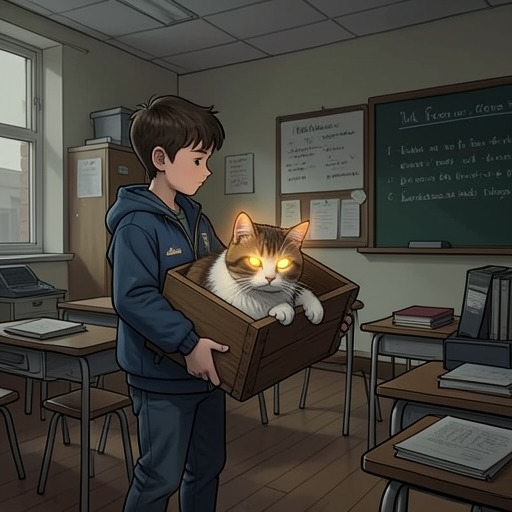
Claude Herdman’s Show-and-Tell cat rampage
The Best Christmas Pageant EverClaude Herdman’s Show-and-Tell cat rampage turns a classroom presentation into a schoolwide cautionary tale: a hungry, agitated cat escapes its box, terrorizes the first graders, and leaves the room in ruins. The incident ends not with Claude catching the animal, but with the class driven outdoors and a new rule against bringing anything alive to Show-and-Tell.
Background and Setup
The incident begins with Claude bringing the family cat to Show-and-Tell in a box. He had not fed it for two days, so it was already angry before it reached the classroom. The detail makes the presentation’s danger concrete from the start: this is not a calm pet unexpectedly startled by a noisy room, but a hungry animal carried into a school setting without being settled or controlled.
When Claude opens the box, the cat shoots straight up into the air, according to those who described it. It lands on the top ledge of the blackboard and claws four long scratches down its face. That first dramatic movement quickly gives way to a sustained disruption. The cat tears around the room, scratching small children, shedding fur, and scattering books and papers. The speed of the escalation is central to the story: the whole first grade is emptied in three minutes flat.
The Classroom in Chaos
Miss Brandel orders the children into the hall, then tries to corner the cat herself. She pulls a coat over her head and takes a broom, but the covering prevents her from seeing. As she runs up and down the aisles, she calls, “Here, kitty!” and swings at the sound of the cat hissing. Her improvised attempt at control compounds the disorder: she knocks over the Happy Family dollhouse and a globe, then breaks an aquarium containing twenty gallons of water and about sixty-five goldfish.
Miss Brandel repeatedly calls for Claude to come and get his cat. Claude, however, is already in the hall with the rest of the class. When she later asks why he did not take control of the animal, he answers, “You told us to go out in the hall.” His reply turns the immediate crisis into an ironic exchange about obedience. Claude follows the teacher’s instruction exactly, even though the consequence is that the person who brought the cat does not help retrieve it. The episode does not suggest that the cat is under his control; the classroom’s destruction makes clear that nobody has managed to contain it.
Damage and Immediate Consequences
The cat settles somewhat once it gets food, eating most of the goldfish and the two pet mice Ramona Billian had brought for Show-and-Tell. Ramona cries that she cannot even bury them, and the school sends her home. Her loss is distinct from the general commotion: while the children’s fear and the classroom damage affect the group, the mice are her pets, and their disappearance prompts a personal grief the adults cannot remedy.
By the time the episode subsides, the room is strewn with broken glass, papers, books, puddles of water, and dead goldfish. Miss Brandel is described as a wreck, and most of the first graders are hysterical. Someone takes the children outdoors and gives them recess for the rest of the day. The response does not restore the classroom or undo the losses; it removes the distressed class from the scene and brings the school day to an early end for them.
Aftermath and Significance
Claude takes the cat home. Afterward, the school establishes a rule that nothing alive may be brought to Show-and-Tell. The policy is the incident’s clearest lasting consequence: a classroom activity is restricted because one presentation has shown how quickly a living animal can turn it into an emergency. The sequence links specific damage—a broken aquarium, injured children, scattered belongings, and dead small animals—to a preventative rule, rather than treating the chaos as a temporary spectacle with no institutional response.
The episode also supplies a compact portrait of Claude’s place in the school’s stories. He brings the cat, but he does not retrieve it; when questioned, he points to the teacher’s order as his reason for remaining in the hall. That literal answer sits beside the more alarming fact that he had withheld the cat’s food for two days. The anecdote holds those details together without resolving them into a single explanation of his behavior. Its brisk escalation, from opening a box to emptying a grade, makes the disorder memorable, while the resulting ban shows that the consequences reach beyond the classroom. At the Woodrow Wilson School, the cat’s brief appearance changes what every child is allowed to bring to Show-and-Tell.