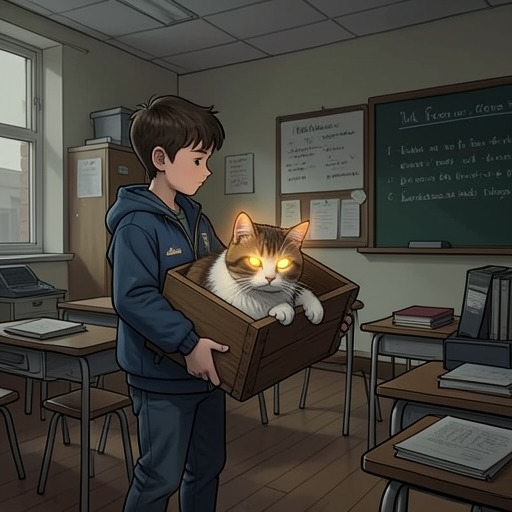
Claude brings the Herdman cat to Show-and-Tell
The Best Christmas Pageant EverClaude Herdman brings the Herdman cat to Show-and-Tell in an episode that converts a routine classroom presentation into a swift, destructive rampage. The cat’s escape leaves the room in ruins, but the event’s lasting consequence is a schoolwide rule against bringing anything alive to Show-and-Tell. Its comedy depends on the gap between the teacher’s instructions and the apparent expectation that Claude would take responsibility for the animal: he obeys the order to leave the room, while the cat remains inside to wreak havoc.
The Presentation and Its Trigger
One day, Claude Herdman empties the whole first grade in three minutes flat by bringing the cat to Show-and-Tell. He has not fed it for two days, so it is already angry when he carries it to school in a box. When the lid opens, the cat shoots straight upward, according to the children who describe its escape. The presentation begins not with a display or explanation but with the animal suddenly loose in the classroom.
The cat lands on the top ledge of the blackboard and claws four long scratches down its surface. It then tears around the room, scratching young children, shedding fur, and scattering books and papers. The episode’s speed is central to its effect: a classroom gathering turns almost immediately into a scene of flight and disorder, and the first grade is cleared in minutes.
The Classroom Rampage
Miss Brandel orders everyone to run into the hall. She stays behind, pulls a coat over her head, takes a broom, and tries to corner the cat. With the coat preventing her from seeing, she runs up and down the aisles, calling “Here, kitty!” and striking the broom down whenever the cat hisses. Her attempted method of control compounds the damage: she knocks over the Happy Family dollhouse and a globe, then breaks an aquarium holding twenty gallons of water and about sixty-five goldfish.
Miss Brandel repeatedly calls for Claude Herdman to come catch his cat, but Claude Herdman has gone into the hall with the rest of the class. Once the immediate commotion has passed, she is applying Band-Aids to anyone who can show her any blood. She asks why Claude Herdman did not come back to get the cat under control. His answer is that she had told the class to go into the hall. The explanation makes the episode’s central reversal plain: Claude Herdman’s conduct, for once, follows the teacher’s instruction, even as the situation seems to demand that he do the opposite.
Damage and Aftermath
The cat settles down somewhat after it gets something to eat: most of the goldfish and the two pet mice that Ramona Billian had brought for Show-and-Tell. Ramona cries that she cannot even bury them, and she is sent home. The classroom’s disorder is both physical and emotional. Broken glass, scattered books and papers, puddles, and dead goldfish cover the room; Miss Brandel is also described as badly shaken, while most of the first graders are hysterical. Someone takes the children outdoors, and they spend the rest of the day at recess.
The damaged aquarium and the dead animals make clear that the cat’s rampage is not merely a noisy interruption. The children are scratched, the classroom is wrecked, and Ramona loses her pets. The cat’s appetite eventually calms it, but only after it has eaten the animals that were themselves brought to the classroom as presentations. The scene’s escalating mishaps end not with a successful capture or an orderly return to class, but with the children outside for the day.
School Rule and Narrative Significance
Claude Herdman takes the cat home. Afterward, the school adopts a rule that nothing alive may be brought to Show-and-Tell. The policy is a direct institutional consequence of this particular incident: an activity intended for students’ objects and demonstrations is permanently restricted by one animal’s escape and the damage it causes.
The episode also belongs to a broader pattern at Woodrow Wilson School. The Herdman children move from grade to grade, the narration says, like South American fish that strip bones clean in three minutes flat; the comparison echoes the exact speed of the classroom evacuation and casts the school’s experience of them as repeated, rapid disruption. Yet they are never kept back a grade. Against that larger reputation, Claude Herdman’s answer to Miss Brandel supplies a small but pointed distinction: the chaos is real, but in this instance he can defend his absence by citing the teacher’s own instruction. The event turns that literal obedience into both the punch line and the explanation for why the cat remained loose.