Fred Shoemaker’s toolhouse fire
The Best Christmas Pageant EverFred Shoemaker’s toolhouse fire begins with a dangerous experiment and ends, by an uncomfortable turn of fortune, as a relief to the neighbors. The Herdman children burn down a building with a stolen chemistry set; the fire exposes their reckless habits, but also destroys a toolhouse already regarded as an eyesore and a possible source of rats. The same event is therefore both a serious consequence of the children’s behavior and, to the adults nearby, a welcome removal of a local problem.
Causes and Background
The fire is introduced against the Herdman family’s reputation for misbehavior. The children are described as lying, stealing, smoking cigars, fighting, swearing at teachers, and setting fires. They had played with fire before, but this was the first time they managed to burn down an entire building. The narrator suspects the blaze was accidental, while allowing that the children might have intended it; the account does not settle their initial purpose.
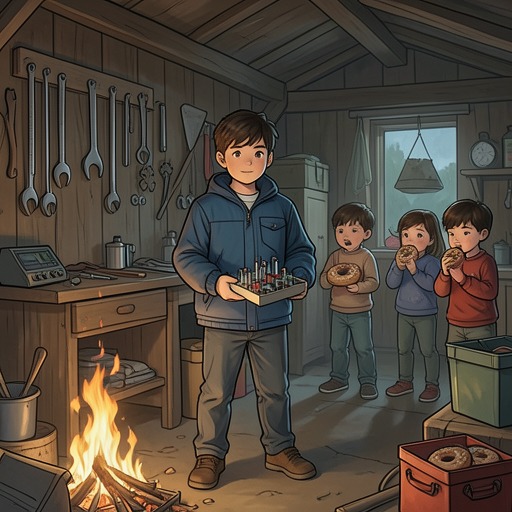
The immediate cause was not cigar smoking, as a fireman’s question to Claude Herdman suggested. The children had been using Leroy Herdman’s Young Einstein chemistry set, which Leroy had stolen from a hardware store. Leroy explained that they combined the small powders, poured lighter fluid around them, and set the fluid alight to test whether the set worked. The experiment destroyed the chemistry set along with the toolhouse. Leroy’s stated disappointment was not about the stolen property or the building: he was angry that he had lost the chance to make one or two bombs.
The building’s condition shapes the fire’s aftermath. Shoemaker’s toolhouse was old, broken down, and already close to collapse. Neighbors had repeatedly urged him to do something about it because it looked so bad and seemed likely to attract rats. That history makes the fire’s consequences different from what they would have been if a sound or valued building had burned.
The Fire and Its Crowd
The blaze draws a substantial response: two fire engines, two police cars, and all the volunteer firefighters arrive. Five dozen doughnuts are sent from the Tasti-Lunch Diner for the firefighters. By the time the fire is out, the doughnuts are gone. The Herdman children have eaten what they could and stuffed the rest into their pockets and shirts; doughnuts bulge around Ollie Herdman’s middle. Their presence at the scene, where everyone knows they are responsible, strikes the narrator as baffling. Instead of hiding, they remain among the spectators and take advantage of the food.
When a fireman asks whether the children started the fire while smoking cigars in the toolhouse, Claude denies the cigar part. His answer does not explain what actually happened; Leroy’s account does. The episode turns on this distinction between an accusation that is partly wrong and a cause that is more dangerous than the accusation suggests: the children were not smoking there, but they were handling chemicals and lighter fluid stolen or obtained through theft and using them without regard for the risk.
The fire chief gathers the fifteen or twenty children watching and warns them about matches, gasoline, and other dangerous things. He does not claim to know what caused this particular fire; instead, he presents it as a lesson in what such dangers can produce. For the watching children, the ruined toolhouse is an example of the consequences of carelessness. For the Herdmans, the narrator says, the lesson is different: they learn that fires sooner or later bring free doughnuts.
Consequences and Irony
The firefighters’ effort and the destruction of the building do not result in the same kind of response from everyone. The neighbors call the fire a blessing in disguise, and Shoemaker himself says he is relieved. Since the toolhouse had been an eyesore and a perceived rat hazard, its destruction removes a nuisance as well as causing damage. The narrator’s father calls it the only good thing the Herdman children ever did, adding that if they had known it was good, they would have burned something else—or someone. His remark makes the neighborhood’s relief sharply conditional: the outcome seems fortunate because of what happened to this particular building, not because setting fires is harmless.
The fire thus resists a simple moral. The chief offers the children a public warning about dangerous materials, but the Herdmans’ practical takeaway is the food that followed the blaze. The cause also makes the apparent comic disorder more serious: Leroy’s stolen chemistry set was not merely a lost toy but the instrument of a fire, and his regret centers on the bombs he did not get to make. Meanwhile, the toolhouse’s poor condition allows the adults to regard the destruction as useful after the danger has passed. The event brings recklessness, damage, and relief together without making any one of them cancel the others.
Narrative Significance
The narration builds the episode through a contrast between the scale of the fire and the Herdmans’ response to it. The fire mobilizes emergency services and gathers a crowd, yet the children’s most visible actions are eating and hiding doughnuts in their clothes. That comic detail does not soften the cause: the same children whose behavior turns a stolen chemistry experiment into a building fire also fail to absorb the warning addressed to the crowd. The gap between the chief’s intended lesson and the lesson the narrator says the Herdmans actually learn establishes their resistance to ordinary correction.
The scene also complicates the narrator’s sweeping description of the children as the worst in the world. Their wrongdoing is unmistakable, and the possibility that the fire was deliberate is left open, but the neighborhood’s response reveals that the burned building was itself a longstanding problem. Even the father’s harsh judgment depends on that local circumstance. Fred Shoemaker’s toolhouse fire therefore serves as an early, concentrated example of the book’s uneasy mixture of danger and comedy: the children create real harm, the adults find an unexpected benefit in its result, and the Herdmans carry away a lesson no one meant to teach.