Imogene threatens Alice over the role of Mary
The Best Christmas Pageant EverImogene threatens Alice Wendleken over the role of Mary in the Christmas pageant, turning a familiar casting choice into a contest between Alice’s attachment to the part and her fear of what Imogene may do. The threat is not merely bluster: the narrator connects it to a past incident in which a pussy willow actually sprouted in Ollie Herdman’s ear. When the narrator’s Mother asks Alice why she did not volunteer, Alice’s silence becomes legible as the consequence of intimidation rather than indifference.
The unanswered question
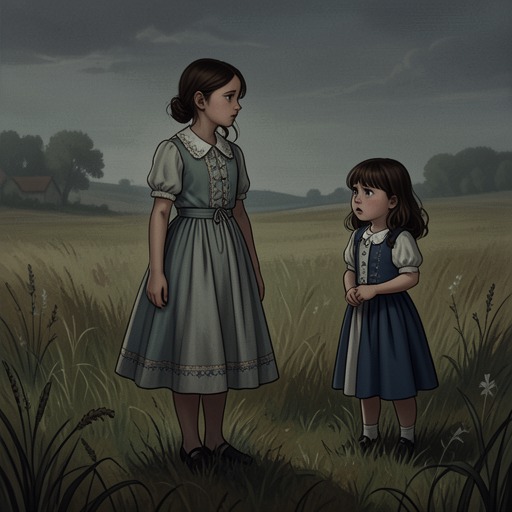
As people leave, the narrator’s Mother takes Alice by the arm and asks why she did not raise her hand to be Mary. Alice says she does not know, and looks angry. The question brings the pageant’s casting decision into view, but Alice’s answer conceals the pressure behind it: the narrator knows that Imogene has warned her what would happen if she dared volunteer.
The moment also exposes a conflict between Alice’s established place in the pageant and her ability to claim it openly. Alice insists that she is always Mary, yet that familiarity has not protected her from Imogene’s threat. The role is important enough for Alice to assert as hers, but the prospect of being targeted has made speaking up costly.
Imogene’s threat
The narrator describes Imogene’s threatened reprisals as ordinary Herdman behavior: clunking someone on the head, drawing all over homework papers, or putting worms in a coat pocket. The list makes the menace concrete through acts of petty, invasive sabotage rather than an abstract warning. Imogene then escalates from those familiar examples to a more specific punishment: she says that, when pussy willows come out the following spring, she will push one so far down Alice’s ear that it cannot be reached; it will sprout and grow until Alice has a bush growing from her ear for the rest of her life.
The threat works by converting something ordinarily associated with spring growth into an image of bodily harm. Its grotesque extravagance might sound impossible to someone unfamiliar with the Herdmans, but the narrator immediately supplies a reason not to dismiss it. The danger is not simply that Imogene threatens Alice; the story gives the threat a history that makes Alice’s fear credible.
The threat’s precedent
Ollie Herdman once had a pussy willow sprout in his ear. At school, he developed a severe earache, and the nurse looked inside with a small lighted tube. Her alarm drew attention from down the hall. Ollie had to be taken to the hospital, put under, and have the sprouted willow dug out of his ear.
That earlier incident explains why Imogene’s threat can function as intimidation instead of a fanciful joke. She has taken an alarming, real event involving her brother and recast it as something she could deliberately do to Alice. The narrator’s account does not establish that Imogene has carried out this particular threat against Alice; it shows instead why Alice has reason to believe she might. The old incident supplies the threat with both its image and its force.
Alice’s silence and the aftermath
The narrator identifies Imogene’s warning as the reason Alice kept quiet about being Mary. Alice herself says she does not care what Imogene does and declares, “I’m always Mary in the pageant.” Her defiance and her silence coexist: the words assert the part she regards as hers, while the narrator’s explanation reveals that the assertion has not translated into volunteering.
Walking home with the narrator, Alice confirms the seriousness of her fear. She says that the Herdmans will do anything, and argues that the narrator’s Mother should have told them no. In Alice’s view, Imogene should be removed from the pageant, along with the other Herdmans, because they may do something terrible and ruin it. Her response shifts the dispute beyond one threatened role: for Alice, the threat raises the question of whether the Herdmans should be allowed to participate at all. The episode thus links the pageant’s casting to the Herdmans’ reputation and shows how that reputation can silence a child before the performance has even begun.