Imogene’s unfamiliarity with the Christmas story
The Best Christmas Pageant EverImogene Herdman’s unfamiliarity with the Christmas story is the force that makes its familiar details newly startling. She and the other Herdman children know that Christmas marks Jesus’ birthday, but not the shepherds, Wise Men, star, stable, or crowded inn. Their questions interrupt the church children’s routine recitation and expose how easily a story repeatedly performed can become one that its audience no longer examines. Imogene’s ignorance is not simply a gap in religious knowledge: it directs attention toward the story’s practical hardships and the vulnerability of its newborn child.
What the Herdmans Did Not Know
The distinction between knowing whose birthday Christmas celebrates and knowing the Nativity story matters. The Herdmans have the first fact but lack nearly everything that gives the birth narrative its shape. When Narrator’s Mother decides to read the story aloud from the Bible, the other children find the exercise tedious because they already know it backward and forward and usually need only to be told their assigned roles and places. For them, the story is familiar pageant material; for Imogene and her siblings, its people, circumstances, and vocabulary are all new.
The account offers concrete reasons for that unfamiliarity, while presenting some of them as the narrator’s understanding rather than as confirmed explanations. The Herdmans read Amazing Comics rather than other books. Their television, which Ralph Herdman bought for sixty-five cents at a garage sale, gives a picture only when someone holds the antenna, and even then shows very little. The narrator supposes that Mr. Herdman never told the children the story before climbing onto a railroad train, while Mrs. Herdman appears to have given up trying to teach them. Together these details place the gap in a broader context of limited access to books, an unreliable television, and absent or exhausted parental instruction.
Their contact with the Bible has not supplied the missing story. While Imogene is taking money from the collection plate in a class, Gladys Herdman and Ollie Herdman draw mustaches and tails on the disciples in an illustrated Bible for young children. Alice Wendleken points to the episode as evidence that the Herdmans do not even know what a Bible is. The vandalized pictures are a sharp counterpoint to the attentive listening that follows: the book they have treated as a surface for doodles becomes, through Narrator’s Mother’s reading, the source of a story they are eager to understand.
Listening Through Questions
Imogene’s first demand is to begin at the beginning, a request that alarms the narrator because a literal beginning could mean Genesis and make the explanation seem impossibly long. Once Narrator’s Mother starts with the Christmas account, the Herdmans’ interruptions show where its language exceeds their knowledge. They call out whenever they do not understand a word. When the reading describes Mary as being with child, Ralph Herdman recognizes the meaning in blunt everyday language, and Imogene’s concern soon turns from vocabulary to the situation itself.
The moment the story says there was no room at the inn, Imogene’s jaw drops and she sits upright. Her response is not a request for pageant instructions but a protest against the treatment of the family: even Jesus, she realizes, was refused lodging. Narrator’s Mother explains that no one knew the baby would be Jesus. Ralph Herdman presses the explanation by asking why Mary did not tell them; Imogene says she would have made sure people knew and questions Joseph’s failure to do the same. Her reaction makes the inn’s refusal feel less like a settled plot point and more like a preventable failure of care.
The stable and the manger prompt the same practical scrutiny. Leroy Herdman asks whether a manger is a bed and why a barn would have one. Narrator’s Mother explains that Mary and Joseph had no bed available and had to use what they could find. Imogene answers with the remembered fact that the family put Gladys in a bureau drawer as a baby. The comparison joins the biblical account to an instance of the Herdmans’ own precarious domestic life: the problem of where to put a newborn is not an abstract detail to her, but something she can measure against family experience.
From Birth to Danger
As the reading moves to the Wise Men, the Herdmans continue to translate unfamiliar religious terms into ordinary, sometimes comic, ones. Claude Herdman associates a king with the president of the United States; Narrator’s Mother tells him that this is close and clarifies that the visitors were kings. Imogene mutters that their arrival is overdue and hopes they will challenge the innkeeper and get the baby out of the barn. Her response keeps the story’s physical predicament in view even as its cast expands.
The gifts create another misunderstanding with revealing consequences. When the text names gold, frankincense, and myrrh, Leroy asks what the latter substances are. Imogene mistakes myrrh for oil and objects that a king should not bring such a cheap present, comparing it unfavorably with gifts from the firemen. The joke depends on the Herdmans’ material frame of reference: they have sometimes received Christmas presents at the Firemen’s Party, where Santa checks packages to ensure they contain no bows and arrows or dart guns. Imogene herself usually receives sewing cards or jigsaw puzzles, which she dislikes. Her complaint about the Wise Men’s gifts therefore reflects both a comic error and the concrete standards by which she evaluates what counts as a good present.
Her questions become more urgent when Narrator’s Mother explains that King Herod sent the Wise Men to find Jesus and intended the child to be put to death. The Herdmans have never heard of Herod. Imogene reacts with dismay that a baby has only just been born and is already threatened with death. The sequence changes the emotional scale of the story for her: birth, lack of shelter, and a questionable gift have led to an immediate danger to the child. Her unfamiliarity makes these developments land as discoveries rather than as details already absorbed into a traditional pageant.
A Changed Understanding
The effect of Imogene’s questions reaches beyond her own learning. By the end of the account, the narrator recognizes that the Herdmans have altered the meaning of a story long considered familiar. The narrator had thought about the wonder of Christmas and the mystery of Jesus’ birth without really understanding it; hearing the story through the Herdmans makes it seem less mysterious. Their attention has drawn out the material circumstances that familiarity can leave in the background: a family with no money, nowhere to go, no doctor, and no one they know, followed by wealthy visitors arriving from the East.
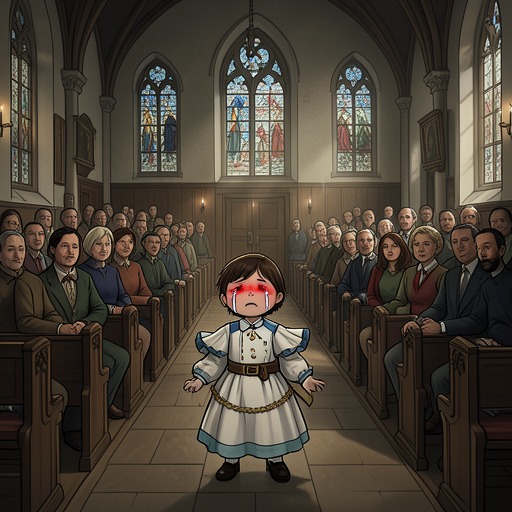
Imogene’s response is described as a sudden physical and emotional overwhelm. In the church, she walks into the corner of the choir-robe cabinet in a daze; her eye becomes puffy, though no one has hit her and she has hit no one. The narrator understands her as having suddenly caught onto the idea of God and the wonder of Christmas. The Herdman family’s ignorance has not merely been corrected by a reading. It has made room for a fresh encounter with the story, one that leaves Imogene crying and the narrator newly able to see the birth as both a religious mystery and the account of a child and parents in trouble.