Manger
The Best Christmas Pageant EverThe Manger, a large wooden feeding trough for animals, is both a practical substitute for a bed in the Christmas story and the central object around which the pageant’s understanding of that story takes shape. The Herdman family’s questions make its material purpose newly visible, while the imperfect scene they create around it brings the birth narrative close to ordinary experiences of need, discomfort, and care.
Definition and place in the story
When Mother explains that Mary and Joseph had no bed for the newborn, Imogene Herdman asks what they laid the baby in and whether a manger is like a bed. Mother clarifies that it is a large wooden feeding trough for animals: not a prepared infant’s bed, but whatever was available when the family had nowhere else to put the baby. The explanation makes the object’s function inseparable from the circumstances of the birth. Its importance lies not in comfort or ceremony, but in the shortage that made it necessary.
The Herdman family’s bewilderment exposes how easily a familiar Christmas image can lose its practical meaning. They know that Christmas marks Jesus’s birthday, but the shepherds, Wise Men, star, stable, crowded inn, and manger are all news to them. When Mother reads that there was no room at the inn, Imogene is struck by the fact that even Jesus could not find a place. The trough consequently belongs to a larger scene of exclusion and improvisation: the family has no room or bed, and the manger becomes the available alternative.
From explanation to improvised care
The account of the manger draws out a personal memory from Imogene. She says that Gladys Herdman was put in a bureau drawer; Ralph Herdman adds that there was a bed, but Ollie Herdman was still in it and would not get out. The exchange is funny, but it also makes the biblical predicament legible through a concrete comparison. A newborn needs somewhere to be placed, and a household without an available bed must use something else. The Manger is not simply an emblem to be admired: it is a makeshift answer to an immediate need.
That practical meaning follows the object into the pageant preparations. Mother decides the cast need not worry about obtaining a real baby and says they will use a doll instead. Imogene is pleased because a doll cannot bite. At dress rehearsal, however, she cannot find the Baby Jesus doll. She wraps a large memorial flower urn in the blanket and drops it on Ralph Herdman’s foot. The mistake interrupts the performance and forces the group to start over repeatedly. The sequence shows how fragile the staged image is: without the right stand-in, the object meant to hold the baby can be occupied by something entirely unlike one.
In the performance, Imogene does have the doll, but she carries it slung over her shoulder rather than cradled in her arms. Before putting it in the Manger, she thumps it twice on the back, as if burping a baby. Alice Wendleken finds the handling improper; the narrator considers that Jesus could have been fussy, hungry, or colicky like any other infant. The trough frames this unceremonious act of care. The scene’s departure from polished pageant convention makes the child’s bodily vulnerability harder to overlook.
Gifts gathered at the Manger
The Manger also becomes a destination for offerings. In the story Mother reads, the Wise Men visit the young child and present gold, frankincense, and myrrh. When Leroy Herdman learns that the gifts include precious oils and fragrant resins, Imogene Herdman objects that oil seems like a cheap present, comparing it unfavorably with gifts from the firemen. Her response connects the biblical gifts to the children’s own experience of Christmas presents, including the sewing cards and jigsaw puzzles Imogene dislikes. The unfamiliar gift is measured not by its place in a sacred account but by the everyday expectations she already knows.
The pageant’s offering at the Manger reverses that comparison. Leroy places a ham in front of it instead of the fancy bath-salts jars usually used for myrrh and frankincense. The ham comes from the Christmas food basket given to the Herdman family by the church charitable works committee; its ribbon still reads Merry Christmas. The narrator recognizes it as their own food-basket ham and argues that the family is giving away its own food, not stolen property. Since the Herdmans have never been known for giving things away, the gesture carries significance beyond the ham’s value. A provision they received is turned into an offering beside the child.
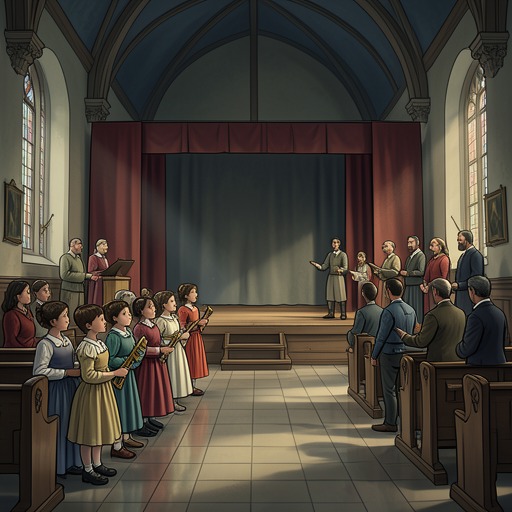
After placing the ham, the Herdman children sit in the only remaining space. The Wise Men are supposed to confer and leave by another door, but the family forgets the convention or declines to follow it. Their stillness makes the staged ending look less like a formal cue and more like tired visitors resting near the child. The Manger thus anchors not only the pageant’s gifts but also the unexpected human arrangement that gathers around them.
Meaning in the pageant
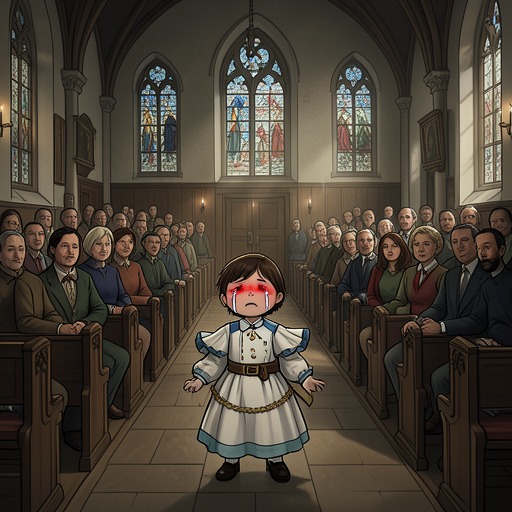
The narrator’s view of the birth story changes as the pageant’s details collect around the Manger. The sight of Imogene Herdman and Ralph Herdman as Mary and Joseph—with a crooked veil, untidy hair, and a doll carried over the shoulder—recalls a family displaced and lodged in an unwelcoming place. The narrator recognizes that the real Holy Family may not have been neat or tidy either. The Manger’s rough, practical function supports this recognition: the story becomes less an idealized tableau and more a birth attended to with whatever care and shelter could be found.
That shift culminates in the narrator’s reflection that Jesus did not arrive like a figure descending from a cloud, but was born and lived as a real person. The Manger makes that claim tangible by placing the baby in an ordinary object meant for feeding animals, while the pageant’s doll, improvised handling, and ham offering surround it with imperfect acts of care. For the narrator, the Herdman family’s version of the scene turns the wonder of Christmas from an abstract mystery into something understandable through vulnerability, need, and the response of people who have little to spare.