The Herdmans take the leading roles in the Christmas pageant
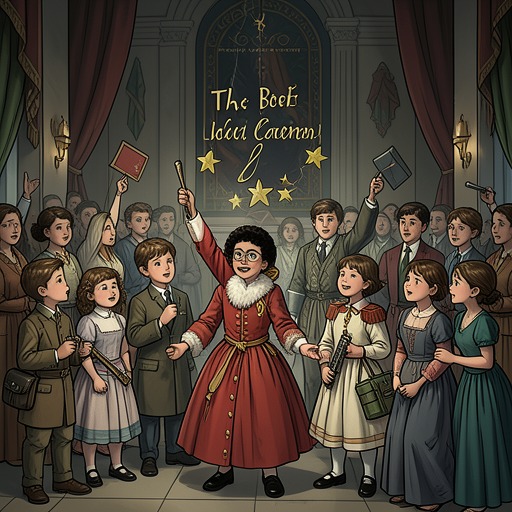
The Best Christmas Pageant EverThe Herdman children take the leading roles in the Christmas pageant after volunteering for Mary, Joseph, the three Wise Men, and the Angel of the Lord. The casting turns a procedure Narrator's Mother expected to be straightforward into a startling reversal: the children the congregation is accustomed to fearing become the pageant’s central figures, while Alice Wendleken, the only girl who had previously volunteered for Mary, refuses the role when asked again.
The planned casting
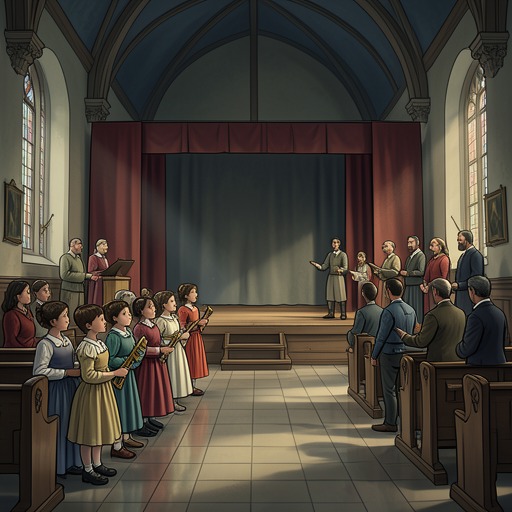
Narrator's Mother begins by explaining the roles that still need to be filled: Mary and Joseph, the three Wise Men, and the Angel of the Lord. She says that these parts are not hard, but are important, and asks the children playing them to attend every rehearsal. The practical requirement sets the scene’s terms: taking a leading part means making a commitment, not simply appearing on the night of the performance.
Mary’s casting is presented as a matter of character as well as assignment. Narrator's Mother describes her as quiet, gentle, and kind, and says that the girl playing her should try to be like that. She expects volunteers, after which the children will decide together. The method sounds orderly and fair, and seems safe because, in previous years, Alice has been the only person to raise her hand. The scene’s surprise comes when that familiar pattern fails.
A reversal in the volunteers
This time Alice sits silently, chewing a piece of her hair and looking down at the floor. The narration places her bodily hesitation before the new volunteer is named: it is not merely that Alice does not offer herself, but that the person expected to do so appears withdrawn. Imogene Herdman raises her hand instead. When Narrator's Mother asks whether she has a question, Imogene answers that she wants to be Mary and adds that Ralph Herdman wants to be Joseph. Ralph confirms it.
Narrator's Mother’s response is disbelief. The narrator compares her stare to the shock of a detective-film scene in which a respectable old woman points a gun through a bank window and demands the money. The comparison captures the gap between Imogene’s direct claim and the familiar image of the children who attend the pageant preparations. The comedy lies in the mismatch, but the casting also immediately tests Narrator's Mother's stated ideal for Mary: Imogene has requested the part, while Alice, whom the group had implicitly expected to fit the established pattern, is no longer willing to volunteer.
Narrator's Mother accepts Ralph as Joseph and tries again to find a volunteer for Mary, looking around the room and calling on Janet, Roberta, and Alice. Alice answers no so quietly that she can hardly be heard. Her refusal makes the change more than a comic surprise about Imogene’s ambition: the customary volunteer has withdrawn, and the role cannot simply return to its previous arrangement. The evidence establishes Alice’s reluctance but does not explain its cause; the scene lets the contrast between her lowered voice and Imogene’s open claim carry the tension.
The remaining roles
The other principal parts fall to the rest of the family. No one volunteers to be a Wise Man except Leroy Herdman, Claude Herdman, and Ollie Herdman. With Imogene as Mary and Ralph as Joseph, the three boys fill the Wise Men’s places. Narrator's Mother is left with a pageant whose main roles are all occupied by Herdman children, a consequence the narrator describes as her being stuck with the cast.
One Herdman child and one principal role remain: Gladys Herdman becomes the Angel of the Lord. The allocation follows from the numbers rather than from a separate contest. Gladys asks what she has to do, and Narrator's Mother explains that the Angel of the Lord brings the good news to the shepherds. The question gives the final appointment its own small moment: Gladys is not just assigned a costume or position; she wants to know the action required of her part.
Significance of the casting
The event changes who will embody the pageant’s central story. Narrator's Mother had introduced Mary through a description of gentleness and kindness, but the casting process does not produce a conventional match between a role’s stated qualities and the community’s expectations of a suitable performer. Instead, Imogene asks for Mary herself, Ralph backs her claim to Joseph, and the other Herdman children volunteer for the remaining principal parts. The narrative presents this as an unexpected outcome, not as proof that the children already possess the traits associated with their characters.
The scene also exposes the limits of a procedure that appears to offer the children a collective choice. Narrator's Mother proposes volunteers and a decision made together, yet her repeated appeals produce no alternative Mary, and Alice’s answer is a quiet refusal rather than renewed participation. The family’s concentration in the cast is therefore both a comic takeover and a practical result of who actually volunteers. By the end, the question is no longer who will play the leading roles: the Herdman children have them all, and the rehearsals must proceed with that fact established.