The Herdmans' Christmas pageant performance
The Best Christmas Pageant EverThe Herdmans' Christmas pageant performance begins as a familiar church production and becomes a startling re-encounter with the Christmas story. The children’s awkward, unpolished actions disrupt the pageant’s rehearsed conventions, but make its central figures seem more exposed and human; by the final carol, Imogene’s tears have changed what the narrator and congregation understand themselves to have witnessed.
A Familiar Ceremony Begins
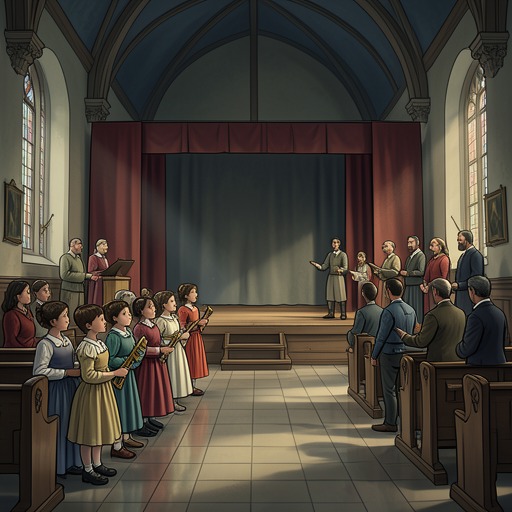
The opening offers little promise of a different experience. Baby angels jostle one another with their wings, shepherds stumble over bathrobes, and the spotlight moves so wildly that watching it makes people feel sick. The piano plays Away in a Manger at a pitch the congregation can barely hear, continuing a familiar pattern of minor disorder and musical strain. Yet the pageant settles, and at 7:30 it begins. The usher-lit candles and the spotlight, now serving as the star, transform the church into a dim stage where the congregation has to sing largely by memory.
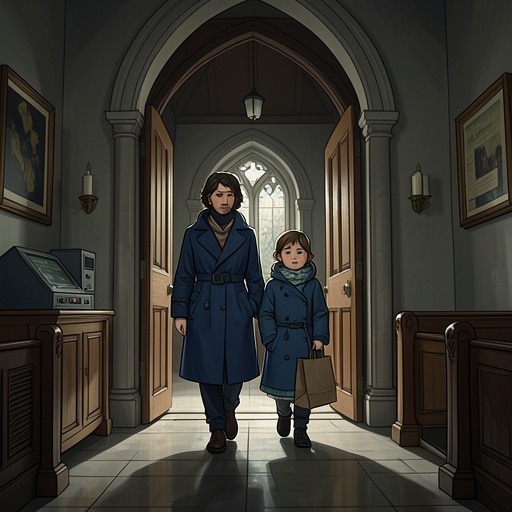
The planned sequence depends on timing and coordination. After two verses of O, Little Town of Bethlehem, the congregation is meant to hum while Mary and Joseph enter from a side door. They do not appear at once, and the humming stretches until it loses the shape of a song. Alice Wendleken fears that the central roles will remain empty. The delay becomes the performance’s first suspenseful break from routine, but Ralph and Imogene are present: instead of shoving one another through the doorway, they stand uncertainly for a moment amid the candles and the crowded church. Their hesitation makes them look less like comic intruders than strangers who have arrived in an unfamiliar place.
Mary, Joseph, and the Child
That entrance shifts the meaning of the scene for the narrator. Ralph and Imogene resemble refugees waiting among their belongings in a strange place, an image that prompts the narrator to imagine how the Holy Family might have felt when forced to shelter in a barn. The pageant’s usual tidy appearance gives way to a Mary and Joseph who look disordered and out of place: Imogene’s veil sits crookedly, and Ralph’s hair sticks out around his ears. Their presentation does not imitate the polished figures the audience expects; it makes discomfort and displacement visible.
Imogene carries the Baby Jesus doll slung over her shoulder rather than cradled in her arms. Before placing it in the Manger, she thumps its back twice. Alice is appalled by what looks to her like an indecorous way to handle the holy figure, and wonders whether the baby could have had colic. The narrator’s answer is that he could have been fussy, hungry, or colicky like any other baby. That ordinary possibility becomes the scene’s theological center: Jesus did not arrive as a remote, spectacular figure, but was born and lived as a real person. Imogene’s unceremonious burping of the doll, intended simply as an action with a baby, gives the narrator a concrete way to grasp that humanity.
Gladys, the Shepherds, and the Gift
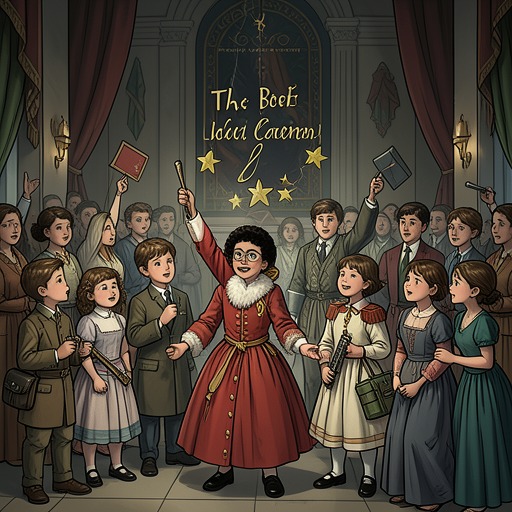
The pageant continues through the expected carols, but its crowded staging keeps making the familiar material physical. The shepherds are more numerous than the other groups, and their crooks bang together as they sing While Shepherds Watched Their Flocks by Night. Then Gladys pushes through from behind the angel choir, forcing her way past people and stepping on feet. As the only performer with spoken words, she delivers her line at full volume: “Hey! Unto you a child is born!” The shepherds tremble, ostensibly at the announcement and, in the narrator’s wry account, mainly at Gladys. Her forceful entrance turns the news of the birth into something that sounds urgent and consequential.
The angel sequence takes time because the primary-school children become nervous, cry, forget where to go, and bend their wings in the doorway. While the boys sing We Three Kings of Orient Are, the Wise Men march up the aisle. Later, during What Child Is This?, they are supposed to confer and leave by another door, indicating that they will return home by a different route. The Herdmans do not carry out that exit; they remain seated. Alice takes this as evidence that the performance is being ruined, while the narrator sees a plausible continuation: the Wise Men have sat down to rest.
A more consequential change comes with the gift. When the narrator hears a suggestion that the Herdmans might have brought something to burn, the thought recalls their reputation for burning things. Instead, the object is a ham still wrapped with its Christmas ribbon. The narrator recognizes it as the ham from the food basket distributed by the church charitable works committee, on which the narrator’s father serves. Alice suspects theft, but the narrator knows it came from the family’s own basket and reasons that they may give away their own food. The gesture matters because the Herdman children have not previously been known for giving anything away except blows. Leroy places the ham in front of the Manger, replacing the pageant’s usual jars of bath salts for myrrh and frankincense. The incongruous offering is also a genuine act of giving, rooted in the family’s own Christmas provisions.
Imogene’s Tears and the Changed Ending
By the time the pageant reaches “Silent Night,” the narrator is no longer impatient for the annual performance to end. Instead, the narrator imagines how the story might continue under the Herdmans’ influence: Mary and Joseph might help the Wise Men escape Herod, or protect the child by sending him away with them. Absorbed in those possible dangers and rescues, the narrator misses the carol’s beginning. The whole congregation, including the audience, sings all its verses. At the line “Son of God, Love’s pure light,” the narrator looks at Imogene and sees her crying.
Her face shines with tears in the candlelight. She does not wipe them away; she remains seated in her crooked veil, crying. The response is unexpected because the audience has been waiting for the Herdmans to do something disruptive or outrageous. Instead, Imogene’s visible emotion becomes the performance’s most powerful surprise. The narrator calls it the best Christmas pageant they have ever had, and people in the church lobby agree that something was special, even though they cannot identify exactly what made it so.
Mrs. Wendleken points to Mary’s black eye as one unusual feature, but the narrator clarifies that Imogene has not been struck and has not struck anyone. Her eye is puffy and swollen because, still dazed, she walked into the corner of the choir-robe cabinet. The injury looks consistent with the Herdmans’ feared reputation, but its actual cause belongs to a moment of absorbed wonder. The distinction unsettles the congregation’s easy assumptions about what a Herdman is likely to do.
The performance also changes the narrator’s understanding. For years, the narrator has contemplated the wonder and mystery of Jesus’ birth without feeling that its meaning had become clear. Imogene’s question about what the pageant was about had first received an incomplete answer: it was about Jesus, but also about a new baby and parents facing trouble, with no money, no place to go, no doctor, and nobody they knew. The visitors arriving from the East were, in this telling, rich friends. Imogene seems to have received the Christmas story not as an explanation to be mastered but as an overwhelming experience, arriving all at once and leaving her crying and walking into furniture. Through the Herdmans’ rough, literal participation, the pageant’s polished symbols become a story of need, welcome, human vulnerability, and a child whose birth matters.