The Herdmans' first visit to Sunday school
The Best Christmas Pageant EverThe Herdmans’ first visit to Sunday school is a comic chain reaction with consequences beyond its bait-and-switch beginning: Charlie’s attempt to deter Leroy Herdman instead brings the Herdman children into the Church, where their hunger for refreshments leads, unexpectedly, to an encounter with a story they barely know. Their arrival starts as a practical joke built on a lie, but the questions that follow unsettle the Sunday school’s confident familiarity with Christmas.
The lunch-box bargain
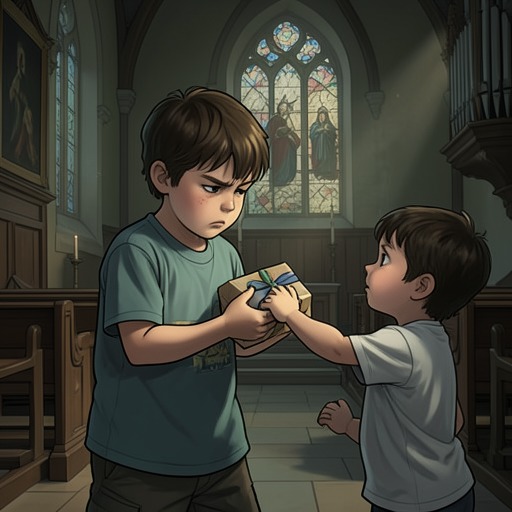
The immediate cause lies in Charlie’s second-grade experience. For three days running, Leroy Herdman stole dessert from Charlie’s lunch box. After giving up trying to stop him, Charlie told Leroy that he could take the dessert because Sunday school supplied all the treats he wanted. The story was designed to make Leroy leave him alone; instead, it gave Leroy a reason to investigate.
Charlie’s invented menu was extravagant: chocolate cake, candy bars, cookies, Kool-Aid, ice cream, doughnuts, and popcorn balls. He also claimed that the minister provided it. The truth was much less tempting. The Sunday school served jelly beans at Easter and punch and cookies on Children’s Day, not a continuous supply of sweets. Charlie’s lie worked precisely because it made the Church sound like a dependable source of food, and Leroy wanted to know where to find it.
A visit for refreshments
The very next Sunday, the Herdman children arrived at Sunday school, slouching in and watching for the promised refreshments. Ralph Herdman asked the Sunday-school superintendent where the cake was. The answer pointed instead to food packages being collected in the kitchen: canned spaghetti, beans, grape drink, and peanut butter, gathered as a Thanksgiving gift for an orphanage. The children saw the cans as possible confirmation of Charlie’s story, and stayed.
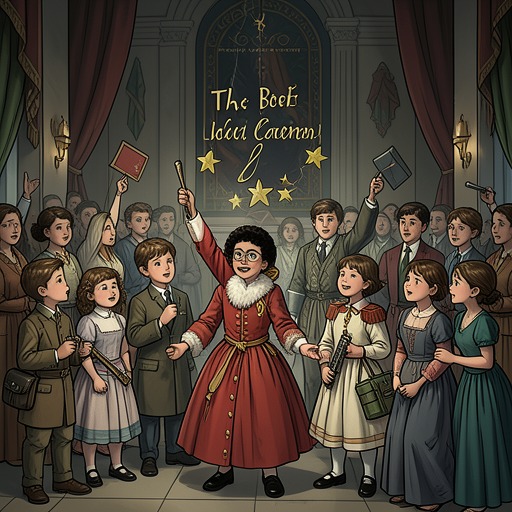
Their conduct made clear that they had not come to join the service. They sang no hymns and said no prayers. The narrator saw Imogene Herdman slip a handful of coins from the collection basket as it passed. The visit thus brings together appetite, suspicion, and the children’s established disregard for the rules of the Church; it does not begin as an act of religious interest. Yet it puts them inside the Sunday-school community, where they hear about the next gathering and the preparations for The Herdman Christmas pageant. The superintendent announces that rehearsals will soon begin and that the main roles will be chosen the following Sunday, while emphasizing that every boy and girl should take part.
From attendance to questions
The first visit becomes significant through what the Herdmans reveal in subsequent Sunday-school sessions. They know that Christmas is Jesus’ birthday, but the rest of the story is new to them: the shepherds, Wise Men, star, stable, and crowded inn. Their unfamiliarity has concrete causes. They do not read beyond comic books, and the family’s second-hand television is so difficult to watch that someone has to hold its antenna. Their father left by climbing aboard a railroad train, while their mother appears to have given up trying to teach them. The Sunday school is not merely another place offering food; it becomes a setting where the story is read aloud to children who have not received it elsewhere.
The Narrator’s Mother begins at the Bible’s beginning, although the regular Sunday-school children already know the Christmas story and expect to learn only their roles and places for the pageant. Ralph Herdman interrupts when the reading describes Mary as being great with child, translating the phrase bluntly as pregnant. The Herdmans’ repeated calls for explanations interrupt the familiar rhythm of the lesson. When the reading reaches the lack of room at the inn, Imogene Herdman is visibly shocked that no one made room even for Jesus. Leroy Herdman then asks what a Manger is and why there would be a bed in a barn. In response to the question of what a family might do without a bed for a newborn, Imogene explains that the family had put Gladys Herdman in a bureau drawer.
An unfamiliar audience changes the story
These exchanges show the lasting consequence of a visit that began with a false promise of cake. The Herdmans’ questions are not signs that they already understand the religious meaning of the story; they expose how little they have been told, and make its circumstances newly concrete for listeners who thought they knew it by heart. An inn refusing room, a newborn without a proper bed, and parents without help become practical facts to examine rather than familiar elements to repeat.
That shift reaches beyond the classroom. The narrator later recognizes that, despite years of thinking about the wonder of Christmas and the mystery of Jesus’ birth, the story had not truly made sense before. The Herdmans’ response makes the birth story less abstract: a baby arrives to parents with no money, no place to go, no doctor, and no familiar people nearby, before visitors come from the East. Their first appearance at Sunday school therefore marks more than an attendance change. A lie about refreshments brings outsiders through the door; their unprepared, direct attention then alters how the established group hears the story it had assumed it already understood.