The Herdmans’ first Sunday-school visit
The Best Christmas Pageant EverThe Herdmans’ first Sunday-school visit is a comic misunderstanding that opens into a genuine encounter with the Christmas story. Drawn in by Charlie’s false promise of lavish refreshments, the children arrive looking for food rather than worship; yet their questions, their sudden interest in the pageant, and Imogene’s response to the Nativity unsettle the congregation’s comfortable familiarity with it.
The Lunchbox Bargain and the First Visit
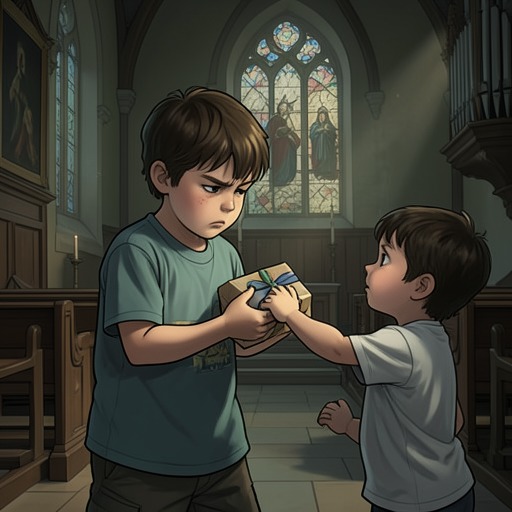
The immediate cause is a schoolyard exchange between Charlie and Leroy Herdman. For three days, Leroy takes the dessert from Charlie’s lunch box, until Charlie gives up resisting and tells him, “I get all the dessert I want in Sunday school.” Leroy wants details. Charlie supplies an extravagant list—“Chocolate cake,” candy bars, cookies, and Kool-Aid—and insists that refreshments are always available. The claim is false: the Sunday school has jelly beans at Easter and punch and cookies on Children’s Day, not a constant supply of treats. When Leroy asks who provides them, Charlie names the minister, unintentionally giving the story an authority that makes the bait more persuasive.
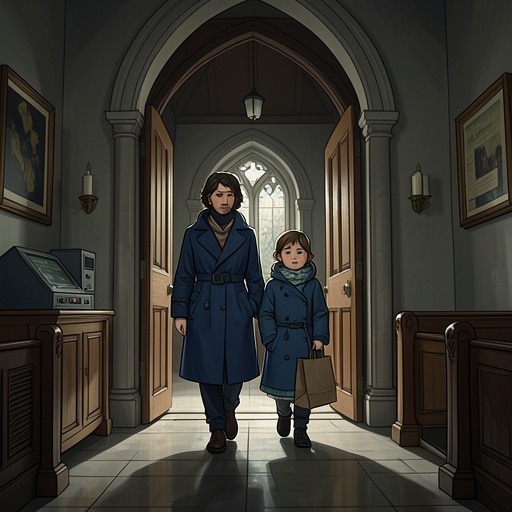
The very next Sunday, the Herdman children arrive at Sunday school, slouching in and keeping their eyes open for refreshments. Their purpose is plain: they expect Charlie’s promised food. It is an especially misleading day for them to choose. The congregation is collecting canned goods in the kitchen for the Orphans Home, and the Herdmans see spaghetti, beans, grape drink, and peanut butter. Those provisions are not the cake and candy Charlie described, but they seem to offer enough confirmation to keep the children there. They do not sing hymns or say prayers. Imogene also slips a handful of coins from the collection basket as it passes her, making their first appearance a disruption as well as an arrival.
An Invitation to the Pageant
At the end of that morning, Sunday-school superintendent Mr. Grady announces that rehearsals for the Christmas pageant will soon begin. The following week, the children will gather after the service to decide who plays the main roles; he emphasizes that every boy and girl should take part and asks them to tell their parents they will stay late. The annual announcement earns little excitement from the established Sunday-school children, who already assume they know which roles they will have. The Herdmans, however, do not share that familiarity with the routine.
Alice Wendleken turns to the narrator with a sticky smile and says, “I hope you’re going to be in the angel choir again. You’re so good in the angel choir.” Her compliment carries an anxious implication: she hopes the narrator will not become Mary. The narrator does not want that part, or the angel-choir role, but expects to be assigned something. Imogene, meanwhile, elbows the narrator and asks what the pageant is. The question marks a turn from the family’s search for refreshments toward the play itself. When told it is a play, Imogene becomes interested; the Herdmans are avid moviegoers, though they evade paying admission by having some start a fight at the box office while others slip inside, then spreading through the theater so the manager cannot find them all.
Imogene Claims Mary
At the later gathering to assign roles, the familiar expectations abruptly fail. The Narrator’s Mother explains that Mary was quiet, gentle, and kind, and says the girls will decide together who should play her. Alice, normally the only girl to volunteer, sits silently, chewing a piece of her hair and looking at the floor. The only hand raised belongs to Imogene. Asked whether she has a question, Imogene answers, “I want to be Mary.” She then adds that Ralph wants to be Joseph, and Ralph agrees. The Narrator’s Mother can hardly believe the demand. For the other children, the roles have been predictable parts of a pageant they know; for the Herdmans, the roles are newly encountered possibilities they claim without observing the usual social order.
Their interest exposes how little they know about the story they have volunteered to perform. The Herdmans know that Christmas is Jesus’ birthday, but the shepherds, Wise Men, star, stable, and crowded inn are all news to them. Alice says she cannot believe their ignorance and points to a recent incident in which Gladys and Ollie drew mustaches and tails on the disciples in an illustrated Bible. The children have few other routes to the story: they read only Amazing Comics, and the family’s second-hand television works poorly unless someone holds its antenna. Their father has left on a railroad train, and their mother appears to have given up trying to teach them. Their eagerness for the principal roles therefore precedes any understanding of the Nativity they are to enact.
Hearing the Christmas Story Anew
Because the Herdmans do not know the narrative, the Narrator’s Mother begins reading it from the Bible instead of moving straight to casting and stage positions. For the other Sunday-school children, who know it by heart and expect to be told where to stand, this is an unwelcome delay. The reading nevertheless gives the Herdmans something the regular participants lack: a first encounter with the circumstances behind the familiar pageant. Ralph interrupts at the description of Mary as being “great with child,” shouting, “Pregnant!” The blunt response makes the adults’ customary language newly conspicuous, and the reading continues through the children’s interruptions and demands for explanations.
When the account says there was no room at the inn, Imogene sits up, her jaw dropping, and asks, “My God! Not even for Jesus?” The shock is not merely that the story contains hardship; it is that the hardship has been present all along, unnoticed by children accustomed to treating the pageant as a set of assigned parts. Imogene objects that Mary should have told people she was expecting a baby, and wonders why Joseph did not tell them. Leroy asks what a manger is and why there would be a bed in a barn. The Narrator’s Mother explains that there was no bed, so Mary and Joseph had to use what was available for the baby. Imogene answers with a household comparison: the family once put Gladys in a bureau drawer. The question turns an object familiar from the pageant into a practical problem of shelter and caring for a newborn.
Consequences and Significance
The visit’s consequence is larger than the Herdmans’ entrance into the cast. Their uninformed questions compel the Sunday-school group to pause over details it had learned to recite without considering: an unattended pregnant woman, an overcrowded inn, and a baby with no bed. The congregation’s initial response to the Herdmans is shaped by expectation and alarm, but the children’s attention to the reading proves different from their reputation for restlessness. When Imogene tells the others to be quiet because she wants to hear, they remain fixed on the Narrator’s Mother and listen for explanations whenever the language confuses them.
That encounter reaches beyond the church’s practical problem of assigning roles. The narrator later recognizes that, although the pageant is about Jesus, its force lies also in the new baby and parents in trouble—without money, a place to go, a doctor, or people they know. Imogene does not approach the story as a familiar religious lesson or a routine performance. Her responses arise from the precarious circumstances she hears in it, and the narrator concludes that the Herdmans have made the mystery of Christmas more intelligible. The first visit, prompted by a lie about dessert, thus changes the terms of the pageant: the children who came expecting food make the regular participants look again at what the story says.