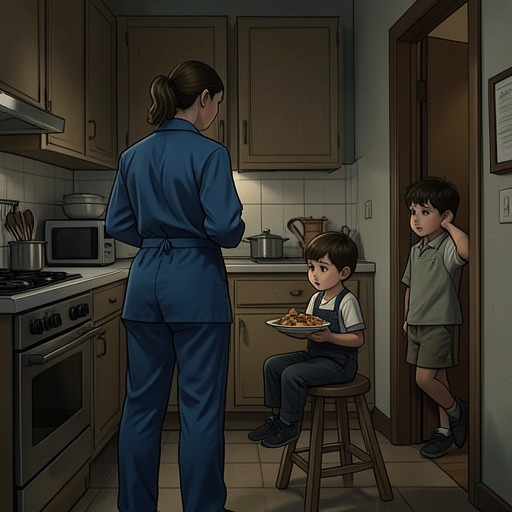
The Herdmans’ unsupervised home life
The Best Christmas Pageant EverThe Herdmans’ unsupervised home life is defined by the gap between the adult care the children lack and the practical responsibility they assume for one another. Their father disappeared when Gladys was two, their mother spent long hours at a shoe factory, and the children organized their own care in a descending chain of older siblings looking after younger ones. The arrangement helps explain both their self-reliance and their unfamiliarity with ordinary family and church routines, without making their behavior merely a matter of individual character.
Family circumstances
The children’s father left by climbing aboard a railroad train when Gladys was two years old. The family did not know what he was or where he had gone, and the narrator says that nobody blamed him. That absence is presented as a settled fact of the children’s lives rather than a mystery they are trying to solve. It also means there is no present father in the household to provide care or supervision.
Their mother, Mrs. Herdman, works double shifts at a shoe factory and is rarely at home. The narrator sometimes sees her walking the family cat around the block on a length of chain, a distinctive glimpse of her outside the factory but not evidence of sustained adult presence with the children. The account sets this sparse image beside the larger routine: most of the time, the children are left to manage their own lives.
Work, assistance, and care
Miss Philips, a social-service worker and friend of the Narrator’s Mother, tries to obtain welfare money for the family. The proposed assistance would let Mrs. Herdman work a single shift and spend more time with her children. Mrs. Herdman refuses, saying that she likes her work. The effort therefore does not change the household’s arrangement: the possibility of additional time at home is offered, but not taken up.
Miss Philips gives the Narrator’s Mother a less straightforward explanation. She believes the issue is neither the work nor the money, but that Mrs. Herdman would rather be at the shoe factory than shut up at home with her crowd of children. Her sigh and admission that she cannot blame her register the strain without turning it into a simple judgment. The episode places paid work, proposed public assistance, and the demands of caring for a large family beside one another, while leaving the mother’s own preference and experience to be described through another adult’s assessment.
The children’s system of care
With little adult supervision, the Herdman children largely look after themselves. Their care is organized through age and seniority: Ralph looks after Imogene, Imogene looks after Leroy, Leroy looks after Claude, and responsibility continues down the line. The narrator compares this with the way large families teach younger children what older ones know, but the comparison also points to how much of the Herdmans’ learning is passed among children rather than supplied by adults.
Gladys, the youngest, is described as the meanest of the children. That detail complicates any assumption that the oldest children’s influence steadily softens as it travels down the line. The account presents the siblings’ system as both a practical response to adult absence and a means by which their behavior is transmitted: they teach one another, but what they pass along is not necessarily kindness or restraint.
Encounters with church and school
The children’s appearance at church begins with a schoolyard exchange about food. For three days, Leroy steals dessert from Charlie’s lunch box. Charlie finally tells him that he gets all the dessert he wants in Sunday school, and Leroy asks for details. When Charlie says the minister provides it, he unintentionally gives the children a reason to go. The next Sunday, the Herdman children arrive looking for refreshments.
They mistake a collection of spaghetti, beans, grape drink, and peanut butter for the promised food. The packages are actually being gathered for the Orphans Home as a Thanksgiving gift. Their misunderstanding shows how an ordinary church practice looks to children who have come expecting a reward described at school, rather than knowing the purpose of the collection or the customs of the congregation.
Their unfamiliarity extends to the Christmas story. The Herdman children know that Christmas is Jesus’ birthday, but the shepherds, Wise Men, star, stable, and crowded inn are all new to them. The narrator’s account thus connects their home circumstances with a lack of religious instruction, while distinguishing what they do know from the much larger story they have not encountered.
Significance and limits
The Narrator’s Mother’s account of the Herdmans’ home life appears beside episodes in which the church and its members must decide how to respond to them. The narrator initially imagines the children heading toward prison, but their involvement with the church and the Christmas pageant changes the course of that expectation. Their arrival is not presented as the result of a carefully organized outreach effort: it begins with Charlie’s information about dessert, and the children misunderstand the Thanksgiving food collection before learning about the pageant’s story.
The household background makes their disruptive behavior intelligible without excusing every action or reducing the children to the conditions around them. It also draws attention to where care is located: Mrs. Herdman is away working, Miss Philips proposes assistance, and the children themselves fill the daily gaps by looking after one another. Their church encounters then place that improvised family arrangement in contact with adults and institutions whose routines and knowledge the children do not share.