Adéle de Marcanville
The Best Werewolf Short Stories 1800-1849Adéle de Marcanville is the daughter of Gaspar de Marcanville and Rosalie de Marcanville, living with her father in poverty after his degradation and banishment. Though the narrative places her within Gaspar’s story, she is not merely a passive witness: her affection, fear, and need for security influence his decisions, while her presence preserves the memory of the noble household from which both have fallen.
Identity and Exile
Adéle de Marcanville appears in St. Yrieux as a young woman whose history is concealed from the townspeople. She and her father occupy a retired apartment in a deserted mansion, having come from a distant part of Normandy. The pair are described as living in the deepest poverty, yet they neither ask for relief nor complain. Their reserve separates them from the gossiping neighbors and even from other residents of the house. They are allowed to remain because they can provide reasonable security for their rent, but they receive little sympathy and are subjected to little inquiry. Adéle’s obscured identity is therefore established through both social invisibility and the deliberate silence surrounding her family.
Her circumstances are the consequence of Gaspar’s political ruin. Once Count Gaspar de Marcanville, friend of Francis I of France and a Knight of the Order of the Holy Spirit, he has been reduced to the life of Hubert, the Hunter of the Limousin. Adéle shares the material consequences of that fall without sharing its prideful resistance. Where her father tries to hide his indigence, she bears humiliation with greater contentment and gentleness. Her character is thus defined by a contrast between inherited dignity and adaptive endurance.
Life with Gaspar de Marcanville
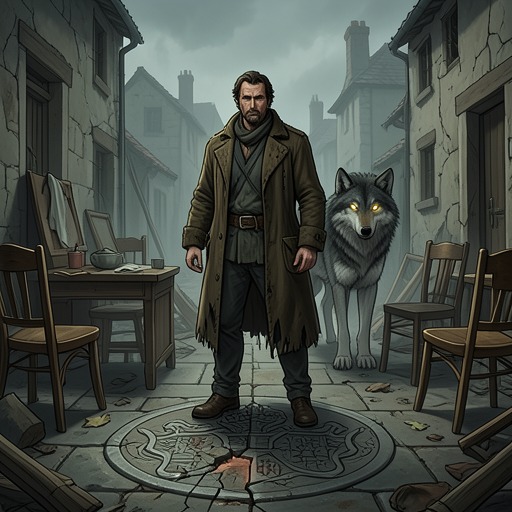
Gaspar spends much of his time away from St. Yrieux, ranging through the neighboring mountains and forests in search of game. He brings portions of his spoil back to Adéle, whose subsistence depends upon his dangerous labor. The arrangement makes the forest both workplace and threat: it sustains them, but it also exposes Gaspar to wolves, robbers, and the possibility of never returning.
When Gaspar comes back worn down by his exertions, Adéle tries to restore his spirits. Her efforts often fail, but the attempt reveals the emotional labor she performs within the impoverished household. She does not challenge his suffering with abstract consolation; instead, she seeks to draw him away from the conditions that perpetuate it. Her concern is practical as well as affectionate, because each expedition leaves her waiting alone and uncertain whether he will return.
Adéle’s fear is expressed through the dangers she imagines in his absence: a forest midnight, fierce howling wolves, and robbers more cruel than the animals. The specific threats register the precariousness of their existence and anticipate the supernatural terror later attached to the woods of the Limousin. Her anxiety is not presented as mere timidity. It is a rational response to a life in which the family’s sole provider repeatedly disappears into a landscape that the townspeople already associate with violent creatures.
Relationship with Her Father
Adéle’s relationship with Gaspar is organized around care and opposition. She embraces him and urges him to abandon the exhausting hunt for safer employment nearer home, asking for the security of his presence. Her wish is not to separate him from his former identity but to keep him alive and beside her. In this sense, she becomes the immediate moral counterweight to his wounded aristocratic pride.
Gaspar answers her appeal bitterly. He asks whether she would have him set his hand to the sickle or plough after it has held a sword in battle and a banner-lance in the tournament. He rejects the idea that a companion of the Order of the Holy Spirit should become a manual laborer among the artisans of the town. His resistance shows that poverty has not erased his former rank from his self-understanding; it has made that rank a source of shame, anger, and refusal.
Adéle’s gentleness exposes the cost of this refusal. Gaspar declares that, but for her, he would remain in the forest until he forgot his language and species and became a Wehr-Wolf or a wild buck. The remark joins his social exile to an imagined transformation into an animal, while Adéle remains the reason he does not wholly abandon human society. She is consequently both the object of his protective duty and the bond that prevents his grief from becoming complete savagery.
Loss, Movement, and Survival
Gaspar’s exile begins after De Saintefleur treacherously causes him to be blamed for an attempted act against Francis I of France. Although Gaspar could have defended himself by exposing his former friend, his magnanimity keeps him silent, and he receives degradation and banishment rather than restoration. He carries little into exile beyond Rosalie de Marcanville and his daughter Adéle, making Adéle one of the few remaining possessions of his former life and one of the few relationships that survive the political catastrophe.
The family withdraws into the dark and extensive Harz Mountains, where Gaspar’s physical decline is intensified by fatigue and sorrow. There he becomes an accomplished hunter, pursuing wild buck and bear because Adéle and Rosalie give him reasons to continue living. His survival is therefore explicitly relational: without dependents, he might surrender to famine or to the wolf, but responsibility keeps him in the chase.
About ten years after Gaspar’s exile, Rosalie dies, leaving him a widower while Adéle is scarcely eighteen. The loss removes the other adult member of the household and concentrates Gaspar’s obligations and grief upon his daughter. In the aftermath, he considers leaving solitude, returning to France, and demanding the Ordeal of Combat with De Saintefleur. His plan fails when he sees how profoundly the years of labor and sorrow have altered his appearance. Adéle’s continued dependence helps redirect that thwarted quest for public vindication into a more concealed strategy of survival.
Gaspar concludes that he may remain unknown in the forests surrounding St. Yrieux, support Adéle under the guise of a hunter, and place her nearer to the residence of her sovereign should he die. He therefore uses part of his remaining property to secure a dwelling in the dilapidated chateau. Adéle’s presence changes the meaning of this retreat: it is not simply a retreat from society but a calculated attempt to preserve her life and, however precariously, her connection to the world of rank from which the family has been expelled.
Narrative Role and Significance
Adéle de Marcanville functions as the human measure of Gaspar’s transformation. His speeches turn exile into an argument about honor, species, and the loss of aristocratic identity; her conduct turns it into a daily problem of hunger, absence, fatigue, and fear. Through her, the narrative shows that Gaspar’s pride has consequences borne by another person, even though she responds with patience rather than accusation.
She also occupies the threshold between concealed nobility and apparent poverty. The townspeople know only an impoverished father and daughter who avoid conversation, while the reader learns that the father is a dispossessed count and former royal companion. Adéle’s modesty helps sustain the disguise, but her very dependence keeps the buried past active. She is the reason Gaspar continues to hunt, the reason he returns to France, and the reason he chooses an obscure residence near the court rather than a final disappearance into the wilderness.
Her importance is consequently quiet but decisive. Adéle does not command armies, expose De Saintefleur, or reclaim the family estates. Instead, she preserves intimacy amid political betrayal and material collapse. The contrast between her consoling gentleness and Gaspar’s bitterness gives the exile narrative its emotional structure: where he sees degradation and the threat of becoming less than human, she continues to seek safety, companionship, and a livable future.