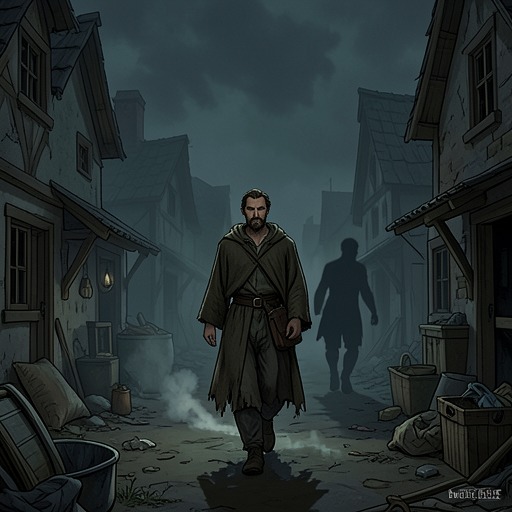
All Souls’ Eve
The Best Werewolf Short Stories 1800-1849All Souls’ Eve is the supernatural and emotional threshold of “Hugues the Wer-Wolf,” transforming an isolated family vigil into a confrontation with death that the survivors cannot interpret as natural. Falling on the night before All Souls’ Day, it is presented as the year’s most haunted interval, when the dead are reputed to rise from their graves and return to their homes. Within that charged calendar, grief, superstition, and the unknown converge until Hugues Wulfric’s sister dies at the very moment the household seems to be invaded by the dead.
Sacred Time and Folkloric Meaning
All Souls’ Eve is defined as a night set apart from ordinary time. The story places it before the later cultural prominence of Halloween and describes it as the haunted night of the year, associated with the return of the dead. Its force therefore comes not merely from darkness but from a communal belief that the boundary separating graves from homes has temporarily weakened. The event belongs to a wider history in which supernatural beings emerge from superstition, pass into folklore, and eventually become subjects of literary invention. The werewolf tradition itself is traced through Greek, English, Italian, German, and French sources, with different names for the figure now called the Werewolf and with devils or sorcerers commonly identified as the causes of werewolfism.
The night also gathers several older motifs of transformation and uncertain identity. Medieval and earlier poetry had already described the lycanthrope as a being caught between human and animal forms, including the striking image of clothing changing into wolf hair and human arms becoming legs, while the transformed person wants to speak but cannot. All Souls’ Eve gives this literary inheritance a temporal setting: the night does not simply contain a monster, but makes the world receptive to crossings between the living and the dead, the human and the animal, and the visible and the unseen.
The Orphaned Vigil
When All Souls’ Eve arrives, Hugues Wulfric and his sister are already marked by recent bereavement. Their parents have died from sickness and poverty, and Hugues has buried them himself, wrapping their bodies in scraps of hemp cloth and covering the grave with only a few clods of earth. Several days later, the orphaned survivors keep watch alone in the hut by a fitful fire. Their mother’s former presence is remembered through the hearth and through the cheerful tales that once animated the household; the same domestic space now becomes a place of exposure and dread.
The setting intensifies the event through a sequence of natural images that seem to acquire supernatural agency. Wind howls along the bleak hillside and whistles through trees stripped of their last leaves. The sun has sunk, fog spreads through the air like mourning, and no star appears in the heavy sky. The hut, recently visited by death, stands as the only enclosure around the two young survivors. Their loneliness is not abstract: it is concentrated in the cold hearth, the empty place of the mother, and the silence that allows every distant sound to become evidence of a returning spirit.
Their fear rises through interpretation rather than immediate sight. The sister believes a shriek has been repeated by every forest echo and imagines the tread of a gigantic phantom whose breath has shaken the door. Hugues admits that he too has heard distant voices murmuring strange words, though he tries to reassure her by reminding her that he is beside her. She asks that they pray to the holy Virgin to restrain the dead from haunting their dwelling. Hugues answers with a protective ritual, throwing onto the fire a holy branch gathered on the previous Palm Sunday, which he believes will drive away evil spirits and allow their mother to enter safely if she is among the returning dead.
The Apparition of the Dead
The siblings’ conversation turns the night’s folklore into an immediate domestic possibility. Hugues suggests that their mother may be among the unshriven and unshrouded dead, coming to visit her beloved children on the eve when the dead leave their graves. He proposes opening the door so that she may resume her accustomed place beside the hearth. His sister, however, experiences the exterior world as a hostile threshold: the air is damp and cold, the gusts sweep past the hut, and groans seem to issue from the dead around them.
The supposed procession gradually becomes visible and audible through distant signs. Hugues sees pale, lurid lights rising across the marsh and interprets them as the dead coming to sit before a meal prepared for them. The bells of All-hallowtide seem to approach on the gale, mingling with hollow voices. His sister declares that the horror has become unbearable and senses that this will be her last night on earth. Hugues then points again to the lights and hears the prolonged tolling of the bell as confirmation that the dead are coming. The scene’s terror depends on withheld explanation: the siblings recognize omens, but neither they nor the reader receives a stable account of what the sounds and lights actually are.
At the climax, both survivors kneel and bow their heads, invoking eternal repose for the ashes of the dead. Their prayer is answered by an abrupt and violent change in the hut. The door closes with force, as if slammed by a vigorous hand; the timber supporting the roof cracks; the fire is suddenly extinguished; and a plaintive groan merges with the blast entering through the door’s crevices. When Hugues raises his sister, she is dead. The event thus shifts the value of the scene from fearful expectation to irreversible loss: the children feared that the dead might enter, and one of the living becomes dead without a visible assailant or an explained physical cause.
Consequences for Hugues Wulfric
The death on All Souls’ Eve completes the destruction of Hugues Wulfric’s immediate family. He had already become responsible for two younger sisters after burying his parents; within a fortnight, both sisters descend into the grave as well. After laying the last one in the earth, he considers whether he should lie beside his family and share their peaceful sleep. His grief appears not in public weeping but in mute, sullen contemplation over the rough burial place and the loneliness that now defines his future.
For three consecutive nights, Hugues wanders from his solitary hut, alternately prostrating himself and kneeling on the funeral turf. He has eaten nothing for three days. All Souls’ Eve therefore functions as more than atmospheric decoration or a calendar reference. It is the event that strips Hugues of family, sheltering belief, and ordinary social belonging, leaving him physically weakened and spiritually exposed. The night’s supernatural ambiguity also prepares the later werewolf narrative: death has entered the story through a threshold where ritual, weather, rumor, and bodily fate can no longer be cleanly separated.
Narrative and Genre Significance
The event exemplifies the book’s account of how werewolf literature developed from inherited superstition into poetry and short fiction. The werewolf was historically described as a human being who, through sorcery, devilish ointment, and an enchanted girdle, could assume both the appearance and nature of a wolf and act with the violence of one. Later literary traditions expanded the figure through stories and poems such as “The Lay of Marie” and “William and the Werwolf,” while the nineteenth century moved the monster decisively from poetry into the short story. All Souls’ Eve provides an especially effective bridge between those traditions because it supplies a folkloric calendar, a ritual atmosphere, and a narrative mechanism for making the dead feel present without displaying them directly.
Its horror is strongest before the final revelation. The story repeatedly offers possible evidence of supernatural visitation—voices, a shriek, footsteps, icy breath, lights across the marsh, tolling bells, and a door moved by an unseen force—while preserving uncertainty about their source. That economy allows superstition to operate as both setting and psychological pressure. The night becomes a contested space between sacred protection and profane intrusion: prayer, the Palm Sunday branch, and the appeal to the Virgin attempt to restore order, but the extinguished fire and the sister’s death show that ritual reassurance cannot guarantee safety. All Souls’ Eve consequently establishes the central imaginative condition of “Hugues the Wer-Wolf”: a world in which the boundary between the human and the monstrous is not merely described by legend, but experienced as a nightly threat to the body, the family, and the meaning of death.