Cæsar
The Best Werewolf Short Stories 1800-1849Cæsar is Krantz’s elder brother and the first child of Krantz’s father’s marriage, born into a family whose history of violence, flight, and supernatural punishment shapes every surviving member. In Krantz’s retrospective account, Cæsar appears as a brave, protective boy whose attempt to understand the strange conduct of his stepmother makes him both an investigator and a victim. His death confirms the danger concealed within the household and becomes one of the losses through which the family’s curse is fulfilled.
Identity and Family Background
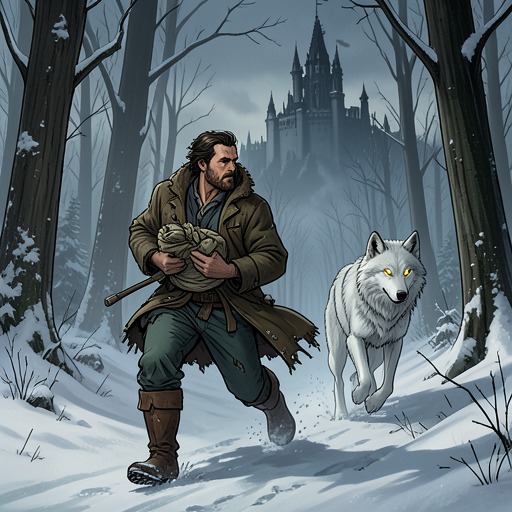
Cæsar was the eldest of three children: Cæsar, Krantz—then called Hermann—and their younger sister Marcella. Their father had once been the steward of a wealthy Hungarian nobleman in Transylvania. Although he was a serf, he was neither poor nor illiterate, and his position had given the family a degree of security before a domestic betrayal destroyed it. Their mother entered into an affair with the nobleman while their father was away; on discovering them together, he murdered both and fled with his children through the winter to the Hartz Mountains.
The children grew up in a harsh and isolated existence. Their father’s fear of capture, together with remorse and the misery of exile, kept him constantly active and often made him severe. When he left the cottage, he would not permit a fire to remain burning, so the children had to shelter beneath heaps of bearskins until his return. Yet Cæsar, Krantz, and Marcella were unusually devoted to one another. They did not habitually quarrel, and when disagreement arose between the two boys, Marcella would reconcile them by kissing both and pleading for peace. Cæsar’s later courage therefore grows out of a closely attached sibling bond rather than from solitary bravado.
Courage and Protective Conduct
The decisive episode begins when Cæsar is nine, Krantz seven, and Marcella five. Their father returns from an unsuccessful hunt in severe weather and, in a fit of temper, seizes Marcella and throws her aside, causing her mouth to bleed. Cæsar immediately runs to lift her. The children are accustomed to their father’s harshness and afraid of him, but Cæsar’s instinct is to protect the injured child rather than preserve his own comfort beside the fire.
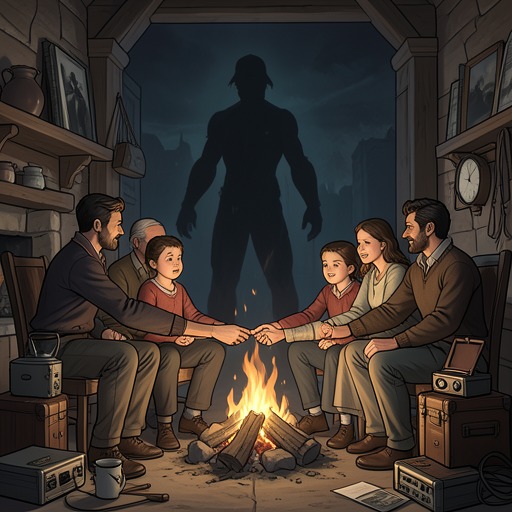
Soon afterward a wolf howls close beneath the cottage window. Their father takes his gun and leaves in pursuit, hoping to shoot the animal. The children wait anxiously, still hoping that the hunt will succeed and restore their father’s good humour. As midnight approaches, Cæsar cautiously opens the door only a few inches to see whether their father is returning. When he sees nothing, he goes back to the fire and helps prepare supper. He reaches down meat from above the chimney and, with Marcella and Krantz, places it in platters for their absent father as well as themselves. The domestic care of this scene contrasts with the violence that is about to enter the cottage, making Cæsar’s responsibility toward the family especially clear.
Pursuit of the Stepmother
Cæsar gradually notices a pattern that the younger children cannot explain. Their stepmother repeatedly leaves the cottage at roughly the same hour, and after her departure they hear a wolf growling beneath the window. On returning, she washes herself before going to bed. She rarely eats at meals and seems to dislike cooked food, yet she sometimes puts raw meat furtively into her mouth. These recurring signs suggest a connection between the woman’s nocturnal movements and the wolf outside, though the children do not yet understand its nature.
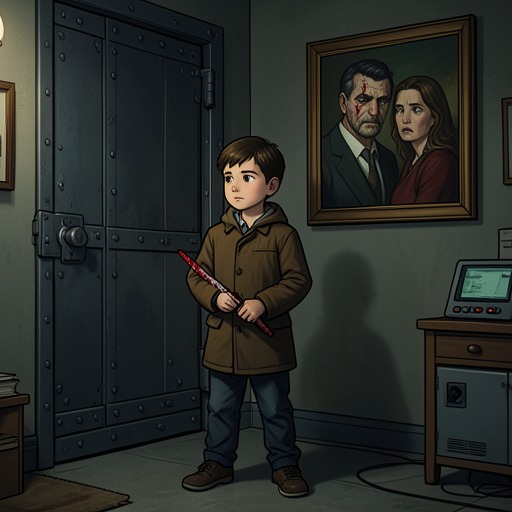
Cæsar refuses to remain passive. Although Marcella and Krantz try to dissuade him, he decides to follow their stepmother and discover what she does in the forest. The next night he lies down fully dressed, waits until she leaves, takes his father’s gun from its place, and goes after her. His action combines courage with a child’s limited means: he has no adult authority, no reliable explanation, and no protection beyond the weapon he secretly carries. He becomes the family’s first active pursuer of the hidden threat.
The children wait in terror. After a short time they hear a gunshot. Their stepmother then returns wearing a bloody dress. She checks whether their father is asleep, lights the fire, and claims that she is unwell. She changes her linen and burns the garments she wore. The children discover that her right leg is bleeding heavily, apparently from a gunshot wound. The wound provides an immediate, physical link between Cæsar’s pursuit and her return, while his absence makes the danger unmistakable.
Death and Its Immediate Consequences
When morning comes, Krantz asks their father where Cæsar is. Their stepmother helps conceal the significance of the missing gun by suggesting that someone must have opened the door during the night and drawing attention to its disappearance. Their father takes a broad axe and goes into the forest. He returns within minutes carrying Cæsar’s mangled body, lays it down, and covers the boy’s face.
The stepmother offers a false explanation: Cæsar must have taken the gun to shoot a wolf, and the animal must have overpowered him. Krantz and Marcella cannot prove what they have witnessed, but they understand that their stepmother is somehow connected with the death. Cæsar’s courage has therefore produced knowledge without producing justice. His pursuit exposes the truth to the children while leaving the adult victim, their father, in error.
Their father buries Cæsar himself and piles stones over the grave so that wolves cannot dig up the body. The act shows both grief and the family’s constant fear of animal violence. For several days he abandons the chase, mourning the boy and uttering bitter denunciations against wolves, even as the stepmother continues her nocturnal departures. Cæsar’s death thus becomes an unresolved wound: it changes the household’s emotional balance, confirms the children’s suspicions, and intensifies the father’s hostility toward the creatures he believes responsible.
Narrative and Thematic Significance
Cæsar’s story is told by Krantz many years later as part of the history he believes explains his own fate. The account is therefore a memory within the larger narrative rather than an independently witnessed present-time episode. Krantz’s recollection emphasizes Cæsar’s tenderness toward Marcella, his willingness to confront danger, and the helplessness of children trapped inside adult violence and supernatural secrecy.
His death also establishes the pattern by which the family’s marriage oath and its punishment operate. The hunter spirit later declares that the father has committed a double murder, that two children are already gone, and that the third will follow. Cæsar is one of the two losses invoked in that judgment, while Marcella becomes the other. His fate consequently links intimate family tragedy to the wider werewolf mythology: the wolf is at once an actual predatory presence, an apparent disguise for human violence, and an instrument through which the supernatural penalty reaches the family.
Cæsar’s role is especially important because he is neither a passive child nor a successful detective. He acts from loyalty and moral concern, but the world around him converts investigation into vulnerability. His attempt to defend the family reveals the concealed danger only to those least able to resist it. In that sense, his death embodies the book’s recurring collision between superstition, violence, and social power: once a person or creature has been classified as monstrous, fear supplies explanations faster than evidence can correct them, and the innocent may be destroyed alongside the guilty.