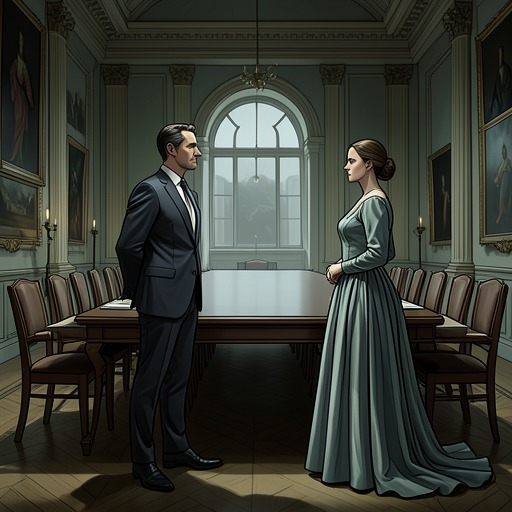
Château de Montmorenci
The Best Werewolf Short Stories 1800-1849Château de Montmorenci is the estate of the Montmorenci family and one of the principal centers of aristocratic power in the conflict surrounding Victor de Vardes and Francoise Thilouze. Its importance lies less in a separately described architectural appearance than in the social order it embodies: marriage arrangements, inherited rank, family interest, and the surveillance of conduct all converge around it. Through the estate, a private attraction becomes a threat to an alliance between powerful houses and eventually contributes to the machinery directed against a poor physician’s daughter.
Estate and Social Position
The château is associated with the Montmorenci family, whose daughter Clemence de Montmorenci is one of the richest heiresses in France. Victor de Vardes had travelled through Europe, visited foreign courts, jousted in tournaments, and won the admiration of women before returning to his father’s château. His return was not treated as a private homecoming: his father summoned him so that he could pay his addresses to Clemence, and the proposed marriage was arranged by both families for motives of mutual interest and accommodation.
The planned alliance gives Château de Montmorenci a significance beyond residence. The union of the Montmorenci and De Vardes estates was considered highly desirable, and Clemence’s lineage was measured in aristocratic terms, as the heiress of a hundred quarterings. Francoise Thilouze, by contrast, was regarded as the low-born daughter of a poor physician whose ancestry was treated with contempt. The opposition between the two women is therefore also an opposition between inherited property and precarious respectability, between a politically useful marriage and an attachment that the families consider socially intolerable.
Victor de Vardes and the Road to Loques
Victor’s courtship of Clemence begins as an act of obedience rather than passion. He had experienced many boyish infatuations while travelling, but none had truly touched his heart. Clemence seemed amiable, sensible, and gentle, though plain and poorly dressed; he felt neither love nor dislike toward her and was willing to comply with the wishes of both families because his heart was unoccupied.
His routine connected the château with the village of Loques, where Manon lived. Victor rode daily to the château of his intended father-in-law and often stayed through much of the morning when company and entertainment were available. The road passed through Loques, and his casual salutation to Manon developed through repetition into a silent flirtation. Manon interpreted his smiles and frequent appearances as evidence of love, although Victor himself thought little of the exchange.
The sight of Francoise altered that routine. Her face seized Victor’s attention with a force that his earlier encounters had not produced, and he became impatient to ride back in the hope of seeing her again. His connection with Château de Montmorenci thus acquires an ironic quality: the route meant to advance an arranged marriage becomes the route by which he encounters the woman who makes that marriage emotionally impossible.
Surveillance and Escalating Conflict
Victor and Francoise tried to avoid the parts of the estate frequented by the Montmorenci family, but they could not evade the foresters attached to the domain. These men observed the hours the two young people spent together in the woods or at the alchemist’s house on the woodland borders. The estate therefore functions as a space of observation even when its family members do not yet know what is happening. Its foresters convert the lovers’ secrecy into information that can circulate through the surrounding community.
Pierre Bloui, the chief forester, was also a rejected suitor of Manon. An excellent huntsman but weak, ignorant, and ill-mannered, he had repeatedly been refused by her, yet continued to visit because he believed his position and friendship with Manon’s father made him a good financial match. Pierre was the first to tell Manon what was occurring at Cabanis: Victor was spending his time with Francoise instead of courting Clemence. His report brought the château’s expectations and Victor’s hidden conduct into direct collision.
Manon, inflamed by jealousy, encouraged Pierre’s superstition by pretending to share his suspicions about Michael Thilouze. Pierre passed the insinuations to the other foresters, who readily accepted the idea that Michael and Francoise were uncanny or suspicious. Information originating in the estate’s surveillance network was therefore joined to rumor and superstition, preparing the social justification for action against the alchemist’s household.
Family Authority and Persecution
Clemence noticed Victor’s declining attention, although she experienced surprise more than pain because the proposed alliance had been designed by the parents rather than chosen by the young couple. The older members of the Montmorenci and De Vardes families reacted very differently. Once Jacques Renard, irritated and jealous, informed them that Francoise was the cause of Victor’s withdrawal, their indignation became extreme.
The families first tried strong remonstrances and representations with Victor, but he refused to abandon Francoise. His resistance is described as a willingness to accept ruin for love. The château’s authority is consequently not merely domestic; it is part of a wider regime in which pride of blood, contempt for ordinary people, ignorance, and superstition determine what counts as an acceptable relationship. Because the intended marriage would unite two estates, Victor’s choice is treated as an offense against property and lineage as much as an act of personal disobedience.
The later fate of Michael and Francoise shows the consequences of that hierarchy. In the marketplace of Loques, the families of Montmorenci and De Vardes attended the spectacle of the prisoners’ deaths, with the exception of Clemence, whose heart recoiled from seeing her rival perish. The presence of the families among the spectators places the authority associated with Château de Montmorenci beside the public institutions of judgment, church, and execution. Michael and Francoise were condemned for alleged devilish magic, for bewitching Victor, and for Francoise’s supposed transformations into a wolf. The social conflict that began with an unsuitable romance thus ends in a public death sentence.
Narrative Significance
Château de Montmorenci is important as a social location rather than merely a geographical one. It is the destination of Victor’s dutiful courtship, the source of the marriage alliance that opposes his desire, and the domain whose foresters discover and report his meetings with Francoise. Its power operates through ordinary structures—family expectation, estate management, rank, and marriage—before it merges with rumor, superstition, and punitive authority.
The estate also makes visible the story’s contrast between private perception and public judgment. Victor sees Francoise as the woman who awakens his heart; the families see her as an intrusion into noble blood; the community receives suggestions that her household is uncanny; and the court ultimately transforms those suspicions into a sentence. Château de Montmorenci therefore stands at the point where romance is measured against property and lineage, and where the defense of aristocratic order turns a personal choice into persecution.