Château de Vardes
The Best Werewolf Short Stories 1800-1849Château de Vardes is the family chateau of Victor de Vardes, an aristocratic residence whose authority shapes the romantic and persecutory plot. It represents the social world that arranges marriages, controls movement, and stands in visible opposition to the vulnerable household of Michael Thilouze and Francoise Thilouze.
Family Residence and Social Position
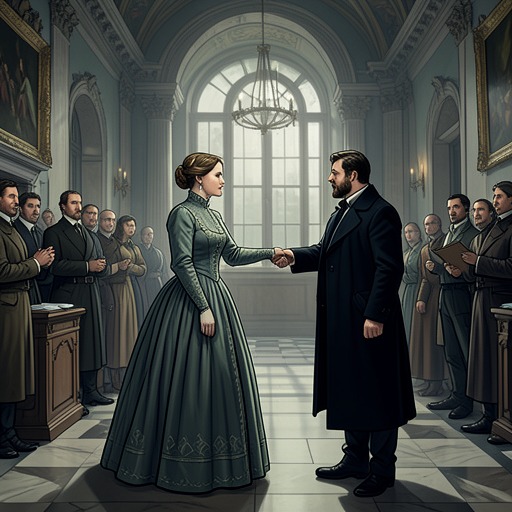
Château de Vardes is identified as Victor de Vardes’s father’s chateau, the home to which Victor returns after years away. Victor had travelled through Europe, visited foreign courts, competed in tournaments, and attracted the admiration of women before being summoned back by his father. The summons had a precise purpose: Victor’s father considered it time for him to marry and intended him to pay his addresses to Clemence de Montmorenci, one of the richest heiresses in France.
The chateau therefore functions not merely as a residence but as the center of a family strategy. Victor is expected to accept an alliance arranged by both families for mutual interest and accommodation. He initially feels no strong attraction to Clemence, yet he also has no aversion to the proposed marriage, since his heart appears unoccupied and he is prepared to obey his father without protest. Château de Vardes is consequently associated with inherited authority, dynastic expectation, and the conversion of private marriage into an aristocratic arrangement.
Victor’s Departure from Its Sphere
Victor’s return to Château de Vardes does not restore him permanently to the life his family has planned. After meeting Francoise Thilouze, he becomes increasingly drawn toward her and spends more and more of his time at the physician’s home near Cabanis. His father responds by sending him to Paris shortly before Michael Thilouze and Francoise are arrested. The stated pretext conceals the real purpose: Victor is to be removed from the neighborhood of Cabanis.
This movement away from Château de Vardes marks a decisive spatial and emotional change. The chateau is the place of family command and arranged alliance, while Cabanis becomes the place where Victor encounters Francoise’s beauty, learning, and alchemical world. His absence from the region has grave consequences, because it leaves Francoise and her father without the one powerful ally who might have intervened on their behalf when the charge of witchcraft is brought against them.
Aristocratic Presence at the Execution
The connection between Château de Vardes and the persecution becomes visible at the execution in Loques. A large crowd gathers in the marketplace to witness the deaths of Michael Thilouze and Francoise, and members of both the Montmorenci and De Vardes families are seated among the spectators. Lady Clemence is the notable exception: her heart recoils from witnessing the death of her rival, although she remains no more enlightened than the society around her and does not doubt the justice of the sentence.
The presence of the De Vardes family places the chateau’s social world within the public spectacle of punishment. Around the square, the gentry occupy a scaffold decorated with tapestry and garlands of flowers, while the condemned stand before a pile of faggots attended by executioners, priests, friars, and the bishop. The contrast is stark: aristocratic ceremony and ornament surround a judicial killing founded on alleged magic, a wolf’s foot, and Francoise’s missing left hand. Château de Vardes is not shown as the scene of the execution itself, but its family presence links the secluded aristocratic residence to the machinery of social judgment.
Narrative Significance
As a location, Château de Vardes embodies the power of a noble household to determine a young man’s future and to regulate his access to other spaces. Its influence reaches outward through marriage negotiations and paternal command, then through Victor’s forced absence from Cabanis. The chateau’s authority is strongest when it can arrange or remove; it cannot, however, protect Francoise and Michael from the consequences of suspicion once legal and popular violence has taken hold.
The location also sharpens the novel’s contrast between rank and vulnerability. Victor’s family belongs among the privileged spectators, while Francoise and Michael are displayed as criminals before the crowd. Yet the chateau’s apparent security cannot produce a happy aristocratic resolution: Victor’s intended match is displaced by his love for Francoise, Victor himself is removed from the scene, and Lady Clemence’s humane reluctance remains powerless against the sentence. Château de Vardes thus stands for an aristocratic order whose reach is extensive but whose moral protection is limited, especially when prejudice turns private rivalry into public persecution.