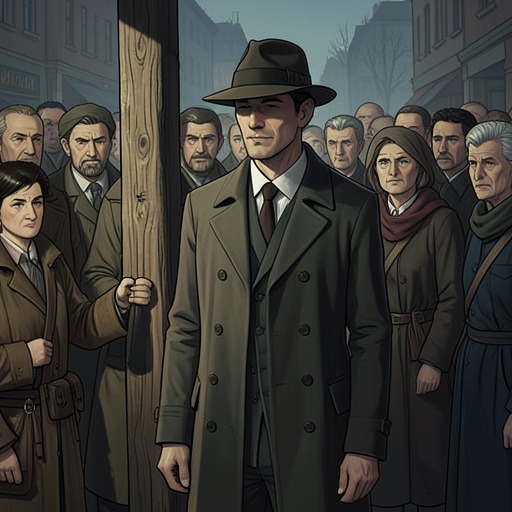
Death sentence
The Best Werewolf Short Stories 1800-1849Death sentence is presented not as a neutral judicial conclusion but as the terminal condition produced when rank, superstition, and local power converge. In the case of Michael Thilouze and Francoise Thilouze, the sentence threatens two vulnerable people with burning at the stake after an accusation of witchcraft has been transformed into legal fact. Its decisive significance lies in the contrast between the weakness of the evidence and the enormous force mobilized against it: a rumor originating in jealousy becomes an investigation, an investigation becomes a trial, and a trial becomes a public ceremony whose machinery must be interrupted by the king himself.
Causes and Institutional Manufacture
The sentence begins with the threatened social order surrounding Victor de Vardes and Francoise Thilouze. Victor’s family regards Francoise as an intolerably low-born replacement for Clemence de Montmorenci, whose marriage to him had been planned to unite the estates of Montmorenci and De Vardes. When Victor refuses to abandon Francoise, the elders seek other means of restoring the alliance. The period’s combination of pride of blood, contempt for the rights of ordinary people, ignorance, and belief in Witchcraft makes accusation more convenient than persuasion.
Jacques Renard exploits a superstition already circulating among the foresters concerning Michael Thilouze and his daughter. Whether Jacques believes the allegation is left uncertain; what is clear is that it gratifies his spite and serves his purpose. The marquis orders the foresters and other observers to watch the alchemist and his daughter for proof of malpractice, giving an appearance of inquiry to a process driven by hostile interests. The sentence therefore emerges from an alliance between aristocratic anxiety and popular credulity rather than from an impartial search for truth.
The immediate physical evidence is a wolf’s foot found after Francoise has escaped a trap at the cost of her left hand. Pierre Bloui interprets the severed foot as the transformed hand of a witch, and Jacques Renard and the marquis allow the story to advance despite the uncertainty surrounding it. Once Francoise’s actual injury is added to the object, the two unrelated facts are fused into a single supernatural explanation. The court treats the combination as incontrovertible, demonstrating how an accusation can make ambiguous bodily evidence appear self-confirming.
The Condemnation at Loques
A commissaire du quartier, followed by a mob from Loques, arrives at Cabanis within hours of Pierre’s report and removes Michael Thilouze and Francoise Thilouze. Their judicial process is described as a trial only by courtesy: the advantages are entirely on one side, while the physician and his daughter are poor, terrified, unaided, and confronted by powerful enemies. They plead innocence, but the wolf’s foot and Francoise’s missing left hand are accepted as proof. The verdict condemns both father and daughter to die at the stake for alleged abominable and devilish magic arts.
The condemned pair spend the interval before execution in tears, prayers, and attempts at mutual consolation, believing themselves abandoned by the world. Michael never closes his eyes during the final night. Francoise, shortly before sunrise, falls asleep and dreams that it is her wedding day, with Victor de Vardes leading her to the altar amid villagers’ cheers. The real cheers that awaken her are those of the populace gathering to witness the execution. The sentence thus invades even the emotional space of hope, replacing the imagined wedding procession with the actual crowd assembling for death.
The execution is deliberately organized as a spectacle. In the marketplace of Loques, scaffolding surrounds the square so that spectators can watch; the section reserved for the gentry is decorated with tapestry and garlands of flowers. The families of Montmorenci and De Vardes attend, except Clemence de Montmorenci, whose heart recoils from seeing her rival die, although she still accepts the justice of the sentence according to the assumptions of her age. A pile of faggots occupies the center, while assistant executioners, priests, and friars wait in their black and grey robes.
The ceremony extends the punishment beyond killing into public humiliation and ritual instruction. A procession led by the judge and closed by the chief executioner marches the prisoners around the square several times, ensuring that the crowd receives a full view of them. The bishop of the district celebrates mass for their souls and delivers an oration on the enormity of their supposed crime, ending with an exhortation to confession and repentance. The judge then reads the formal sentence, asserting that Francoise, through her own arts and those of her father, bewitched the Count Victor de Vardes, visibly transformed herself into a wolf on several occasions, and lost her hand when caught in a trap.
Resistance and Reversal
Michael’s response to the sentence is a final attempt to alter the distribution of suffering. Kneeling before the multitude, he begs that Francoise be spared and that he alone be allowed to die. Some people are moved, but a commanding voice from the nobles’ section orders the executioner to continue. The scene makes the hierarchy unmistakable: popular pity can arise, yet aristocratic authority can suppress it before it becomes effective.
The first interruption comes from Manon Thierry, whose earlier foolish words helped originate the report. Remorse has become unbearable because she recognizes that her spite has placed her uncle and cousin in mortal danger. She ventures out despite personal risk, reaches the marketplace disheveled and bloodstained, and drags a dead wolf behind her. Unable to speak when she reaches the authorities, she points to the animal and pleads for mercy through her expression. The crowd understands the appeal, reverses its mood, and begins calling for pardon. Her courage briefly transforms spectators of punishment into advocates for the condemned.
That reversal is itself resisted by the nobility. The Montmorenci interest proves stronger than the crowd’s sympathy; stern voices demand silence and order the ceremony to proceed. The assistants again raise their torches, and Manon, exhausted by grief, terror, and loss of blood, collapses face down. The sentence therefore survives not because the public remains convinced, but because those with social power insist that the ritual continue even after its emotional foundation has begun to crumble.
The decisive reversal arrives with Victor de Vardes. The sound of a horse galloping over the drawbridge announces his approach, and the crowd opens a path for a rider whose horse is covered with foam. Victor carries the king’s order for arrest of execution. Pierre Bloui has faithfully carried his embassy to Paris, where the ardent lover’s prayers and representations move Henry IV to issue a mandate commanding respite until further investigation. Royal command interrupts the local court at the very moment when the torches are ready to ignite the pile.
Consequences and Significance
Once Henry IV’s favor toward the lovers becomes known, the supposed harmlessness of Michael Thilouze and Francoise Thilouze is generally acknowledged. The evidence changes meaning without changing form: the wolf lacking a foot, once treated as confirmation of guilt when paired with Francoise’s missing hand, is now accepted as proof of innocence. The reversal exposes the instability of the judicial interpretation. What appeared incontrovertible was never self-evident; it was made conclusive by the authority that controlled the proceedings.
Michael and Francoise escape under the king’s protection, and Victor and Francoise are married. The death sentence is therefore suspended rather than carried out, and the episode ends with life, love, and family reunion restored by royal intervention. Yet the conclusion refuses to make the rescue wholly reassuring. The narrative recalls the many unfortunate people who died at the stake on no better evidence, turning this exceptional reprieve into an indictment of the ordinary victims whom no powerful lover, courageous witness, or king’s order reached in time.
The episode also clarifies the political structure of punishment. Local officials, the church, the nobility, the crowd, and the executioners all participate in the sentence’s production and display, but the same legal order can be halted by the sovereign. The condemned are excluded from effective protection while remaining fully exposed to institutional violence; their innocence becomes publicly legible only when a higher power authorizes that recognition. Even the wider supernatural framework reinforces the question of judgment. Krantz speaks of malevolent beings who punish comparatively unoffending mortals, while the hunter-spirit declares that a murderer must pay the penalty attached to a marriage vow and condemns Krantz to continued life. Against these forms of unseen or absolute judgment, the Loques episode shows human justice operating with comparable certainty and comparable danger, yet without comparable truth.
Finally, the sentence is a study in delayed recognition. The crowd first gathers for entertainment, then responds to Manon’s sacrifice, and finally celebrates Victor’s arrival with cries of welcome. Public feeling changes repeatedly, but institutional force remains steady until the king intervenes. The movement from rumor to verdict, from verdict to spectacle, and from spectacle to reprieve makes death sentence a central expression of the narrative’s concern with persecution: law can name innocence as crime, ceremony can make violence seem righteous, and a single command can expose how little justice the condemned had actually received.