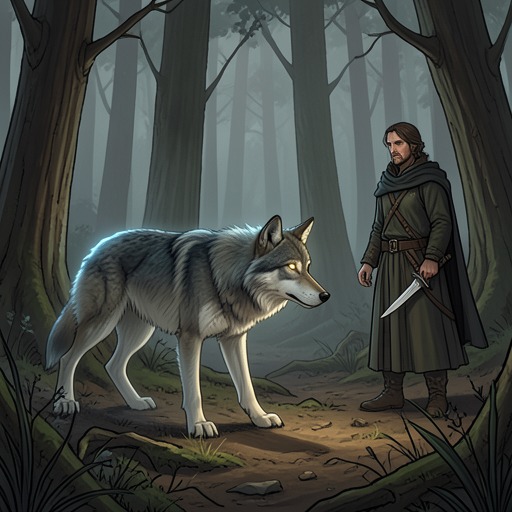
Enchanted-girdle werewolf transformation rule
The Best Werewolf Short Stories 1800-1849The Enchanted-girdle werewolf transformation rule presents lycanthropy as an acquired and conditional metamorphosis rather than an innate animal identity: a sorcerer anoints the body with a devil-inspired ointment, fastens an enchanted girdle, and becomes wolf-like both to observers and, in the account’s stronger formulation, to the transformed person’s own understanding. The rule therefore supplies one of the earliest clearly described mechanisms for werewolf transformation and helps turn scattered superstition into a repeatable narrative pattern.
Definition and Mechanism
The rule is recorded through the older Teutonic conception of the were-wulf as a “man-wolf,” with the Greek term Lycanthropos offered as an equivalent. The transformation depends on two material actions: applying a prepared ointment and putting on the enchanted girdle. While the girdle is worn, the sorcerer does not merely resemble a wolf from the outside. The account says that the person experiences both the shape and the nature of a wolf, allowing the transformation to affect appearance, perception, and conduct at once.
The girdle establishes a temporal limit. The sorcerer remains in wolf form only so long as the enchanted object is worn, which makes the rule fundamentally different from an irreversible change of species. The object is consequently both instrument and constraint: it grants the power to transform, but its continued presence governs the duration of the monstrous state. The evidence does not specify how the girdle is removed or whether the ointment has an independent duration, so the rule is best understood as conditional without assigning it a more elaborate system than the tradition provides.
Conduct and Moral Meaning
Transformation carries behavioral as well as physical consequences. The werewolf is said to act as a real wolf in worrying, killing, and destroying human beings. The rule thus makes violence part of the metamorphosis itself, not merely an accidental result of an altered appearance. Human predation becomes the decisive sign that the transformed figure embodies a supernatural danger rather than an ordinary wolf.
The tradition places the mechanism within witchcraft and diabolic causation. The ointment is made through the “instinct of the devil,” and the transformed persons are identified as sorcerers. In later accounts, men in compact with the Arch Enemy are believed to possess the power to assume the form and nature of wolves at particular times. These formulations preserve the same basic structure: forbidden agency produces the change, the body becomes the visible evidence, and wolf-like violence confirms the moral interpretation imposed upon it.
Development in Werewolf Tradition
The rule belongs to a long movement by which werewolf beliefs passed from superstition into folklore, legend, poetry, and short fiction. At the beginning of the nineteenth century, traditions concerning the monster existed in Greek, English, Italian, German, and French languages, under varying names. The English editorial history described in the evidence treats the years from 1800 to 1849 as the cradle of the werewolf short story, a period in which the form was still rare but increasingly capable of adapting older beliefs.
A related early poetic tradition gives the bodily transformation a more visibly physical vocabulary. In the account identified as Marie’s “Lai du Bisclavaret,” the history of werewolf literature is connected to medieval poetry, while another cited description emphasizes clothes becoming wolf hair, arms becoming legs, and the transformed person wanting to speak but being unable to do so. Those details extend the girdle rule’s concern with altered body and altered nature into a fuller anatomy of metamorphosis. They also show how the tradition could migrate from a practical device, the enchanted belt, toward imaginative descriptions of transformation in progress.
The French terminology surrounding the rule further demonstrates its circulation across cultures. The transformed figure is called a Wehr-Wolf in German tradition, a Bisclavaret or Loup Garou in French tradition, and a Wild Wolf in the English presentation of the Limousin legend. In that story’s setting, the Upper Limousin is imagined as a region where such men wander from their hills and mountains at midnight, howling through nearby towns and villages. The vocabulary changes, but the underlying pattern remains recognizable: human identity is suspended by supernatural means, wolf nature takes control, and the community experiences the result as a nocturnal visitation.
Material Objects and Misrecognition
The enchanted girdle makes transformation legible as a material process, yet later werewolf narratives often preserve only the surrounding effects rather than displaying the object itself. In the Ashford tradition, the Wulfrics are accused of prowling by moonlight, feeding on the newly buried dead, and draining the blood of the living. Actual wolves had entered the churchyard through a breach in the walls during severe winters and disinterred corpses, while a beggar had fractured his skull against the Wolf’s Cross; nevertheless, these incidents were attributed to the Wulfrics in their supposed wer-wolf guise. The contrast shows how a rule of supernatural transformation can operate culturally even when no girdle is seen: ordinary animal behavior and accidental violence are reinterpreted through an inherited model of metamorphosis.
The same process appears in the story of Francoise Thilouze. Once the Marquis de Montmorenci and the Count de Vardes were known to bear ill will toward Michael Thilouze and Francoise Thilouze, rumor supplied the missing mechanism by claiming that hunters had seen Francoise walking with Victor de Vardes before she suddenly changed into a wolf and fled. A particularly large wolf that had repeatedly escaped the foresters’ guns was then treated as the representative of the supposedly transformed Francoise. Here the rule becomes an instrument of accusation: the community does not establish the presence of an enchanted girdle, but uses the expected possibility of transformation to turn prejudice into alleged proof.
Narrative Function and Limits
As a literary device, the rule creates a compact chain of cause, change, behavior, and danger. The ointment and girdle provide an initiating cause; the wolf form supplies a visible change; the appetite for violence supplies recognizable conduct; and the limited duration implied by wearing the girdle leaves open the possibility of return or exposure. This combination helps explain why the rule could travel so effectively from learned antiquarian discussion into poetry and short stories.
The broader tradition also distinguishes the supernatural wolf from actual animals without erasing the connection between them. The evidence notes the belief that a wolf which has tasted human flesh prefers it thereafter, a naturalistic observation or speculation that could help generate stories of demonic appetite. In the Harz Mountains, Gaspar de Marcanville survives through hunting, killing wild buck with a spear and attacking bears; elsewhere, a white wolf lures a hunter upward through the mountains toward a forbidden open space, and an enormous tiger carries off Krantz. These episodes are not themselves proof of the girdle mechanism, but they show the surrounding narrative field in which wolf behavior, human fear, hunting, and supernatural transformation are repeatedly placed in uneasy proximity.
The rule’s significance therefore lies less in offering a complete magical technology than in establishing a durable grammar for the werewolf story. It defines transformation through an external object, joins altered shape to altered instinct, and frames the result through the moral language of sorcery and the devil. As werewolf fiction developed, writers could retain, complicate, or suppress the girdle while preserving its central dramatic question: whether the wolf is an animal, a human being under enchantment, or a social accusation made visible through the language of the supernatural.