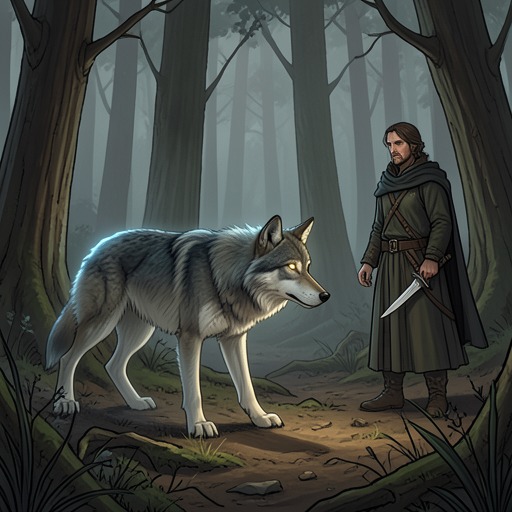
Fire-fork werewolf reversal rule
The Best Werewolf Short Stories 1800-1849The Fire-fork werewolf reversal rule is a specific method for altering the condition of a person afflicted with werewolfism: a blow from a fire fork, delivered between the eyes, changes the transformed man back into the beast. Its decisive importance lies in the reversal itself. Rather than treating werewolf transformation as an irreversible curse or resolving it through death, the rule makes the supernatural condition subject to a concrete physical intervention and gives a familiar domestic object an unexpectedly exact function.
Definition and Origin
The rule is identified in the discussion of “The Wehr-Wolf: A Legend of the Limousin,” a story first published anonymously in The Olio, or, Museum of Entertainment in 1828 and later reprinted by Richard Thomson in Tales of an Antiquary. The story is set in 1520 and is described as the oldest werewolf story in the collection and perhaps the first werewolf short story in the English language. Within that literary history, the fire-fork device is singled out as an original contribution: the story is apparently the first to describe striking a man beset with werewolfism between the eyes with a “fire fork” in order to change him back into the beast.
This mechanism belongs to a broader history in which the werewolf moved from superstition and folklore into poetry and then into the nineteenth-century short story. Earlier accounts describe sorcerers using an enchanted girdel to assume the shape and nature of wolves, while medieval poetry continued the lycanthrope legend. The fire-fork rule differs from those older transformation formulas because it specifies neither a devilish cause nor a magical garment as the immediate agent of reversal. It supplies a practical action, a target on the body, and a definite result.
Operation and Narrative Function
The rule reverses a human-to-werewolf condition by means of a blow between the eyes. The wording makes the location significant: the intervention is not an indiscriminate beating but a directed strike against a defined point. The rule therefore gives the supernatural change a bodily vulnerability and converts recognition of the condition into an opportunity for intervention.
Its logic is paradoxical. The fire fork does not restore the afflicted person to human form; it changes him back into the beast. The rule is consequently a reversal of one state into another, not a cure in the ordinary sense. That distinction preserves the werewolf’s animal identity even while interrupting the human subject’s current condition. The supernatural body remains unstable, but its instability follows a repeatable pattern rather than pure mystery.
Relation to Werewolf Traditions
The rule extends, rather than abandons, established werewolf motifs. Traditional accounts describe the werewolf as a human being who assumes both the shape and nature of a wolf, often through sorcery, an ointment, or an enchanted girdel. Other lore explains popular fear by attributing unusual violence, attacks on livestock, and the preference of wolves that have tasted human flesh for further human food to demonic possession. These traditions make the werewolf a contested figure between person and predator; the fire-fork mechanism gives that contest a material point of contact.
The device also belongs to a story that introduces another protective innovation: wearing a werewolf skin as a cloak to prevent attacks from other werewolves. Together, the cloak and the fire fork create a compact system of supernatural rules. One object protects a human from werewolves by imitating their external condition, while the other disrupts a human victim’s altered state through a forceful bodily blow. The story thus treats werewolfism through objects, coverings, surfaces, and points of impact rather than leaving it as an undefined spiritual terror.
Significance and Afterlife
The fire-fork rule is important because it helped establish the modern werewolf short story as a form capable of inventing specific transformation mechanics. The period from 1800 to 1849 is characterized as the cradle of werewolf short stories, when the genre was still in its infancy but was already producing original variations on inherited legend. “The Wehr-Wolf: A Legend of the Limousin” occupies a foundational place in that development, and the fire fork is one of the clearest reasons for that assessment.
The rule also reveals how literary monsters become more narratively manageable as folklore is reshaped into short fiction. The older werewolf is surrounded by superstition, persecution, and fear: rural communities avoid naming the wolf, attribute accidents and deaths to supernatural agents, and sometimes treat alleged werewolves as sorcerers. The fire fork does not dispel that cultural fear, but it makes the transformation legible as a process with a possible reversal. In doing so, it supplies the kind of concrete limitation that allows a supernatural story to organize suspense around timing, recognition, and the success or failure of a precisely directed act.