Gaspar de Marcanville’s final transformation and death
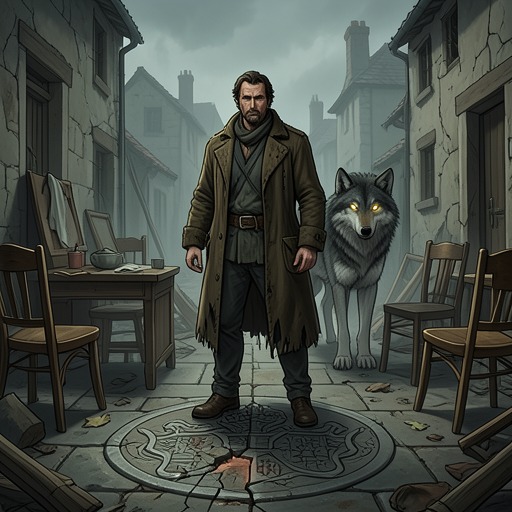
The Best Werewolf Short Stories 1800-1849Gaspar de Marcanville’s final transformation and death is the decisive climax of his story: after years of exile, hunting, and grief, Gaspar appears as a large Wolf, kills the Count de Saintefleur, and is fatally struck while changing back into a man. His death reveals that the “Wehr-Wolf of Limousin” is not merely a village rumor but Gaspar himself, and it turns his long struggle for justice into a victory immediately shadowed by annihilation.
Causes and Background
Gaspar’s final appearance grows out of a history of political betrayal and forced withdrawal. After De Saintefleur’s treachery, Gaspar was driven into exile with Rosalie de Marcanville and their daughter Adéle de Marcanville, taking refuge in the dark recesses of the Hanoverian Harz. He prepared a faithful account of the betrayal and obtained a certificate from his confessor, Father Ægidius, addressed to the King, so that his family might recover its rank and estates if Gaspar died during the dangerous journeys by which he supported them.
The exile hardened him into a hunter. Years spent in the Hercynian woods gave Gaspar considerable skill: the wild-buck could not escape his spear, and even the bear was too weak to resist him. His purpose was not simple self-preservation. He endured because Rosalie and Adéle still depended on him, making the chase both a means of obtaining food and an obligation to the family he was trying to protect. His grief over his fate repeatedly broke into violent passion and lamentation, and about ten years after the exile Rosalie died, leaving Gaspar a widower while Adéle was scarcely eighteen.
With Rosalie gone, Gaspar resolved to leave his solitude, return to France despite the danger of unrecalled exile, and place his papers before the throne. He intended to demand the Ordeal of Combat with De Saintefleur. Yet when he reached the wooded Province of the Upper Limousin, the changes wrought by ten years of severe labor and sorrow weakened his resolve. The event that follows therefore carries a double pressure: Gaspar has come close to public justice, but his altered body and ruined circumstances make a direct restoration of his former identity increasingly impossible.
The Confrontation and Recognition
The climax begins when Adéle confronts the Count de Saintefleur and he identifies himself as her father’s ancient enemy. Adéle answers that the time of vengeance belongs only to Heaven. The declaration is immediately answered by a hoarse voice and the arrival of the creature that has haunted the story’s moral landscape: a large Wolf, already wounded by the loss of a fore-paw, leaps upon the Count and ends his existence.
The Wolf’s injury is a concrete link between the supernatural avenger and the human hunter behind the legend. It also distinguishes this killing from the generalized peasant fears attached to wolves and werewolves. Earlier traditions imagined such creatures as sorcerers who assumed wolf-shape through an enchanted girdle and then killed or consumed human beings; popular belief likewise attributed cemetery deaths and attacks to demonic agency. Here, however, the Wolf enters at the precise moment of Gaspar’s personal revenge, giving the inherited monster-form a specific history and a human grievance.
The action turns again when the royal train, discovered by the peasants, arrives with flambeaux. A Knight carrying a large partizan strikes at the Wolf. Adéle vainly tries to protect the animal, but the blow has enough force to destroy both the Wolf and the man into whom it is changing. The creature gives one terrific howl, falls backward, and is revealed in the form of a tall, gaunt man dressed as a hunter. The sudden change supplies the event’s recognition: the feared Wehr-Wolf is Gaspar de Marcanville.
Death and Immediate Aftermath
Gaspar’s transformation is not followed by rescue or vindication. The weapon that kills the Wolf also kills the human form, collapsing supernatural punishment and ordinary violence into the same stroke. The Count de Saintefleur dies by the hand, or paw, of the avenger, while Gaspar dies at the moment his identity becomes visible to those who might have judged his cause.
Adéle completes the scene’s tragic reversal. Drawing a packet from her bosom, she offers it to the King and then sinks lifeless upon the body of her father. The packet connects Gaspar’s death with the documentary proof he had prepared during exile: his testimony and Father Ægidius’s certificate can finally reach the sovereign, but only after Gaspar has lost his life and Adéle has collapsed beside him. The papers preserve the possibility of legal recognition even as the family’s immediate future is marked by death.
The ending thus gives Gaspar the revenge he sought without granting him a return to his former social existence. His enemy is dead, his evidence is delivered, and the royal presence makes acknowledgment possible; nevertheless, the restored identity arrives too late to save him. The narrative’s promised return from exile becomes an inverted homecoming in which the survivor reaches the court only through the exposure and destruction of the monster within him.
Folkloric and Narrative Significance
Gaspar’s death condenses the long development of the werewolf tradition into a literary scene of revelation. Earlier accounts describe werewolves as men allied with the Devil, capable of taking on the form and nature of wolves, while French tradition names them loup-garous or bisclavarets. The Limousin setting preserves that folklore directly: the Upper Limousin is presented as a region associated with Wehr-Wolves who leave their hills and mountains at midnight, running howling through nearby towns and villages.
The event also belongs to a broader movement from superstition into literature. Werewolf beliefs had passed through Greek, English, Italian, German, and French traditions; medieval poetry continued the lycanthrope legend, and nineteenth-century writing carried the monster from poetry into the short story. Gaspar’s final scene participates in that transformation by giving a named, socially displaced man the body of the legendary beast, then using the return to human form as the mechanism of recognition rather than as a route to survival.
Its strongest structural effect is the concentration of several reversals in sequence. Adéle’s appeal to divine vengeance is followed by the Count’s death; the apparent triumph of the Wolf is followed by the royal attack; the destruction of the animal reveals Gaspar; and the revelation that might have cleared his name is followed by his death. The werewolf form grants Gaspar the power to punish betrayal, but it also makes his justice indistinguishable from the very monstrosity that society fears. The final transformation therefore exposes both a man and a legend, while leaving the reader with a victory that can never become restoration.