Hugues Wulfric–Branda relationship
The Best Werewolf Short Stories 1800-1849The Hugues Wulfric–Branda relationship is the central bond of consolation and recognition in Hugues Wulfric's early story. Branda's sympathy counters the prejudice that has isolated him, and Hugues's love gives him a reason to remain alive when bereavement, poverty, and persecution have made death seem preferable. Their eventual marriage transforms a fragile courtship into a durable household alliance, but it also carries the marks of the mutilation, coercion, and social hatred through which the relationship has had to pass.
Recognition Across Social Exclusion
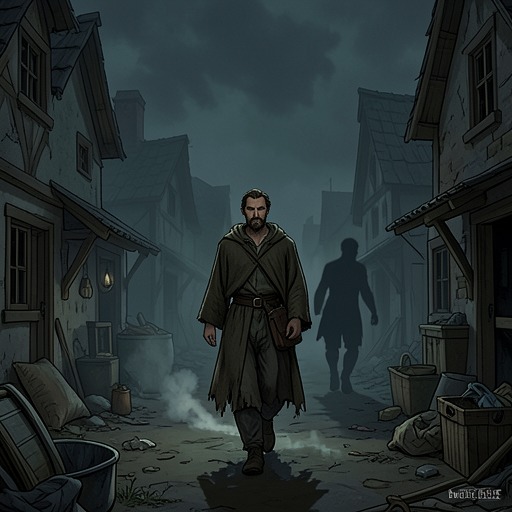
Hugues is presented as a young man who might have been the finest in all that part of Kent, but repeated outrages and privations have drained the colour from his face, sunk his eyes, and contracted his brows. His fierce, oblique glance and tattered clothing encourage the reputation imposed upon him, yet his robust proportions, majestic carriage, rustic grace, soft voice, and fluent Norman French distinguish him sharply from the condition attributed to him. The narrative therefore makes Branda's attraction an act of moral perception as much as romantic preference: she sees a persecuted human being where malicious gossip insists on seeing a monster.
Branda, the niece of Willieblud, the flesher of Ashford, first notices Hugues while passing on horseback through a coppice near the town. Hugues has been driven there by the difficult single-handed chase of a wild hog, a detail that places him within the dangerous, marginal world of the forest rather than the protected social life of the town. The malignant old women attempt to poison Branda's opinion with falsehoods, but their stories fail. She sometimes turns considerably out of her way to meet him and exchange his cordial greeting, while he, recognizing the attention she has begun to offer, summons the courage to look at her more closely.
Love as Hugues's Last Attachment
Hugues's response is immediate but shaped by deprivation. In his restricted wanderings beyond the forest, Branda is the brightest and comeliest maiden he has encountered, and gratitude for her kindness deepens into love. He is on the point of declaring his feelings when domestic bereavements arrive one after another, overwhelming the already isolated young man. The relationship thus begins not in security but at the edge of collapse, with affection emerging as a counterforce to inherited hostility and material misery.
During the holy Christmastide, Hugues sits alone beside a failing hearth, thinking of his dead kindred and imagining that his own hour of reunion with them is near. Hunger twists through him, intense cold congeals his bones, and the decay of the fire mirrors the extinction of hope. Yet recollection of Branda intermittently eases his anguish and brings a faint smile to his wan features. In his despair he prays for his sufferings to end and wishes he possessed the power of the wer-wolf attributed to him, so that he could terrify those who persecuted his family and perhaps survive by finding carrion. Amid this fantasy of retaliation, Branda remains the decisive exception: she is the only being in the world whom he believes cares for him, and that conviction alone reconciles him to life.
The scene makes the relationship more than a conventional romance. Branda does not merely provide a future bride for a persecuted hero; her recognition becomes a psychological lifeline. Hugues's longing for vengeance and his longing for Branda coexist, but they do not carry equal moral weight. The imagined wolf would answer persecution with terror, whereas Branda's presence answers it with human attachment.
Willieblud's Fear and Branda's Defense
Hugues's supernatural appearance later becomes a source of leverage against Willieblud, whose fear is intensified because he knows that the paw extending toward him was once a human hand. Hugues, satiated by a meal obtained with unusual ease, promises himself that he will repeat the expedient, finding malicious pleasure in augmenting Branda's uncle's terror even while remaining smitten with Branda's charms. Willieblud responds by paying an imposed tribute of meat whenever the wer-wolf crosses his path, without insisting on its weight or quality. He becomes gloomy, reluctant to set out for market, and afraid of the nocturnal journey that he once enlivened with whistling and snatches of song.
Branda cannot understand the cause of this permanent depression. She questions, importunes, and supplicates her uncle until he finally recounts his nocturnal adventures and strange compact with Hugues. Her response is not credulous fear but offended loyalty. She declares that Hugues is no more a wer-wolf than Willieblud himself and calls the story an idle tale or a trick. Her defense shows that affection has already altered the meaning of the evidence: what Willieblud interprets as sorcery, Branda interprets as calumny directed against a man whose reputation is worse than his worth.
That defense does not prevent violence. Willieblud returns with a freshly severed human hand enclosed in a wolfskin glove and places it before Branda as proof that the wer-wolf has received his due. He celebrates the mutilation as a victory over witchcraft, while Branda immediately understands what has happened. Her shriek, tears, and hurried departure mark the moment when private love becomes active compassion. The injury is not an abstract symbol for her; it is the bodily suffering of the person she has chosen to believe in.
Mutilation, Care, and Marriage
Branda reaches Hugues's hut while he lies writhing on his couch, his clothing and floor drenched with gore. His face reveals moral as well as physical suffering, and his mutilated wrist, roughly wrapped in hemp, can no longer conceal the loss of his hand. She kneels beside him, searches tenderly for the wounded wrist, and joins her lamentations to his. Her denunciations of the sanguinary flesher make her position unmistakable: she does not stand between two competing versions of the story as a neutral observer, but beside Hugues as the victim of the violence inflicted by her own household.
The scene is interrupted when another visitor knocks at the shattered door. Branda looks through the loophole to identify the newcomer and responds with a silent gesture of despair. The evidence does not disclose the visitor's identity or describe the immediate exchange, but it preserves the crucial emotional fact: even after she has crossed into Hugues's refuge to care for him, the couple remain exposed to renewed danger. Their intimacy is therefore inseparable from concealment, pursuit, and the threat represented by the very community in which Branda has been raised.
Willieblud's later fate completes the destructive consequence of the conflict surrounding the relationship. Hoping to escape further persecution from the fatal hand, he carries it to the cemetery at Canterbury and has it buried in consecrated ground after solemn exorcism. The hand returns to the light and is found nailed to his shutter. Robbed of peace and desperate to erase the evidence of his deed, Willieblud leaves Ashford without even bidding farewell to Branda; days later he is found drowned in the river Stour, still clutching the phantom hand in his death-contracted grip. His death removes the uncle whose fear and brutality had made the lovers' situation so perilous, but it also leaves Branda heir to the stock and chattels of the household.
A year after Willieblud's death, Hugues, now without a hand and therefore a confirmed wer-wolf, marries Branda, described as his faithful leman and the late flesher's sole heiress. The marriage is both romantic fulfillment and material reversal. Hugues gains the steadfast companion whose care preserved the possibility of life; Branda enters a union with the man she defended when society branded him monstrous. Yet the qualification that Hugues is now confirmed as a wer-wolf prevents the ending from restoring an untouched, preternatural innocence. The relationship reaches permanence through the wound rather than by escaping it.
Narrative and Thematic Significance
The romance is structured as a contest between public naming and private knowledge. Town gossip classifies Hugues through alleged atrocities, while Branda attends to his conduct, appearance, language, and cordial greeting. Her judgment does not erase the supernatural or violent dimensions of his story, but it refuses to let accusation become the whole of his identity. In this sense, the relationship exposes social exclusion as an active force: prejudice helps create the isolation, hunger, and desperation that make Hugues's transformation and retaliatory behavior possible.
The surrounding narrative repeatedly shows emotions spreading through communities. Fear makes Willieblud surrender meat and withdraw from ordinary life; gossip sustains suspicion; pity first reaches Hugues through the women who question his reputation; and Branda's compassion converts the mutilated hand from proof of monstrosity into evidence of cruelty. Elsewhere in the book, similar collective passions produce persecution and rescue: Manon Thierry's jealousy of Francoise Thilouze helps generate a fatal accusation, then her remorse drives her to seek Pierre Bloui's aid; at the execution, Manon's arrival dragging a dead wolf turns the crowd from spectators demanding punishment into voices pleading for mercy. Against that broader pattern of contagious fear, Branda's loyalty offers a private emotional community founded on recognition rather than rumor.
The ending consequently carries a double meaning. It grants Hugues and Branda the conventional reward of marriage, inheritance, and mutual fidelity, but the reward is shadowed by the severed hand and Willieblud's death. Their love does not cure the social world or undo bodily loss. Its decisive achievement is narrower and more human: it gives Hugues one relationship in which he is not reduced to the name imposed upon him, and it allows Branda to remain faithful to the person she had recognized before the violence made his alleged nature impossible to deny.