In perpetuam rei memoriam
The Best Werewolf Short Stories 1800-1849In perpetuam rei memoriam is the Latin inscription carved beneath a stone wolf over the portcullis of the old Château de Vardes. Its decisive significance lies in the way it converts a violent and contested episode into a permanent public memorial: the wolf records the supernatural accusation surrounding Francoise Thilouze, while its missing fore-foot recalls the bodily loss through which that accusation was supposedly proved.
Inscription and Physical Form
For long years after the events at the château, visitors could see a wolf carved in stone above the portcullis. The animal was conspicuously incomplete, lacking one of its fore-feet. Beneath it appeared the inscription, “In perpetuam rei memoriam.” The damaged figure and the Latin words work together: the wolf is not an undisturbed emblem of power, but a permanently marked image whose missing limb fixes a particular injury in collective memory.
The memorial survived the lives of those involved and remained visible until the Château de Vardes fell into utter ruin. Its placement over the entrance gave the remembrance a public and architectural form rather than leaving it as a private family recollection. The inscription therefore outlasted both the immediate witnesses and the building that displayed it, even though the account does not state who commissioned the carving or when it was made.
Relation to Francoise Thilouze’s Trial
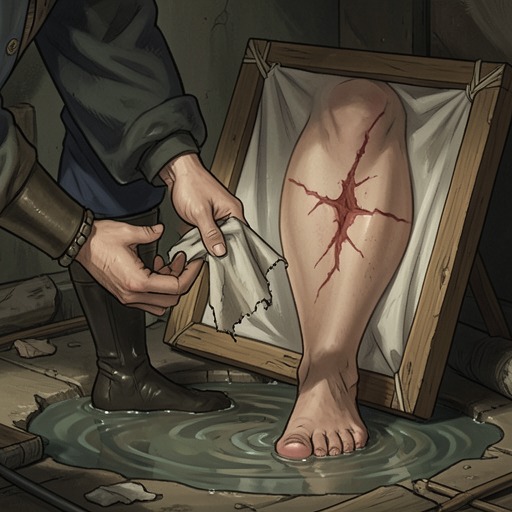
The inscription is inseparable from the case against Michael Thilouze and Francoise Thilouze. They were condemned to be burnt after being found guilty of “abominable and devilish magic arts.” The sentence specifically alleged that Francoise had bewitched Victor de Vardes, had transformed herself visibly into the shape of a wolf on several occasions, and had lost her hand after being caught in a trap. The stone wolf’s absent fore-foot thus echoes the bodily mark invoked by the prosecution as evidence of her supposed transformation.
Yet the public meaning of the memorial is more complicated than the court’s verdict. At the execution, Manon Thierry arrived disheveled, bloodstained, and dragging behind her a dead wolf. Her exhausted appeal caused the crowd to change from eager spectators into voices demanding pardon, although the Montmorencis’ influence initially overruled that popular reaction. Victor de Vardes then arrived on a foam-covered horse carrying the king’s order for arrest of execution. The inscription preserves the case, but it does not settle the conflict between supernatural allegation, aristocratic power, remorse, heroism, and rescue that shaped it.
Memory, Ruin, and Narrative Meaning
The phrase gives the episode an official-looking permanence even though the story itself exposes how unstable its public judgments were. Neighbours could interpret deaths as a tardy chastisement from Heaven; communities could magnify fear through gossip and repeated tales; and the people of St. Yrieux could gather almost nightly to discuss Wehr-Wolves, often intensifying their terror with false stories. Against this culture of rumor, the inscription offers a concise formula of remembrance, but the object beneath it remains an ambiguous wolf whose mutilation points back to accusation, suffering, and disputed truth.
Its endurance also creates a sharp contrast with the human fragility surrounding the event. Manon Thierry was left torn and lacerated after her perilous effort and died after receiving the forgiveness and thanks of her uncle and cousin; Michael Thilouze soon followed her to the grave. The memorial’s survival over the ruined Château de Vardes gives stone what the people themselves could not retain: a visible trace of the catastrophe, reduced to an image, a missing limb, and a phrase declaring that the matter must be remembered forever.
Significance as a Memorial Formula
In perpetuam rei memoriam functions less as a fresh action than as a framing device for the entire legend. It fixes attention on a single material sign—the incomplete wolf—and asks later observers to reconstruct the history behind it. The phrase does not explain the tragedy, identify the guilty, or describe the rescue; instead, it preserves the wound as an emblem and leaves the surrounding narrative to supply its competing interpretations.
Because the inscription remained after the château became ruinous, it embodies the story’s central tension between disappearance and persistence. Families die, witnesses vanish, reputations change, and institutions collapse, but the carved wolf continues to testify to an episode in which fear became legal condemnation, compassion became collective resistance, and a physical mark was made to stand for an entire supernatural history. In that sense, In perpetuam rei memoriam is both memorial and fragment: a surviving piece of stone that keeps an unstable past present.