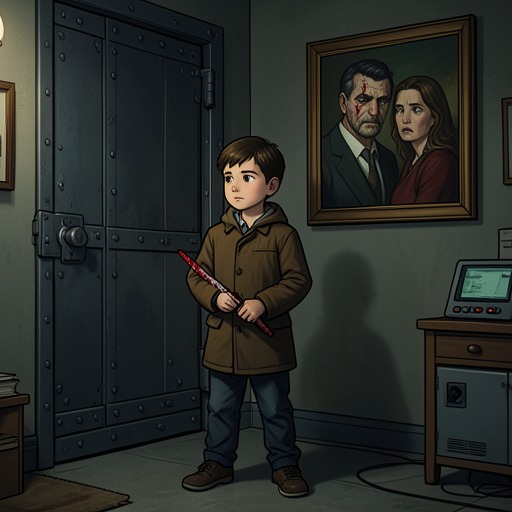
Krantz’s death and the fulfillment of the curse
The Best Werewolf Short Stories 1800-1849Krantz’s death and the fulfillment of the curse are the concluding movement of a hereditary punishment rooted in murder and a supernatural marriage oath. Wilfred’s judgment does not simply promise Krantz a violent end; it condemns him to live while the people bound to the oath disappear, turning survival itself into the penalty and making his eventual death the final confirmation of the curse’s power.
The Oath and Wilfred’s Judgment
Wilfred’s sentence follows Krantz’s double murder and the oath made under supernatural authority. When Krantz’s father attempts to attack the hunter, the axe passes through Wilfred’s form, revealing that ordinary violence cannot reach him. Wilfred then declares that spirits have power only over those who have committed murder and identifies the father’s crime as a double murder. The punishment is tied directly to the marriage vow: two of the father’s children are already gone, the third is destined to follow, and the oath is described as registered beyond any human attempt to revoke it.
The sentence reverses the ordinary meaning of mercy. Wilfred says that killing the father would be kindness, whereas his actual punishment is that he must live. The curse therefore works through delayed suffering rather than immediate execution. Its logic is cumulative: the father survives long enough to witness the loss of his children, and Krantz inherits not only the family history but also the expectation that the same supernatural account will eventually be settled through him.
Flight to Holland and the Father’s Death
After Wilfred disappears, Krantz’s father rises, embraces his child, and kneels in prayer. The next morning he leaves the cottage forever, taking Krantz with him and travelling to Holland. The flight is not a release from the curse but its first consequence, carrying the family’s unresolved crime into a new country and a new phase of Krantz’s life.
The fugitives reach Holland with a small amount of money, but their security lasts only a few days. In Amsterdam, Krantz’s father is seized by brain fever and dies raving mad. Krantz is placed in an asylum and later sent to sea before the mast. These successive dislocations—escape, illness, death, confinement, and forced service—make the curse legible as a process rather than a single supernatural blow. The father’s life ends in madness, while Krantz is left alive, displaced, and increasingly isolated from any ordinary future.
Krantz’s Foreknowledge and the Curse’s Fulfillment
Krantz later recounts this history to Philip and asks whether he himself must pay the penalty of his father’s oath. He is not merely fearful of death; he is convinced that the oath must claim him in some manner. That conviction gives his later death the character of fulfillment rather than surprise. The prophecy has already established its pattern through the disappearance of two children and the father’s forced survival, while Krantz’s own movements become a tense continuation of the same design.
The story places this hereditary doom beside the book’s wider supernatural framework, in which All Souls’ Eve is the haunted night when the dead are reputed to rise and return home. Against that calendar of returning spirits, Wilfred’s judgment creates a different kind of recurrence: a spoken vow crosses generations, follows the family through flight, and converts death into the final proof that the past remains active. Krantz cannot simply begin again in Holland or at sea, because the oath makes his future answerable to an earlier crime.
Tragic and Ritual Significance
The event completes a pattern in which speech, ceremony, and punishment possess material force. The marriage oath is made even in a wild country without a priest or ordinary law, yet Wilfred treats it as binding; the vow becomes an instrument of judgment, and its consequences outlast the place where it was spoken. In this sense, Krantz’s death is not an isolated end but the last stage of a ritualized chain linking marriage, murder, flight, madness, and survival.
The contrast with other public ceremonies in the narrative is stark. Feudal authority can enforce submission through proclamation and fines, while ecclesiastical and judicial institutions stage punishment before crowds; Wilfred’s supernatural tribunal requires neither marketplace nor church. Its verdict is carried by memory and time. Krantz’s death therefore closes the curse by demonstrating that an oath made outside recognized human institutions can still govern a life more completely than human law, exile, or physical distance.