Krantz’s supernatural marriage oath
The Best Werewolf Short Stories 1800-1849Krantz’s supernatural marriage oath is the decisive moment when Krantz’s second marriage to Christina becomes more than a private agreement. In a remote cottage without a priest or civil law, Wilfred makes Krantz swear by the spirits of the Hartz Mountains to protect, cherish, and love Christina; Krantz also accepts a curse upon himself and his children should he violate the vow. The scene joins marriage, pagan ritual, and threatened retribution, establishing an oath whose consequences extend beyond the couple to the next generation.
Circumstances of the Marriage
The oath follows a gradual change in Krantz’s attitude toward Christina. After the huntsman and his daughter are accommodated at the cottage, Wilfred and Krantz go hunting daily while Christina performs the household duties and cares for the children. Even little Marcella’s initial dislike begins to fade. Krantz, who had previously shown an aversion to women, becomes attentive to Christina and often remains awake with her beside the fire after the others have gone to bed. After roughly three weeks, he asks her to marry him and receives both her consent and Wilfred’s approval.
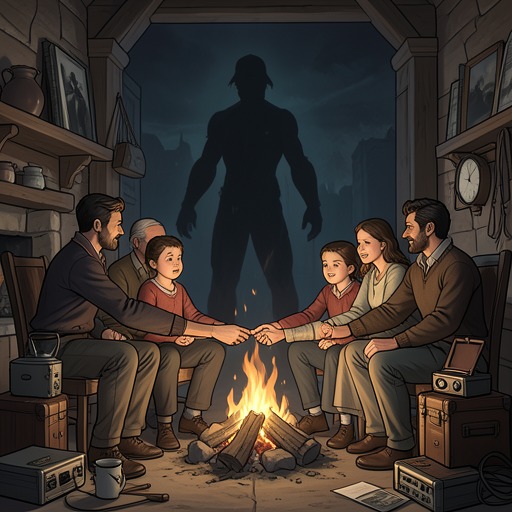
The proposed marriage takes place outside ordinary ecclesiastical and legal structures. Wilfred explains that there is no priest in the wild country and no law to bind the parties, but insists that some ceremony must satisfy a father. He therefore offers to marry them according to his own custom, and Krantz agrees. The absence of an institutional ceremony does not make the union casual; instead, it transfers authority from church and law to Wilfred, the wilderness, and the spirits associated with the Hartz Mountains.
Form and Content of the Oath
Wilfred begins by directing Krantz to take Christina by the hand and swear. When Krantz asks why the vow should not be made by Heaven, Wilfred rejects that Christian formula, saying that he prefers the spirits of the Hartz Mountains. His chosen witnesses are therefore not clerical or civic powers but supernatural forces rooted in the mountain landscape. The oath is presented as an alternative marriage law, one that carries its own authority even though no priest is present.
Krantz repeats Wilfred’s declaration that he takes Christina as his wedded wife. He promises that he will always protect, cherish, and love her, and specifically swears that his hand will never be raised against her to harm her. The wording defines marriage as an active obligation of care while simultaneously placing physical violence at its centre as the act most emphatically forbidden. The vow thus contains the standard promises of affection and protection in a form that ominously anticipates their possible violation.
The second portion adds the penalty. If Krantz fails in his vow, he calls upon the vengeance of the mountain spirits to fall upon himself and his children. The punishment is imagined through animal violence: the children may perish by the vulture, the wolf, or other beasts of the forest; their flesh may be torn from their limbs; and their bones may blanch in the wilderness. This is not a private penalty proportionate only to Krantz’s conduct. It is hereditary and expansive, converting a husband’s failure into a threat against his descendants.
Ritual Tension and Immediate Consequences
Krantz hesitates while repeating the final words of the curse. The hesitation marks a value shift within the ceremony: the marriage that began as a promise of protection becomes charged with fear when its failure is given a concrete and inherited price. Little Marcella bursts into tears as he repeats the last sentence, and her distress unsettles the adults, particularly Krantz. He responds harshly to the child, who suppresses her sobs and hides her face beneath the bedclothes.
The reaction exposes the oath’s effect before any later punishment occurs. The children are not passive witnesses to a harmless family arrangement; they are named as collateral within its supernatural terms. Marcella’s tears make visible the cost of the ceremony, while Krantz’s harshness shows that the vow already produces strain rather than security. The oath’s promise to protect the household is therefore shadowed from the beginning by the possibility that the household itself will become the field of vengeance.
The next morning Wilfred mounts his horse and rides away. The marriage is then treated as completed: the narrative calls it Krantz’s second marriage, and ordinary domestic life resumes much as before. Yet Christina does not become a benevolent mother-in-law. During Krantz’s absences she often beats the children, especially Marcella, and looks eagerly at the fair child with hostility. The contrast between Krantz’s spoken promise to protect his wife and the household’s subsequent violence gives the oath an immediate dramatic irony. Its language establishes an ideal of protection, while the family routine reveals that protection is neither secure nor equally extended to everyone under Krantz’s roof.
Supernatural and Narrative Significance
The ceremony functions as a threshold between ordinary domestic life and the supernatural order governing Krantz’s story. Its setting lacks the safeguards of church and law, and its authority comes from a landscape populated by spirits capable of acting for good or evil. In this form, marriage is not merely a social transition but a binding passage into a dangerous moral economy: promises have power, violations invite punishment, and the consequences cross generations.
The oath also provides the story with a compact pattern of foreshadowing. Krantz’s pledge forbids him to raise his hand against Christina, while the penalty invokes wolves and the tearing of flesh. Marriage, bodily harm, children, and wild animals are brought together in one ritual utterance. Later developments can therefore be understood not as unrelated horrors but as returns of the terms spoken at the cottage. The repeated invocation of the Hartz Mountains gives the curse a remembered source, while the image of bones blanching in the wilderness turns the vow into a verbal prophecy of desolation.
Within the larger collection, the oath belongs to a recurring world in which ritual determines identity and punishment. All Souls’ Eve is described as the haunted night before All Souls’ Day, when the dead are reputed to rise and return home. Elsewhere, ceremonies expose the conflict between social order and supernatural danger: the public river punishment is governed by proclamation and feudal authority; the secret meeting in the corridor of Château de Keridreux turns religious surroundings into the scene of clandestine intrigue; and the public execution of Michael Thilouze and Francoise Thilouze transforms accusation into spectacle. Krantz’s oath is the intimate counterpart to these public rituals. It begins in a cottage, but its language gives private conduct consequences as grave as any ecclesiastical sentence or public execution.
The oath’s lasting importance lies in its combination of consent and coercion. Krantz agrees freely to marry Christina and repeats each required formula, yet the terms are shaped by Wilfred’s authority and enforced by powers Krantz does not control. The marriage promises love and protection, but its supernatural clause makes the family vulnerable to a punishment described in the vocabulary of the forest. Because the ceremony binds Krantz, Christina, and the children into one threatened structure, it becomes the moral and supernatural hinge of the family’s subsequent tragedy.