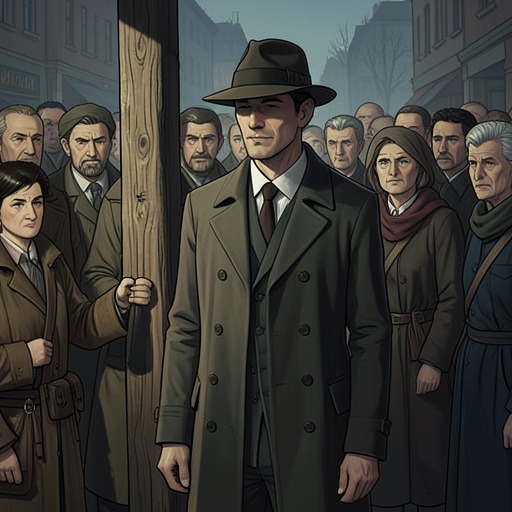
Pierre Bloui
The Best Werewolf Short Stories 1800-1849Pierre Bloui is the chief forester attached to the Montmorenci estate, an excellent huntsman whose practical position makes him a desirable marriage prospect for Manon Thierry but whose weakness, ignorance, and poor manners ensure her contempt. He becomes a crucial intermediary in the persecution of Michael Thilouze and Francoise Thilouze: first spreading information that exposes Victor de Vardes’s love for Francoise, then pursuing supposed supernatural evidence against her, and finally carrying the appeal that saves the accused from execution. His importance lies in this moral reversal. Pierre begins as a tool of jealousy and aristocratic power, but ends by allowing love and conscience to overcome fear and servility.
Position and Suitability
Pierre’s authority comes from his work rather than from rank. As chief forester, he knows the estate’s woods and watches the movements of those who pass through them. He is described as an excellent huntsman, but also as weak, ignorant, and ill-mannered. Manon repeatedly rejects his proposals, yet Pierre does not understand that her refusal is decisive. His dullness makes his feelings less perceptive rather than less persistent: he continues visiting Loques because he believes his office and income make him an excellent match, and because old Thierry is favorably disposed toward him.
This combination of social usefulness and personal inadequacy governs Pierre’s conduct. He has enough access to privileged households to carry information upward, but not enough independence to question the judgments of his employers. His economic position encourages him to court Manon, while his dependence on the Montmorenci family makes him eager to please them. He therefore becomes particularly vulnerable when private jealousy, class prejudice, and superstition offer him a chance to advance himself.
Gossip, Jealousy, and the Witchcraft Charge
Pierre is the first person to tell Manon what is happening at Cabanis. The foresters have observed Victor and Francoise meeting in the woods and near Michael Thilouze’s house, despite the lovers’ efforts to avoid the Montmorenci family. Pierre reports that Victor, instead of courting Clemence de Montmorenci, spends his time with Francoise, the daughter of a poor physician. He does not initially understand the jealousy he provokes in Manon, but his information gives her resentment a definite object and helps carry the lovers’ secret into the hostile households.
Manon responds by suggesting that Victor has been bewitched by Francoise and Michael. She does not truly believe the accusation, but her anger makes her behave as if she possesses hidden knowledge. Pierre accepts the implication literally. He passes the suspicion to his fellow huntsmen, who add their own suggestion that Michael and Francoise are not respectable or natural people, and the rumor soon reaches Jacques Renard. Pierre’s credulity thus transforms a jealous insinuation into a communal belief. The accusation does not arise from discovered fact; it is manufactured through overheard intimacy, class contempt, and a desire to explain Victor’s rejection of an arranged alliance.
Pierre then seeks an active role in the witch-finding that follows. He believes that proving Francoise guilty will win favor with his employers and satisfy Manon, although he neither understands the full source of her hostility nor cares to investigate it. Jacques Renard’s certainty confirms his own fears, while loyalty to his superiors supplies the moral permission to act. The story presents Pierre as a man who has surrendered his conscience to the conscience of those above him: their interests become his interests, and their suspicion becomes his evidence.
The Trap and the Misread Evidence
Pierre is reluctant to shoot the wolf because he is convinced that the creature is really a human being. His hesitation shows that superstition has not entirely erased his perception; he recognizes the possibility of a person beneath the apparent animal form. Yet instead of challenging the accusation, he searches for a method that will protect his feelings while serving the prosecution. He places numerous baited snares in the part of the domain frequented by Victor and Francoise, hoping to catch Francoise in either her human or wolf shape.
The trap first yields a wolf’s foot. Pierre finds that an animal has been caught and has torn itself free at the cost of the limb. Rather than treating the mutilated foot as ambiguous evidence, he carries it away and resets the snare. When he later hears that Francoise has seriously injured her hand and that Michael has been forced to amputate it, he interprets the coincidence as absolute proof. In his imagination, Francoise must have been caught in the trap and escaped by sacrificing her hand; once separated from her body, the hand supposedly retained the wolf form it had assumed.
The detail that most horrifies and exalts Pierre is therefore not a witnessed transformation but the correspondence between a wolf’s missing foot and Francoise’s missing left hand. His face moves from joy to fear as he persuades himself that he has discovered the decisive proof. He needs a glass of cognac before presenting the wolf’s foot to Jacques Renard, a physical sign of how completely the supposed discovery overwhelms him. The episode exposes the violence of evidence shaped by expectation: the object does not establish the theory, but the theory determines what the object means.
From Persecutor to Rescuer
Within hours of Pierre’s report, a commissaire and a mob from Loques arrive at Cabanis and carry away Michael and Francoise on a charge of witchcraft. The judicial process is heavily controlled by their powerful enemies, and the physician and his daughter are quickly condemned to die at the stake. In court, the wolf’s foot, combined with Francoise’s actual amputation, is treated as incontrovertible evidence. Pierre’s private interpretation has become institutional violence, and his action helps convert rumor into a death sentence.
His reversal begins when he sees the wolf beneath the chestnut trees. The animal is lame, and Pierre knows he could have shot it, yet he refrains because he fears that his lord and lady would be displeased. This sight does not instantly make him courageous: it first reveals the depth of his servility. He has evidence that contradicts the prosecution, but he still remains silent when Jacques Renard tells him not to meddle in the matter. Nevertheless, his belief in the guilt of the accused has changed. He now privately accepts that the wolf cannot be Francoise, who is imprisoned at the same time.
Manon forces the moral consequence of that knowledge upon him. Unable to write or send a letter to Victor, she asks Pierre to go to Paris and tell him of the danger facing Michael and Francoise. Pierre fears trouble with the Montmorencis, but Manon promises to marry him if he undertakes the journey. The offer is a bribe, yet it is also an act of self-sacrifice by Manon, who uses the only power she possesses to save her uncle and cousin. Pierre agrees partly because of the promise and partly because his own opinion has changed. Love, self-interest, and conscience converge, and at sunset he sets out for Paris.
The Embassy and Moral Significance
Pierre faithfully performs his embassy. He reaches Victor de Vardes and conveys the danger, enabling the ardent lover to appeal to Henry IV. The king issues an order suspending the execution until the case can be investigated. Victor arrives at the last moment bearing the mandate, while the crowd changes from anticipation of a public burning to celebration of the rescue.
Pierre’s final contribution is therefore indirect but indispensable. He does not confront the aristocratic families in open defiance, expose the false reasoning in court, or rescue the prisoners by force. Instead, the same man who once carried suspicion through the estate carries the appeal that travels to Paris and returns with royal authority. His movement between those two messages marks the structure of his character: information first serves prejudice, then serves justice.
The story does not erase Pierre’s earlier responsibility. His snares, credulity, and eagerness to please helped place innocent people at the stake, and his rescue effort succeeds only after Manon’s pressure and the king’s intervention. Yet his change matters because it demonstrates that superstition is not merely an error of belief; it is a chain of obedience that can be broken when a person accepts the moral meaning of what he has seen. Pierre’s conscience arrives late, but it arrives in action. He remains a compromised figure, precisely because his final courage gains force from the persecution he helped make possible.