Ploërmel
The Best Werewolf Short Stories 1800-1849Ploërmel is presented as a considerable but strikingly isolated town whose physical remoteness intensifies the danger surrounding Hugues Wulfric’s mission. It is the destination of the urgent journey from Château de Keridreux to summon Father Etienne, the knight’s confessor, before twilight can force the knight to resume his nightly character as a loup-garou. The town therefore functions not merely as a stopping place but as a threshold between the threatened domestic world of the castle and the religious, secretive world from which supernatural aid is expected.
Setting and Appearance
Ploërmel lies amid a landscape without the ordinary signs of commercial connection. Its approaches are merely tracks leading from neighboring huts and castles; no great road spreads outward like an artery, and neither navigable river nor canal compensates for the absence of a proper highway. The description makes the town’s isolation structural rather than accidental. It is not simply difficult to reach because of bad weather or an unfortunate route: its surrounding geography denies it the channels through which wealth, traffic, and ordinary social life would circulate.
The town’s melancholy is reinforced by its architecture. Its houses are old and black, while the convent becomes visible on the brow of a hill, seeming to guard the scene with sullen austerity. The convent’s elevated position gives it a commanding presence, but not one of welcome or comfort. It appears to watch over a strange quiet, making Ploërmel seem enclosed by religious severity and historical decay. The setting thus prepares the reader for encounters in which prayer, secrecy, jealousy, and supernatural suspicion are inseparable.
Hugues Wulfric’s Mission
Hugues Wulfric reaches Ploërmel after the consultation at Château de Keridreux determines that he must ride immediately to Father Etienne. The purpose of the journey is precise and desperate: he is to deliver a letter imploring the confessor to come to the castle, where it is hoped that the priest’s prayers and anathemas may allow the evil hour of twilight to pass without the knight being driven into his loup-garou form. Ploërmel is consequently the place from which the proposed religious intervention must be brought back to Keridreux.
The journey is complicated by the secrecy imposed at the castle. Hugues has concealed a pillion beneath an old cloak because the Dame of Keridreux requires explanations before permitting anyone to leave. At the oak of Mi-voie, he discovers that the two letters carried in his breast lack both seal and address. Unable to read, he cannot distinguish the letter intended for Father Etienne from the one intended for the dame, and must decide to risk delivering both if necessary. Ploërmel is therefore approached not with the confidence of a messenger carrying a clear commission, but with the anxiety of a servant navigating a web of jealousy and concealed intentions.
The Convent and Its Rivalries
Hugues crosses himself mechanically upon entering Ploërmel and resolves that nothing short of sorcery will detain him there beyond sunset. His reaction reveals how the town’s appearance has become fused with the immediate supernatural emergency. The convent is not a neutral institution in his eyes; it is a place associated with powers that may either protect his master or delay the rescue until the transformation has occurred.
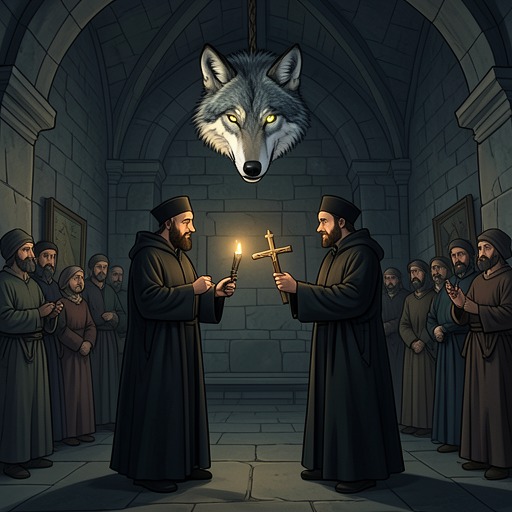
At the convent, Hugues successfully delivers the correct letter to Father Etienne. The priest is a precise, somewhat sour-looking elderly man whose expression combines grief and surprise at the report that the Knight of Keridreux has become a loup-garou. He agrees to accompany Hugues after reading the singular epistle. Yet the letter, as Father Etienne discovers, is not the straightforward appeal Hugues believes it to be. It invites the priest to meet the Dame of Keridreux privately at dusk, using the knight’s alleged transformation as the pretext. The convent is thus a site where the religious remedy is entangled with the dame’s concealed relationship and with the danger posed by her former confessor, Father Bonaventure.
Father Etienne and Father Bonaventure are rivals within this enclosed setting. Each worries that the other will discover the affair involving the Dame of Keridreux, and each attempts to leave while first ensuring that the coast is clear. Their repeated retreats turn the convent into a comic maze of surveillance and avoidance. Hugues, waiting beside the horse, watches the two monks repeatedly approach and withdraw until the delay becomes intolerable. Ploërmel’s religious authority is consequently shown as divided: the men who should provide spiritual clarity are themselves governed by jealousy, suspicion, and self-protection.
Departure at Dusk
The passage of time transforms Ploërmel from an errand’s destination into a source of immediate peril. As Father Etienne and Father Bonaventure continue their evasions, the sun sets and the warder’s horn sounds from tower to tower. For Hugues, the horn is like a voice of despair, because every moment spent in Ploërmel increases the likelihood that his master will be forced into the forest before help can arrive. The town’s bells and towers, ordinarily marks of civic order, instead measure the approach of the supernatural crisis.
Hugues finally abandons patience and caution. When Father Etienne reaches the waiting horse but pauses to look around, Hugues lifts him onto the saddle, places himself on the pillion, and rides away at full gallop without waiting for permission or a blessing. The priest clings to the horse’s mane with one hand and to Hugues’s uncombed beard with the other; the violent motion jolts prayers and curses from him by turns. Father Bonaventure gives chase, creating a second frantic departure from Ploërmel, but his palfrey stumbles while leaping a ditch. Father Etienne, seeing the pursuer vanish, mistakes the sudden disappearance for something supernatural and anathematizes the phantom horseman.
Hugues reaches his destination within minutes and drags his horse to the stable, swearing that he will never ride double with a priest again. Ploërmel has therefore delayed the rescue almost to the critical hour, yet it has also supplied the religious figure whom the castle’s crisis demands. Its narrative function lies in that double movement: the town is both the source of necessary aid and the setting of the confusion that nearly makes the aid useless.
Narrative Significance
Ploërmel concentrates the story’s contrast between sacred appearance and compromised human conduct. The convent, the priest, the prayers, and the anathemas promise protection against the loup-garou, but the actual religious representatives are caught in secret desire and rivalry. The town’s dark houses, barren approaches, and watchful convent externalize this contradiction. It looks like a place from which order might descend, yet its inhabitants multiply disorder through concealment.
As a threshold location, Ploërmel also binds geography to time. Hugues must cross its lonely approaches before sunset, and the town’s isolation makes every delay consequential. The fading light changes a messenger’s routine journey into a race against transformation. By the time Hugues departs, Ploërmel has become a place of dusk, pursuit, and mistaken supernatural appearances—a civic and religious space whose austerity magnifies, rather than dispels, the fear surrounding the Knight of Keridreux.