Serfdom
The Best Werewolf Short Stories 1800-1849Serfdom is a hereditary status that governs a person’s legal standing even when that person possesses wealth, education, responsibility, or social respectability. The book treats it as a system of permanent subordination: a serf may rise to useful authority or accumulate property, yet remains bound to the condition into which he was born. Its consequences extend beyond formal dependence, producing flight, family ruin, social exclusion, and the belief that inherited identity itself can carry moral or supernatural guilt.
Definition and Legal Fixity
Krantz explains that his father was born a serf to a wealthy Hungarian nobleman in Transylvania. Although he was neither poor nor illiterate, his intelligence and respectability led his lord to appoint him steward. That promotion improved his responsibilities and perhaps his practical circumstances, but it did not alter his legal identity. The governing principle remained absolute: whoever was born a serf had to remain a serf, even if he became wealthy. Serfdom therefore appears as a status that property and merit cannot cancel.
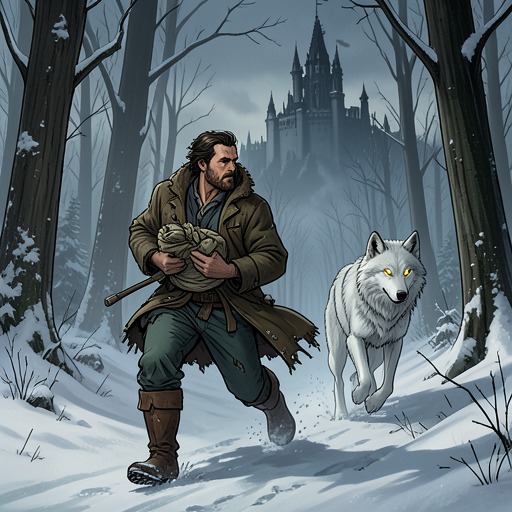
This legal permanence also determines the value of a serf’s testimony and the likely treatment of his actions. When Krantz’s father discovers his wife with the nobleman who has seduced her, he understands that his position will prevent the provocation from being accepted as a justification for killing them. The issue is not simply that he has committed a double murder; it is that, as a serf, he expects the authorities to deny him the mitigating protection that might be available to someone of higher rank. His response is immediate flight rather than appeal: he gathers money, places his children in a sleigh, leaves by night in the depth of winter, and continues until the family is hidden in the Hartz Mountains.
Serfdom and Aristocratic Power
The episode exposes serfdom as a relationship of personal vulnerability, not an abstract classification. The nobleman’s desire for Krantz’s mother is backed by the authority attached to ownership of the land and the family’s dependence upon it. The father’s marriage, household, and bodily security are all exposed to the lord’s will, while the father’s own violence is treated as an offense for which his status offers no credible defense. The same social order that permits aristocratic intrusion into a serf household threatens to punish the serf who resists it.
The book reinforces this pattern through the later treatment of Francoise Thilouze and her father. Victor de Vardes’s family regards Francoise as socially unfit because she is the daughter of a poor physician, while the proposed alliance with Clemence de Montmorenci is valued as a union of estates and lineage. Their effort to destroy the lower-status family relies on the period’s combined pride of blood, contempt for the rights of ordinary people, ignorance, and superstition. The resulting accusation is not formally a case about serfdom, but it reveals the same hierarchy: people without rank can be watched, interpreted, and condemned by those whose social position gives their suspicions institutional force.
Stigma, Labor, and Social Space
The Wulfric family demonstrates how inherited status and inherited stigma can operate together. In the Weald of Kent, the family’s Norman origin and supposed descent from an accursed race of werewolves lead Anglo-Saxon neighbors to exclude them from work on surrounding estates. Their reputation converts ancestry into a practical disability. They are refused employment, blamed for fires, ruined crops, disease, premature births, and other misfortunes, and treated almost as outlaws beyond ordinary human society.
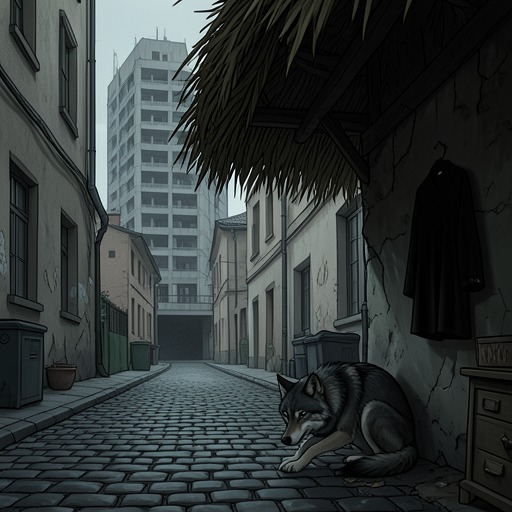
Their exclusion is spatial as well as economic. The family avoids the highways, refuses to enter Ashford by daylight, does not appear at Canterbury market, and is absent from pilgrimages, communal sports, hay-cutting, and harvest celebrations. The priest bars them from communion, while the ale-drinkers exclude them from the hostelry. Their hut, built of chalk and clay and covered with torn thatch, stands at a distance from other dwellings; at twilight, marsh vapors and will-o’-the-wisps intensify the neighbors’ fear of approaching it. The forest and the isolated dwelling thus become both refuge and prison, places where an unwanted family can survive only by remaining unseen.
Hugues Wulfric’s experience makes the material cost unmistakable. After his parents and two younger sisters die, winter interrupts work in the woods and fields. He seeks employment at neighboring farms, offering to thresh grain, cut wood, or drive the plough, but no one will hire him because of the fatality supposedly attached to the Wulfric name. His refusals are accompanied by taunts and threats; dogs are set upon him, and even the alms given to professional beggars are denied him. The result is hunger so severe that suicide becomes imaginable. His continued attachment to life is sustained only by love, while the community’s fear has transformed a potentially employable laborer into a person denied both work and charity.
Flight and the Reproduction of Status
Krantz’s family history shows flight as the characteristic answer available to people trapped beneath a superior’s authority. His father leaves Transylvania with his children and disappears into the Hartz Mountains, where he buys a cottage and cultivates a small plot. The new home offers relative material comfort, but it cannot erase the past. The family’s origin remains bound to violence, secrecy, and the threat of pursuit. Later, after supernatural judgment condemns the father to continued life rather than death, he takes Krantz to Holland; there he dies raving from brain fever, and Krantz is placed in an asylum before being sent to sea.
The family’s movement across Transylvania, the Hartz Mountains, Holland, and Amsterdam does not amount to liberation in any secure sense. It changes the immediate authorities around them but leaves the inherited question intact. Krantz remains convinced that he may have to pay the penalty of his father’s oath, just as the Wulfrics are believed to transmit a lycanthropic stain from father to son. The narrative places legal inheritance and supernatural inheritance beside each other, allowing the curse to resemble a grotesque extension of social doctrine: both insist that the child can be made answerable for an identity and an offense originating before his own choice.
The meeting between Krantz’s father and Wilfred of Barnsdorf briefly interrupts this isolation. A hunter from the same region recognizes Krantz’s name, identifies himself as his second cousin, and embraces him as a fellow sufferer. Their kinship offers solidarity where institutions offer danger, but it does not undo the underlying status system. Even in refuge, the characters are defined by what they have escaped and by the authorities that could still reclaim them.
Institutional Exclusion and Narrative Significance
Serfdom helps explain why the book repeatedly joins social exclusion to accusations of monstrosity. A person excluded from work, church, market, or legal credibility is already being treated as less than fully protected; the label of werewolf or witch then gives that exclusion a moral and supernatural justification. In the Wulfric story, neighbors convert accidents into evidence and the priest converts communal suspicion into religious separation. In the case of Michael Thilouze and Francoise Thilouze, powerful enemies use a wolf’s foot and Francoise’s missing left hand as supposedly incontrovertible proof, and a judicial process heavily weighted against the accused condemns them to die at the stake.
The same logic reaches its most explicit form in Krantz’s family history. His father’s position as a serf makes resistance to aristocratic abuse legally perilous; later, the supernatural sentence imposed upon him preserves the idea that an inherited oath can govern descendants who did not make it. The narrative does not present serfdom as a temporary hardship that individual talent can overcome. It presents a social order in which rank controls access to work, justice, movement, and recognition, while popular superstition supplies the language through which the powerless are made frightening. Serfdom is therefore both a legal condition and a model for the book’s wider concern with inherited stigma: the status is imposed from above, repeated by the community, and carried forward until escape becomes possible only through exile, concealment, or death.