Sire of Keridreux
The Best Werewolf Short Stories 1800-1849Sire of Keridreux is the knightly lord at the center of the river ordeal and nocturnal haunting in “The Wehr-Wolf: A Legend of the Limousin.” His rank gives him authority over Hugues Wulfric and the confidence to treat a frightened dependent as a spectacle, yet his own conduct soon exposes the insecurity beneath that authority. He is simultaneously a powerful master, a resentful husband, a guilty lover, and a man vulnerable to the very superstition he helps reproduce. His transformation is psychological and theatrical rather than securely literal: after being mocked as a loup-garou, he enters a night of apparent metamorphosis, returns naked and exhausted, and becomes the object of the same fearful interpretation that has long governed other lives.
Identity and Social Position
Sire of Keridreux is introduced as a knight in the prime of life, marked by golden spurs and the privileges of the house of Keridreux. Hugues Wulfric serves him as a subordinate, and the knight assumes that his command should be obeyed without question. At the river, he treats Hugues’s reluctance to enter the black, muddy water as a failure of courage and faith rather than a reasonable refusal. He urges Hugues to jump for the honour of the house, insists that the feat is only a short plunge, and interprets resistance as disobedience.
The scene reveals the social mechanism behind Hugues’s misery. The Hugues Wulfrics are already branded by their neighbours as an accursed race of wer-wolves, excluded from employment and religious fellowship because a supposed lycanthropic stain is believed to pass from father to son. Hugues’s family withdraws from markets, pilgrimages, festivities, and ordinary village contact, while local people attribute fires, ruined barns, failed crops, diseased cattle, illness, and premature childbirth to them. The knight does not create this persecution, but his treatment of Hugues reproduces its central logic: a socially vulnerable man is made responsible for satisfying the fears, amusement, and honour of those above him.
The River Ordeal and Beatrix
The knight’s attempt to force Hugues into the river becomes the first decisive reversal in his story. When Hugues is carried beyond the knight’s reach by the current and dragged ashore amid the jeers of the bystanders, the Sire of Keridreux emerges from the water enraged and humiliated. He rejects assistance, clears a space with his sword, and advances on the victim with the apparent intention of killing him for compromising the dignity of his house.
His violence is stopped by Beatrix, who breaks through the spectators and asks for Hugues’s life as a boon. Her appearance produces an extraordinary change: the knight’s sword falls from his hand, his anger disappears, and he stands silent as though confronted by a spectre. The encounter discloses that Beatrix is not merely an appealing stranger but the object of a painful earlier attachment. He addresses her with extravagant chivalric language, imagining that a service worthy of her beauty would be more meaningful than the punishment of Hugues, while she answers with scorn and anger rather than submission.
The knight’s courtly posture cannot conceal the moral disorder of his desire. Beatrix is married to the Dame of Keridreux, and the Sire’s proposal asks her to abandon that marriage and flee with him to Italy. He declares that he is weary of his life, intends to abandon his inheritance, and will either beg or purchase a dispensation from the pope so that he can make her his wife in Rome. The proposed escape is therefore not a moment of pure romantic liberation; it is an attempt to convert guilt and frustration into a new arrangement still dependent on rank, ecclesiastical permission, and the power to claim another person.
Superstition and the Nocturnal Trial
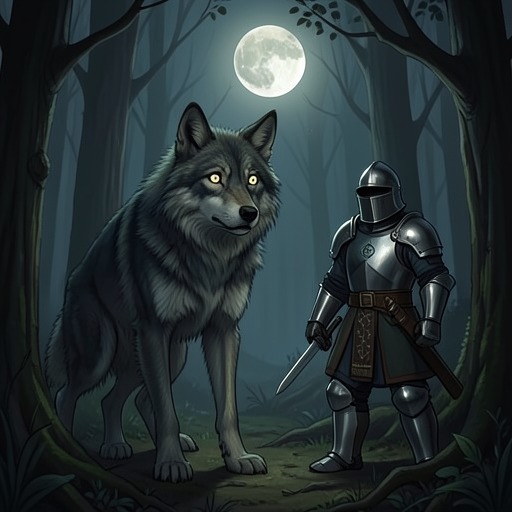
Beatrix refuses him through the language of religious danger. As evening falls, a wolf howls in the neighbouring forest, and she treats the sound as an omen sent by Our Lady. She even suggests that it resembles the knight’s own voice. Her warning makes the supernatural threat feel less like an external monster than a reflection of the knight’s hidden conduct and fear. He answers by confessing that he dreamed the previous night that he had been transformed into a loup-garou and by recalling that Hugues had supposedly seen the Leader of Wolves emerge from the same pool into which he had been pushed.
The confession unsettles Beatrix, who urges him to repent and asks Heaven to prevent his becoming a loup-garou. The knight leaves after emptying the wine jar, still caught between bravado, drunkenness, desire, and dread. As he hurries through the dark, ordinary sensations become signs of animal transformation: his footsteps sound like the gallop of a four-footed creature, and friction against his sleeve briefly convinces him that he wears fur. The rattling of his sword and jingling of his spurs reassure him that he remains human, but that reassurance is already unstable because it depends on external objects and sounds rather than inner certainty.
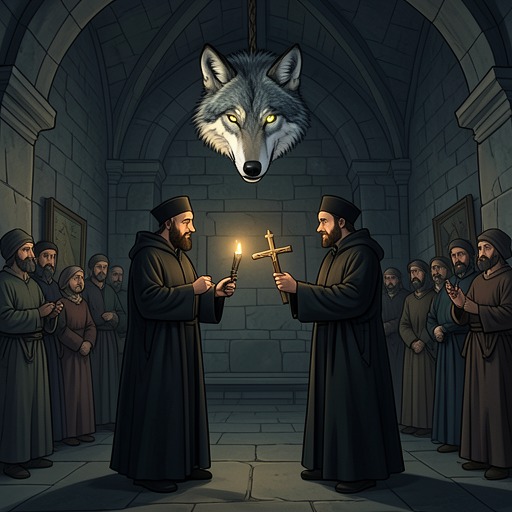
His flight leads him into a gathering of at least a dozen men dressed entirely in white. They greet him by name and by the scandals attached to him, hailing him as the husband of the woman who understands Latin, the guilty lover of Beatrix, and the man who ducked into the fisherman’s well. Their mockery converts private shame into public ritual. Each man spins on one foot, the group then whirls together, and the white garments float like vapour before they proclaim him a loup-garou and raise a din of baying and howling.
The knight first listens in terror, then joins the howling as though competing with the others. He throws away his headgear, spreads back his beard, and tears off his clothing piece by piece until he is naked. The scene makes metamorphosis a performed act: the men name the identity, the knight imitates the animal voice, and the removal of clothing supplies the visual proof of his supposed transformation. Joined hands form a ring around a standing stone, while the spinning trees, rocks, hills, and world overwhelm his senses. The White Men vanish only after he collapses gasping on the ground.
Return, Misrecognition, and Exposure
At daylight, the Sire of Keridreux wakes on the same spot, stark naked, stiff, bruised, and exhausted. The sunrise horn sounds from a nearby watch-tower, and the discovery that he is close to his own castle gives him a measure of relief. He gathers the scattered garments, dresses as best he can, and returns home. The setting is therefore not a distant enchanted realm but the corner of a wood protecting his own fortress: the strange ordeal has taken place within the geography of his authority, turning his estate into the stage of his humiliation.
His return unsettles the Dame of Keridreux. She has prepared to confront him with the anger of a neglected and suspicious wife, but his haggard, frightened appearance does not resemble the signs of ordinary debauchery that she usually holds against him. She allows him to undress and go to bed without accusation. When she later attempts a more intimate approach, he recoils from her embrace and takes refuge at the far end of the unusually large bed. His fear has displaced the domestic struggle without resolving it; the marriage remains a structure of suspicion, while his encounter with Beatrix has made its tensions visible in a new form.
The knight’s disappearance is soon interpreted as supernatural. Reports reach the convent that, for his sins, he has been converted into a loup-garou, and the search organized by his wife finds neither the man nor his clothes. The missing garments matter as much as the missing body because the story’s clothing-based logic makes dress a potential proof of human identity. A rumour thus transforms an unexplained absence into a werewolf case, just as village accidents had earlier been transformed into evidence against the Hugues Wulfrics.
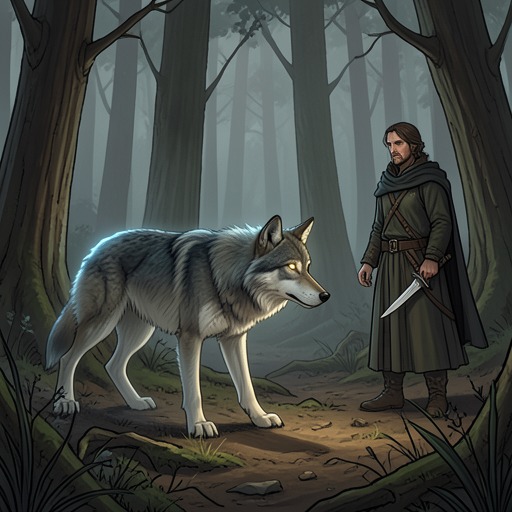
The later discovery exposes the machinery of misinterpretation. Hugues, carrying the mysterious bundle of clothing, encounters what appears to be a white phantom emerging from beneath the ground. He flees, leaves the bundle on the upright stone, and faints. When he awakens to the howling of wolves, he sees his master naked. The supposed phantom takes the bundle, dresses quietly, and kicks Hugues, accusing him of joining the cabal. Hugues explains that he had believed the knight to be a loup-garou and had brought the clothes because some treason had stripped him. The episode restores the Sire’s bodily identity but does not erase the terror: both master and servant have mistaken an ordinary man for a supernatural apparition, and the knight has been forced to occupy the same fearful category once imposed upon Hugues’s family.
Narrative and Thematic Significance
Sire of Keridreux embodies the movement from social power to exposed vulnerability. He begins by wielding a sword against a subordinate who has failed to entertain him, yet his own authority collapses when Beatrix interrupts him, when religious guilt enters his speech, and when a crowd’s words make him hear himself as an animal. The story does not simply punish him through a confirmed supernatural curse. Instead, it places him inside a chain of labels, rumours, performances, and misread signs, showing how easily “werewolf” can function as a social verdict before it becomes a physical transformation.
His ordeal also turns the werewolf tradition into a satire of aristocratic and domestic pretence. Chivalric honour coexists with coercion; marital authority coexists with adultery; religious language coexists with sexual bargaining and drunken escape. The knight invokes honour when forcing Hugues into danger, but Beatrix invokes the same code to save him. He speaks of abandoning inheritance for love, yet his first instinct after the nocturnal spectacle is to return to his castle and resume the life from which he had claimed to flee. His imagined heroic journey therefore ends not in renewal but in exhaustion, concealment, and a return to the compromised household.
The character’s apparent metamorphosis belongs to the story’s broader history of werewolf representation. The tradition described elsewhere in the book grows from superstition and folklore into literature, while older accounts imagine sorcerers assuming wolf shape through enchanted means and early poems depict clothing becoming fur, limbs becoming legs, and human speech failing. The Sire’s episode echoes those inherited motifs—wolf voice, fur, nakedness, clothing, nocturnal gathering, and the inability to distinguish animal from man—yet converts them into an ambiguous comic-horrific performance. His decisive significance lies in that ambiguity: whether he was enchanted, deceived, intoxicated, or merely terrified, he has experienced the social and psychological force of becoming a monster in the eyes of others.