Social ostracism
The Best Werewolf Short Stories 1800-1849Social ostracism is not merely an attitude toward the suspected supernatural in the book; it is a social mechanism that converts rumor into deprivation and eventually into mortal danger. The condition is most fully embodied by the Hugues Wulfrics, whose alleged descent from werewolves excludes them from work, worship, ordinary contact, and protection. Elsewhere, the same logic appears when Michael Thilouze and Francoise Thilouze are seized and condemned on the strength of a hostile community’s interpretation of ambiguous evidence.## Origins of the Stigma The Hugues Wulfrics live in a remote and miserable habitation in the Weald of Kent, between Ashford and Canterbury, under the protection of old forest laws and ostensibly earning their living as wood-cutters. Their Norman extraction already marks them as distinct among the Saxon inhabitants, and the suspicion directed against them is presented as both ethnic hostility and inherited supernatural stigma. Neighbours believe that a lycanthropic taint has passed from father to son through several generations, so the family is treated as an accursed race rather than as a group of individuals whose conduct can be judged separately.
This reputation absorbs almost every misfortune in the surrounding countryside. Fires, collapsing barns, ruined crops, diseased cattle, sick children, and premature births are attributed to the Wulfrics, even when chance, weather, or ordinary illness offers an explanation. Stories of witchcraft, theft, murder, and sacrilege circulate in homes, during work in the fields, and among groups gathered outside the church at Ashford. The family’s supposed guilt therefore becomes communal folklore through repetition: the accusation is constantly retold until it appears to confirm itself.
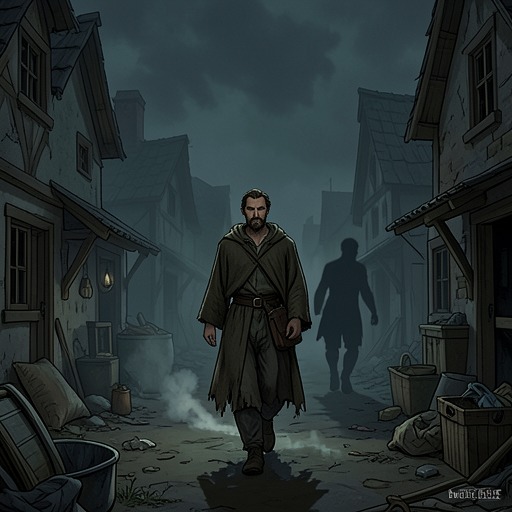
The local landscape reinforces the stigma. Ashford churchyard and the carved cross at the junction of roads toward London, Canterbury, and Ashford are said to be places where the Wulfrics prowl by moonlight, feeding on the newly buried or attacking the living. Actual incidents are reinterpreted to fit the legend: wolves entering the cemetery during severe winters and disinterring corpses, or a drunken beggar fatally striking his skull against the cross, are treated as proof of supernatural intervention. Social ostracism thus depends not on reliable evidence but on a communal habit of arranging unrelated events into a single hostile story.## Everyday Consequences The Wulfrics do not simply endure unkindness; they are removed from the ordinary institutions through which rural life is sustained. They avoid the highways, refuse to pass openly through Ashford, and seek work indoors or in neglected places. They do not attend Canterbury market, join pilgrims at the shrine of Thomas Becket, participate in games or harvest customs, or share in communal festivities. The priest excludes them from church communion, while the drinkers at the local inn exclude them from the social world of the hostelry.
Their isolation is partly imposed and partly strategic. They understand that their neighbours find them repulsive, and, aware that they cannot effectively disprove the accusations, they withdraw from contact. The ruined hut itself becomes an image of this social condition: built from chalk and clay, covered with torn straw, and open to the wind through gaps in its rotten door, it stands far from other dwellings. At twilight, even a serf who strays near it retreats when marsh vapours gather around the house. The physical distance between the family and the community is therefore sustained by fear, poverty, and deliberate avoidance on both sides.
The stigma becomes most brutal when Hugues Wulfric seeks employment after the death of his family. Winter has halted work in the woods and fields, but farms refuse to hire him because they fear the fatality supposedly attached to the Wulfric name. He receives brutal denials, taunts, and threats; dogs are set upon him, and even the customary alms given to professional beggars are withheld. Ostracism here functions as economic punishment. It denies him the means to survive while treating his resulting hunger as though it were evidence of an inherently dangerous nature.## Grief, Identity, and Self-Alienation The family’s exclusion intensifies after death enters the household. Hugues’s father dies first, followed almost immediately by his mother; Hugues buries them himself, wrapping their bodies in strips of hemp and covering them with earth. A passer-by who witnesses the burial crosses himself and flees, reading a private act of mourning as something sinister. Hugues then loses his two younger sisters within a fortnight. He spends three nights kneeling beside the rough graves, has eaten nothing for three days, and considers lying down among the dead himself.
The social world offers no counterweight to this grief. No confessor brings consolation, no physician brings medicine, and no neighbour supplies dependable help. Hugues’s despair is therefore produced by the combination of bereavement and exclusion rather than by bereavement alone. The community has made his family socially dead before it becomes physically dead, and after each death Hugues inherits not only loneliness but the accumulated accusation attached to the name.
The pressure also begins to reshape his relation to humanity. The narrative presents him as driven, against his better nature, toward a general hatred of the human species and even a savage pleasure in opposing it. Yet this is not treated as an original proof of the allegations against him. It is the psychological consequence of repeated rejection, hunger, threat, and helplessness. He is almost separated from the human community in fact before he is imagined as a wolf in legend. His continued attachment to life survives because he loves Branda, whose affection offers the first alternative to the identity imposed upon him.## Appearance, Prejudice, and Limited Recognition Hugues’s physical description exposes the distance between reputation and observable character. Without the injuries and privations he has suffered, he would have been the finest youth in the district. Hunger and persecution have drained the colour from his face, sunk his eyes, and fixed his brows in a habitual contraction; nevertheless, his head possesses a striking, almost savage beauty, his body remains robust, his bearing firm and majestic, and his naturally soft voice accords with the purity of his Norman French.
These details make prejudice visible as a social judgment rather than a neutral response to appearance. The same face that neighbours interpret as threatening can be read by an observer free from the local legend as noble and beautiful. The narrator even suggests that jealousy or prejudice may have helped generate the persecution in the first place. Hugues is not socially rejected because his nature has been established; rather, the community’s interpretation precedes and organizes what it claims to see.
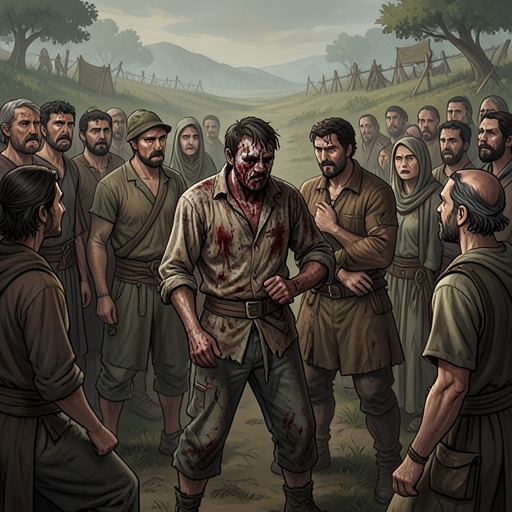
Branda is one of the few people who interrupts that process. After seeing Hugues while riding through a coppice, she remains unconvinced by the malicious stories told by older women. She sometimes turns aside from her route to meet him and exchange a cordial greeting, while Hugues, recognizing her attention, gathers the courage to look at her more closely. Their attraction demonstrates how quickly social identity can change in an intimate encounter: to Branda he can become a wronged and good-looking young man, while to the wider community he remains a hereditary werewolf.## From Community Exclusion to Judicial Violence The same structure of ostracism appears in the case of Michael Thilouze and his daughter Francoise Thilouze, although it culminates more directly in state punishment. After Pierre Bloui discovers a wolf’s foot and connects it with Francoise’s lost left hand, the commissaire du quartier arrives at Cabanis with a mob from Loques and carries away both physician and daughter on a charge of witchcraft. Their enemies’ influence accelerates a judicial process that the narrative calls a trial only by courtesy.
The prosecution treats circumstantial resemblance as incontrovertible proof. Francoise’s missing hand is interpreted through the wolf’s foot, and the possibility that the evidence has another explanation is displaced by the community’s prior belief. Michael Thilouze and Francoise Thilouze are terrified, unaided, and unable to counter the power arrayed against them. They are found guilty and condemned to die at the stake, showing how social exclusion can pass from gossip into official procedure without losing its original irrational basis.
This episode clarifies the political danger of the condition. The excluded person is denied the presumption of belonging and then judged through the very signs produced or selected by exclusion. The crowd, the local authority, hostile influence, and the court do not represent separate stages of impartial inquiry; together they turn stigma into a machinery of punishment. The Wulfrics suffer the same logic in a less formal but equally material way when neighbours deny Hugues work and unleash dogs against him.## Wider Historical and Literary Pattern The book places these episodes within a broader history of the werewolf legend. Werewolf beliefs grow from superstition into folklore, legend, and literature, and the inherited label is repeatedly associated with sorcery, the Devil, foreignness, and the fear of human beings who cross the boundary between man and beast. Early accounts describe sorcerers who anoint themselves and put on an enchanted girdle, after which they appear to others, and to themselves, to possess the shape and nature of wolves while attacking human beings.
Literary representations preserve and transform this mechanism of othering. The description of clothes becoming wolf hair, arms becoming legs, and speech becoming impossible is identified as an early development in recorded poetry; later works, including the medieval poem about William and the Werwolf and Marie’s “Lai du Bisclavaret,” continue the tradition. In the French setting of “Marie’s “Lai du Bisclavaret,” people called Wehr-Wolves or Bisclavarets are imagined as men in compact with the Arch Enemy who assume wolf form at certain times. The language changes across Greek, English, Italian, German, and French traditions, but the social pattern remains recognizable: a community names a dangerous boundary figure and then treats the name as evidence.
The nineteenth century moves the werewolf from poetry into the short story, a transition that makes social response as important as supernatural transformation. Stories of werewolves increasingly explore not only what the creature is but how communities identify, fear, exclude, and punish those believed to be monstrous. Social ostracism is therefore one of the book’s governing themes: it shows that the wolf may be a supernatural figure, but the suffering surrounding the figure is produced by ordinary institutions—workplaces, churches, neighbours, mobs, and courts.