Spirits of the Hartz Mountains
The Best Werewolf Short Stories 1800-1849Spirits of the Hartz Mountains are the unseen powers invoked to explain the most terrifying events in the Hartz wilderness. Their decisive function is to convert superstition into a binding mechanism: a white wolf lures Krantz’s father into a forbidden mountain clearing, a supernatural marriage oath condemns his family, and the spirit Wilfred later enforces that oath by declaring that murder has incurred a penalty that cannot be escaped through death.
Nature and Reputation
The spirits belong to a broader tradition in which werewolves and wolf-like creatures grow from popular superstition into folklore and literary legend. Earlier accounts describe werewolves as sorcerers who assume the shape and nature of wolves through diabolical ointments and an enchanted girdle; other traditions associate wolves with human flesh, demonic appetite, and the desecration of graves. In this imaginative background, the Hartz spirits are not simply animals and not merely ordinary ghosts. They represent an invisible agency through which the wilderness becomes morally charged and human fear acquires a supernatural vocabulary.
Krantz tells Philip that the Hartz Mountains are a wild region filled with strange tales, but insists that his belief is based on personal evidence. He connects these spirits with malevolent beings that are permitted to interfere with, punish, and afflict comparatively unoffending mortals. Philip answers that human beings remain free agents whether they struggle against their own passions or against unseen enemies, and argues that good powers must also exist if evil spirits are allowed to act. The exchange gives the spirits a theological setting: their existence is treated not as an isolated marvel but as part of a contested account of justice, temptation, and human responsibility.
The Mountain and the White Wolf
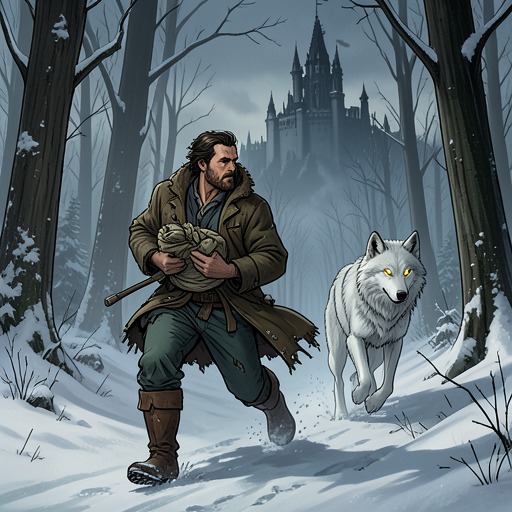
The spirits are said to inhabit particular places in the mountains, especially an open space in the pine forest that hunters know and avoid. Krantz’s father, however, either disbelieves the warnings or ignores them in the eagerness of the chase. A large white wolf appears about thirty yards away, retreats slowly while growling, and repeatedly manipulates the distance between hunter and prey. It allows itself to be followed, then pauses as though challenging pursuit, and finally draws the hunter upward for several hours.
At the clearing the wolf slackens its pace and permits Krantz’s father to approach closely enough to raise his gun. It then disappears without crossing the open ground, leaving him unable to explain how it escaped his sight. The pursuit therefore functions as a lure rather than a hunt. The natural signs of an unusual animal remain precise—the wolf is rare, white, wary, and capable of evading a shot—but its conduct moves beyond ordinary animal behavior. The mountain becomes an active trap, and the boundary between predator, apparition, and spirit is deliberately crossed without warning.
The white wolf’s identity is disclosed only after the family believes that Krantz’s sister has been buried. When the grave is opened, the expected body of the mother-in-law is not present; lying over the remains of the dead girl is a large white she-wolf. Krantz’s father immediately recognizes it as the animal that decoyed him into the forest and concludes that he has dealt with the spirits of the Hartz Mountains. The delayed recognition gives the spirits their characteristic power: they conceal the meaning of the earlier encounter until the human consequences are already irreversible.
The Marriage Oath
The spirits’ power is formalized through Wilfred, the hunter who brings Christina into the cottage and directs Krantz’s father to take her hand. Wilfred rejects an oath sworn by Heaven and demands an oath sworn by the spirits instead. Krantz’s father pledges to take Christina as his wife, protect, cherish, and love her, and never raise his hand against her. The vow is then extended beyond the couple: if he fails, vengeance is to fall upon him and his children, who may perish by the vulture, the wolf, or other beasts of the forest.
The wording makes the oath both matrimonial and juridical. It creates a supernatural household in which a private promise carries consequences for descendants, while the threat of animal violence turns the forest’s creatures into possible agents of judgment. Marcella’s tears as the final words are repeated expose the emotional cost of the ceremony before its meaning is understood. The next morning Wilfred rides away, leaving the family bound to a power whose terms have been accepted without comprehension.
The oath also links the spirits to the recurring werewolf tradition of violated human boundaries. Christina is later identified through the white she-wolf, while Wilfred mockingly refers to the marriage as wedlock to a werewolf. The story does not present transformation as a detached marvel; it makes metamorphosis the visible form of a concealed marital and legal arrangement. The wolf’s body is evidence that the family has entered a pact whose reality was hidden inside an apparently ordinary marriage ceremony.
Enforcement and Punishment
After discovering the she-wolf over Marcella’s remains, Krantz’s father attempts to reject the bargain. He replaces his daughter’s body in the grave, returns to the cottage, and raves in shock. Wilfred then arrives demanding his daughter. When Krantz’s father answers with rage and wishes Christina in hell, Wilfred identifies himself as a potent spirit of the Hartz Mountains and reminds him that the oath forbade him to raise his hand against her.
The father denies having made any compact with evil spirits, but Wilfred insists that the vow was precisely such a compact. He recites its threatened consequences and declares that the children are already subject to them. When Krantz’s father attacks with an axe, the weapon passes through the hunter’s form. The failed blow establishes that Wilfred cannot be treated as an ordinary human opponent and that physical resistance cannot annul the promise.
Wilfred’s judgment is harsher than a simple death sentence. He declares that the spirits have power over those who have committed murder, accuses Krantz’s father of double murder, and announces that two children are gone while the third is still to follow. Yet the punishment is not immediate execution: Wilfred says that it would be kindness to kill him and instead decrees that his punishment is to live. This reversal makes continued existence itself the sentence, forcing the guilty father to carry the knowledge of the oath and the deaths attached to it.
Legacy in the Family History
The surviving child leaves the cottage with her father for Holland. They reach Amsterdam, but he soon dies raving mad after suffering a brain fever, while she is placed in an asylum and later sent to sea before the mast. Her account ends with uncertainty about whether she must personally pay the penalty of her father’s oath, although she is convinced that the curse will reach her in some form. The spirits thus extend their authority across geography and generations: flight from the Hartz Mountains provides no clear escape from the vow.
The later death of Krantz gives the spirits’ threat its final and most concrete confirmation. While Philip and Krantz are in the jungle, an enormous tiger suddenly rushes through the air, knocks Philip down, and carries off Krantz’s naked body with the speed of an arrow. Philip finds only Krantz’s clothes and gold remaining on the sand. The attack fulfills the earlier prophecy that the family would perish through beasts of the forest, while also preserving the story’s animal imagery: wolves, vultures, and the tiger become successive forms through which supernatural punishment is made visible.
The spirits therefore occupy two levels at once. They are part of the inherited superstition surrounding wolves, werewolves, remote mountains, and forbidden clearings; yet within Krantz’s testimony they act as organized powers that lure, transform, pronounce judgment, and preserve the force of a vow after its makers have vanished. Their narrative significance lies in that movement from rumor to apparent fact. What begins as a warning about dangerous places ends as a system of punishment whose agents remain beyond ordinary human law, leaving the family to experience the wilderness not as empty space but as a realm that remembers and enforces human wrongdoing.