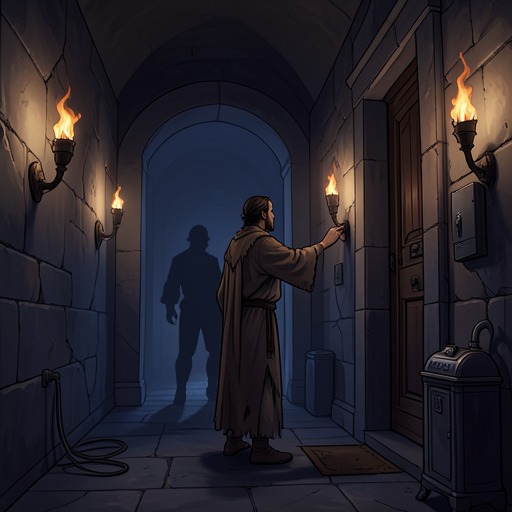
The werewolf attack on Count de Saintefleur
The Best Werewolf Short Stories 1800-1849The werewolf attack on Count de Saintefleur is the decisive act of supernatural vengeance in the Limousin narrative. It converts a long political and personal feud into a sudden public revelation: the apparently helpless stranger beside Adele de Marcanville identifies himself as her father’s ancient enemy, and a wounded Wolf then kills him before the royal party arrives. The attack therefore functions both as an execution and as the final disclosure that the feared Wehr-Wolf is Gaspar de Marcanville.
Causes and Background
The attack grows out of the long conflict between Gaspar de Marcanville and Count de Saintefleur. Gaspar had been driven into exile and had spent years in the dark recesses of the Harz Mountains with his wife Rosalie de Marcanville and their daughter Adele. He survived through hunting, acquiring the skill to bring down wild buck and resist bears because his family depended on him. After Rosalie died, about ten years into the exile, Gaspar resolved to return to France and challenge De Saintefleur through the Ordeal of Combat, carrying a written account of De Saintefleur’s treachery and a certificate from his confessor, Father Ægidius, to support his claim.
The werewolf tradition surrounding the episode supplies the attack with its larger cultural meaning. The book presents Wehr-Wolves, Bisclavarets, and Loups Garoux as men believed to possess the power to assume the form and nature of wolves at appointed times. Earlier accounts connect the figure with sorcery, demonic influence, and the wolf’s supposed preference for human flesh. In the Limousin setting, these beliefs turn wolves into instruments of communal fear, so the final attack can be read simultaneously as an animal assault, a supernatural punishment, and the return of a persecuted human identity.
What Happens
The immediate scene begins after the stranger has been left with Adele and has fainted from loss of blood. Adele bends over him and staunches his wounds with her scarf. When he asks who she thinks she is attending, she answers only that he is a man. He then orders her to set aside the bandages and take his dagger, declaring, "Hear me then, and throw aside these bandages for my dagger, for I am thy father’s ancient enemy, the Count de Saintefleur!" The disclosure transforms Adele’s act of mercy into a confrontation with the man responsible for her father’s ruin.
Adele responds by placing vengeance beyond human possession, saying, "Heaven forgive you, then!" and adding that the time of vengeance belongs only to Heaven. Her reply refuses to become an immediate act of personal retaliation, but it also prepares the scene for a judgment that arrives from outside ordinary human agency. The Count’s confession and Adele’s moral refusal create the conditions for the attack’s abrupt supernatural logic.
The answer comes in the Count’s own words: "And it is come," cried a loud hoarse voice. A large Wolf, wounded by the loss of a fore-paw, leaps upon De Saintefleur and ends his existence. The injury identifies the creature as the same Wolf involved in the surrounding pursuit, while the suddenness of its arrival makes the attack resemble the fulfillment of a sentence already pronounced. The Count is not killed in a duel or by Adele’s dagger; he is overtaken by the animal form of the enemy he has persecuted.
Recognition and Misrecognition
The attack is structured around two successive recognitions. First, De Saintefleur recognizes himself as the object of Adele’s care and reveals his identity to her. Second, the royal party witnesses the Wolf but does not initially understand that it is Gaspar. The scene thus reverses the usual movement from disguise to recognition. The Count’s human identity becomes clear before the Wolf’s human identity does, and the interval between those discoveries is filled by violence.
When the royal train arrives with flambeaux, a Knight carrying a large partizan strikes at the Wolf. Adele attempts to preserve the animal, but the blow is powerful enough to destroy both the Wolf and its hidden human form. The Wolf gives a terrific howl and falls backward as a tall, gaunt man in a hunter’s dress. The physical transformation makes the supposed monster legible only at the instant of its death; the body itself supplies the evidence that the attack was also Gaspar’s final act.
Consequences and Aftermath
The attack kills Count de Saintefleur and Gaspar de Marcanville at the same moment. The Count’s death resolves the central hostility between the two men, but Gaspar does not survive to reclaim his rank, estates, or reputation through ordinary legal vindication. His revenge is therefore complete and incomplete at once: the enemy is dead, yet the avenger is destroyed by the royal response before his return can become a restoration.
Adele’s reaction makes the personal cost unmistakable. After the Wolf’s human form is exposed, she draws a packet from her bosom and offers it to the King, then sinks lifeless upon the body of her father, Gaspar de Marcanville, the Wehr-Wolf of Limousin. The packet carries the documentary proof Gaspar had preserved during exile, while Adele’s collapse joins the recovered evidence to an irreparable bereavement. The papers may establish the truth, but they cannot restore the dead.
The scene also exposes the danger of interpreting bodies through superstition. In the book’s broader werewolf lore, genuine wolves, alleged sorcerers, and transformed humans are repeatedly confused by frightened communities. Wolves that enter cemeteries during severe winters and disinter the dead are taken as proof of the Wulfrics’ fiendish activity; rumors similarly turn Francoise Thilouze into a supposed wolf when huntsmen claim to have seen her change shape. The attack on De Saintefleur intensifies this pattern: the Wolf is real, but its meaning is concealed until the moment violence reveals the man within it.
Narrative Significance
As an event, the attack combines pursuit, metamorphosis, recognition, and revenge in a single Gothic climax. Its dramatic force comes from the collision between several explanations of the same body. To the Count, the stranger is a wounded man whose identity is disclosed in speech; to the royal party, the immediate threat is a dangerous Wolf; to Adele, the creature becomes her father only after the fatal blow. The sequence makes recognition temporally unstable, so that knowledge arrives not before violence but through its consequences.
The event also completes the book’s movement from folklore toward literary tragedy. The werewolf is not merely a demonized beast or a remote superstition: Gaspar’s hunter’s dress, exile, family history, and documentary testimony remain attached to the transformed body. Yet the human explanation does not cancel the supernatural one. The Wolf acts as the vehicle of vengeance, and the final revelation preserves the terror of transformation even as it exposes the social history behind the legend. The Count’s death is consequently both a punishment for treachery and the last terrible proof that the Wehr-Wolf of Limousin was a persecuted man.