The white wolf’s lure
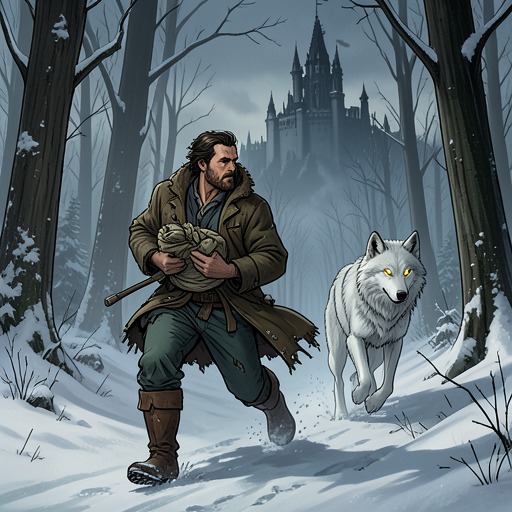
The Best Werewolf Short Stories 1800-1849The white wolf’s lure is the decisive movement by which Krantz’s father is drawn into the high forests of the Harz Mountains and toward an encounter with the malign forces associated with them. What begins as the pursuit of a rare animal becomes a trap: the wolf controls the distance between hunter and quarry, leads him upward for hours, and disappears only after bringing him to a forbidden clearing.
The Pursuit and Its Quarry
Krantz’s father first sees a large white wolf about thirty yards away. Rather than flee outright, the animal retreats slowly, growling and snarling, while keeping just beyond his reach. The hunter follows because he wants to shoot it, both because the white wolf is rare and because the creature seems to offer a possible target. The wolf repeatedly varies its pace: at times it leaves him far behind, then stops to snarl defiantly; when he approaches, it sets off again. This alternation of retreat, challenge, and renewed flight makes the chase less like ordinary pursuit than a controlled invitation.
The hunter refuses to fire until he believes his ball will strike, and the resulting hesitation helps the wolf maintain its advantage. The animal neither attacks nor allows itself to be caught. Its behavior keeps the hunter looking forward, measuring distance, and responding to the quarry’s movements rather than choosing his own route. The hunt therefore reverses the usual relation between human hunter and animal prey: the man appears to pursue, but the wolf determines where the pursuit will end.
The Ascent into the Harz Mountains
The chase lasts several hours and continually carries Krantz’s father higher into the mountain. The physical ascent is also a passage away from ordinary human safeguards. Huntsmen know that particular places in the Harz Mountains are believed to be inhabited by evil influences, and they habitually avoid them. One such place is an open space surrounded by pine forest above the hunter’s position. Its reputation supplies the warning that the pursuit ignores.
The narrative leaves the hunter’s motive at the point of decision uncertain. He may have rejected the stories as wild superstition, or the eagerness of the chase may have made him disregard them. In either case, his movement into the clearing is presented as the consequence of continuing after the white wolf. The danger is not encountered by accident alone; it is reached through the combination of curiosity, hunting desire, and a refusal or inability to heed local knowledge.
The Vanishing in the Clearing
When the wolf reaches the open space, it appears to slacken its speed. The change encourages Krantz’s father to close the remaining distance. He comes near enough to raise his gun and prepare to fire, but at that instant the wolf suddenly disappears. The snow may have dazzled his sight, he thinks, and he lowers the gun to search for the animal. Yet the clearing is open, and the wolf has vanished without any visible route of escape.
The disappearance is the encounter’s central rupture. Until this moment, the wolf’s conduct can be explained as cunning animal behavior, however unusual. Its vanishing defeats that explanation while withholding a complete account of what the creature is. The hunter is left with the physical fact of the clearing and the baffling absence of the quarry. The wolf has not merely escaped the shot; it has brought him to a place where ordinary expectations about distance, visibility, and movement no longer hold.
From Failed Hunt to Supernatural Snare
The hunter’s immediate response is mortification at the failure of his chase. He prepares to retrace his steps, which suggests that he still understands the episode as an unsuccessful hunt rather than as a completed attack. The lure has worked precisely because it does not announce itself as a lure. The wolf offers the promise of capture, delays the shot, and then removes itself at the point where the hunter expects the pursuit to end.
The scene also connects the white wolf with the broader lore of the werewolf and the wolf as a vessel for human fear. Wolves were widely imagined as creatures with a preference for human flesh once they had tasted it, while in Ashford actual wolves had entered a churchyard during severe winters and disinterred the dead. Such incidents were transformed by superstition into evidence of demonic or werewolf activity. The white wolf’s lure develops the same unstable boundary between animal fact and supernatural interpretation: it behaves like a hunted beast, yet its conduct fulfills the expectations of a malignant intelligence.
The wolf’s whiteness intensifies that ambiguity. It is identified as rare rather than simply monstrous, giving the pursuit a credible hunting motive, but its unusual appearance also marks it as exceptional. In the Harz setting, where dangerous clearings are already associated with evil influences, rarity becomes the bait by which the hunter is separated from ordinary judgment. The animal’s natural distinctiveness and its supernatural function remain superimposed rather than cleanly separated.
Narrative Function and Consequences
The episode follows the structure of a pursuit that is secretly an entrapment. The hunter crosses from a known world into a region governed by stories he does not fully respect; the apparent quarry becomes a guide, and the clearing becomes a threshold. The wolf’s disappearance is a reversal in which the pursued creature gains mastery without openly confronting the pursuer. Its power lies in displacement and uncertainty before it lies in violence.
After the wolf vanishes, a distant horn calls the hunter’s attention to another danger: a party is lost in the woods. He remains fixed in astonishment, hears the signal repeated, and then sees a mounted man with a woman seated behind him enter the clearing. Their approach temporarily restores the possibility that the world is inhabited by ordinary mortals rather than only supernatural beings. Yet that moment of reassurance follows directly upon the unexplained disappearance, so the clearing remains charged by what cannot be seen or explained.
The lure thus establishes the Harz Mountains as more than a wilderness setting. They are a landscape in which hunting knowledge, local superstition, and supernatural threat overlap. The wolf draws a man upward, away from safety and toward a site reputed to harbor evil, while the story’s delayed explanation preserves the terror of not knowing whether the hunter has encountered an animal, a shapeshifting being, or an emissary of the mountains’ hidden powers. Its most important consequence is therefore not a confirmed transformation, but the conversion of a rational pursuit into an experience that makes rational control appear fragile.