Transylvania
The Best Werewolf Short Stories 1800-1849Transylvania functions in Krantz’s history as both a geographical homeland and a social order built on inherited subordination. It is the place where his father, originally a serf of a wealthy Hungarian nobleman, could acquire wealth, intelligence, respectability, and the position of steward without acquiring freedom. Birth fixed his status: however prosperous or capable a serf became, he remained legally and socially a serf. The region therefore establishes the unequal conditions that make private violence and flight almost inevitable.
Social Order and Family Tragedy
Krantz’s father had been married for about five years and had three children: Cæsar, Hermann, and Marcella. Their mother was exceptionally beautiful, and a nobleman who owned the surrounding land noticed her. When Krantz’s father was sent away on a mission, the nobleman pursued her and won her consent. The episode is presented not as an affair between equals but as an abuse of power shaped by the authority attached to the noble house and the vulnerability of a serf’s family.
The father returned unexpectedly and found his wife with her seducer. The evidence of the relationship was, in his eyes, conclusive, and he murdered both of them. His social position made the consequences more severe than the personal provocation: he knew that, as a serf, the authorities would not accept even the wrong done to him as a justification. Transylvania thus appears as a jurisdiction in which the nobleman’s power survives the domestic crime that produced it, while the injured subordinate bears the full force of the law.
Escape from Transylvania
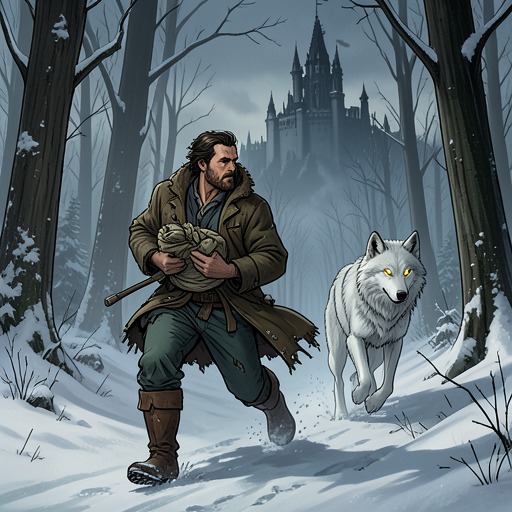
After the double murder, Krantz’s father gathered whatever money he could seize, harnessed his horses to a sleigh, and took his children away in the middle of winter. He understood that remaining anywhere in his native country would leave him exposed to arrest, because the authorities could reach him there. The escape was consequently not a deliberate change of residence but an uninterrupted flight undertaken before the tragedy became known.
The family traveled until the father had hidden them in the secluded intricacies of the Hartz Mountains. Krantz emphasizes that he learned this part of the family history only later; his own earliest memories begin after the flight, in a rude but comfortable cottage near the great northern German forests. The contrast gives Transylvania the character of a buried origin: it is absent from the child’s immediate landscape, yet the violence committed there determines the family’s isolation, poverty, and identity.
A Repeated Pattern of Flight
Transylvania’s significance expands when another fugitive arrives at the family cottage. One winter night, Krantz’s father encounters a mounted hunter carrying his daughter behind him. The pair have traveled far, fear for their lives, and seek shelter from both pursuers and the freezing night. When asked where they came from, the hunter answers that they have escaped from Transylvania, where his daughter’s honor and his own life were equally endangered.
The disclosure immediately awakens Krantz’s father’s sympathy. He remembers his own flight, the dishonor imposed upon his wife, and the murders that followed, so he offers the strangers whatever assistance his poor household can provide. Later, while the two men drink and speak beside the fire, the hunter explains that he too had been a serf whose master demanded the surrender of his fair daughter. His resistance ended when he drove a few inches of his hunting knife into the nobleman. The parallel between the two fathers makes Transylvania more than the setting of one crime: it is a recurring source of persecution from which men flee with their children.
Narrative and Thematic Significance
Because Transylvania is described through Krantz’s later telling, the location operates as remembered history rather than as a fully present landscape. Its details are social and moral before they are scenic: serfdom, the authority of a noble house, sexual compulsion, threatened honor, murder, pursuit, and exile. The region’s power lies in the chain of consequences it sets in motion. A man’s lack of legal protection produces desperate retaliation; retaliation produces flight; flight carries children into the Hartz Mountains; and the memory of that flight enables recognition when another Transylvanian refugee appears.
The repeated stories also create a grim fellowship among victims and perpetrators of an unjust hierarchy. Krantz’s father and the hunter respond differently in circumstance but share the same underlying predicament: both are made vulnerable by a nobleman’s power, and both must decide how much violence and risk will be accepted before escape becomes the only remaining form of agency. Transylvania therefore anchors the book’s broader concern with inherited oppression and displacement, while its remembered injustices continue to shape relationships long after the characters have physically left it.