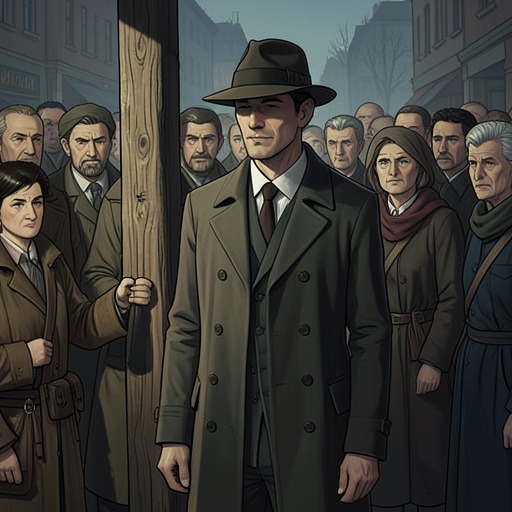
Victor de Vardes
The Best Werewolf Short Stories 1800-1849Victor de Vardes is a young nobleman whose passage from fashionable indifference to devoted action drives the love plot of the Cabanis episode. Initially prepared to obey a marriage arranged for family advantage, he is transformed by his first sight of Francoise Thilouze, a low-born physician’s daughter, and later turns his private passion into a public rescue when her family is condemned as practitioners of witchcraft.
Identity and Background
Victor is introduced as a gay, handsome cavalier of conspicuous rank. His fashionable dress, richly embroidered cloak, distinguished bearing, and reverential salute mark him as a man accustomed to courtly display and social privilege. He has recently returned from a tour of Europe during which he visited foreign courts, jousted in tournaments, and won the hearts of fair ladies before coming home to inhabit his father’s chateau.
His father has summoned him home with marriage in view, selecting Clemence de Montmorenci, one of the richest heiresses in France. Victor accepts the arrangement without aversion because his previous attachments have been passing boyish fancies rather than serious love. Clemence appears amiable, sensible, and gentle, but plain and poorly dressed; Victor feels neither attraction nor dislike toward her. The proposed alliance rests on mutual family interest and accommodation, and he prepares to fulfill it obediently rather than romantically.
From Courtly Habit to Love
Victor’s formal courtship of Clemence consists largely of daily rides to the Chateau de Montmorenci. His road passes through Loques, where Manon Thierry often places herself at the door in hopes of receiving his attention. After Victor casually salutes her, the repeated greeting becomes a silent flirtation: he smiles, she blushes, and Manon convinces herself that his frequent appearance is motivated by love for her, although Victor thinks little about her.
That emotional arrangement collapses when Victor sees Francoise at the doorway. Francoise is captivated by the brilliance of the rider, while Victor is startled out of his habitual gallantry by her face. He turns in the saddle to look back at her and raises his bonnet a second time, continuing slowly as though reluctant to lose sight of her. The encounter changes the value of everything around him: the intended marriage that had seemed merely acceptable remains socially possible, but the stranger at the village door becomes emotionally irresistible.
Victor returns in the hope of seeing Francoise again. Finding only Manon, he lingers, lets his eyes wander over the house and its windows, and rides away at a relaxed pace with a colder salutation than before. His behavior reveals both his new impatience and his reserve: he longs to ask Manon whether Francoise lives there, yet feels unable to begin a conversation that would expose the reason for his inquiry.
For two months, Victor and Francoise conduct a courtship without speaking. Their repeated glances and his deliberate attention gradually establish a mutual attachment, and by the time Francoise leaves Loques for Cabanis, each possesses the other’s heart. Victor’s passion has by then overcome his diffidence. He learns what he needs to know about her from the village blacksmith when the blacksmith’s horse loses a shoe, then uses the nearness of Cabanis to the Chateau de Montmorenci as an opportunity to visit Michael Thilouze under the pretext of seeking medical advice.
Francoise Thilouze and the Broken Match
Victor does not see Francoise at once, but persistence brings him an introduction. Her intellectual cultivation deepens the attraction first created by her beauty. He is genuinely interested in the occult researches associated with Michael’s alchemical work, so his visits to the physician’s house are not merely a lover’s strategy; curiosity about the family’s intellectual world gives him a socially plausible and personally sincere bond with them.
As the relationship develops, Victor transfers increasing portions of his time from the Chateau de Montmorenci to Cabanis. He and Francoise walk arm in arm through the green glades of the wide domain, and he declares that neither the rich inheritance attached to Clemence nor the expectations of their families will make him renounce his love. His vow is significant because it directly opposes the logic of the arranged alliance: wealth and rank can organize a marriage, but they cannot command his heart.
Victor’s choice also provokes Manon’s hostility. From the first salutation to Francoise, Manon becomes her implacable enemy, concealing the cause of her coldness while jealousy grows beneath their former friendship. Victor does not deliberately set out to injure Manon, but his changed attention exposes how much of her earlier confidence depended on believing herself the object of his admiration. His love therefore becomes not only a private attachment but the trigger for rivalry, slander, and the destruction of the social peace around Cabanis.
Separation, Rescue, and Royal Authority
Victor is absent when the consequences of the hostility become fatal. His father has sent him to Paris shortly before Michael and Francoise are seized, officially on a pretext but in reality to remove him from the neighborhood of Cabanis. The separation leaves Francoise and her father without their most powerful advocate at the moment when their enemies turn suspicion into judicial violence.
When the report of witchcraft reaches the authorities, Michael and Francoise are carried away and condemned to die at the stake. The alleged proof is grotesquely circumstantial: a wolf’s foot is produced in court, and it is combined with Francoise’s genuine loss of her left hand. Victor is not present to challenge the accusation, and his absence demonstrates how completely family influence and manipulated evidence have controlled the proceedings.
Manon Thierry eventually seeks a way to alert him. Pierre Bloui faithfully carries her message to Paris, where Victor responds as an ardent lover rather than as a passive nobleman. He persuades Henry IV to act, and the king hastily issues a mandate commanding that the execution be postponed pending further investigation. Victor then rides to the scene on a foam-covered horse, carrying the king’s order for arrest of execution. His arrival reverses the entire public spectacle: the crowd greets him with acclamations, while royal favor causes the supposed evidence against Michael and Francoise to be reinterpreted as proof of their innocence.
Marriage and Narrative Significance
Michael and Francoise escape under the king’s countenance and protection, and Victor and Francoise are married. The ending fulfills the central romantic movement from silent recognition to acknowledged union, but it does not erase the danger that made their happiness possible. Their marriage follows a threatened execution, a forced separation, and a legal reversal based on the same missing-foot evidence that had first been treated as incontrovertible guilt.
Victor’s role is consequently larger than that of a romantic hero. His love crosses the boundary between nobleman and alchemist’s daughter, but the story makes clear that private devotion alone cannot defeat persecution. He must obtain the intervention of the monarch, and the rescue succeeds because royal authority can undo a corrupt trial as quickly as it enabled the social order surrounding it to stand. The episode’s irony lies in the instability of public judgment: a wolf’s foot without the wolf condemns Michael and Francoise, while a wolf without the foot later helps establish their innocence.
Victor also provides the decisive contrast to Clemence de Montmorenci. Clemence would have married him without repugnance, yet his coldness never touched her heart deeply enough to produce lasting regret. Victor’s refusal to remain within an advantageous arrangement is therefore not presented as a mutual romantic catastrophe; it is the necessary consequence of discovering a love that he had never previously experienced. His transformation gives the plot its emotional engine, while his final intervention converts that emotion into action, protection, and marriage.