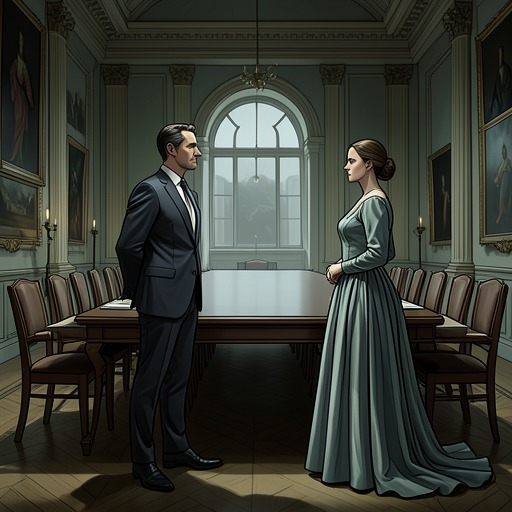
Victor de Vardes–Francoise Thilouze relationship
The Best Werewolf Short Stories 1800-1849The Victor de Vardes–Francoise Thilouze relationship is the central love story linking aristocratic desire with social rebellion in the narrative. What begins without a spoken word becomes a mutual attachment, then a public crisis in which Victor must oppose his family’s expectations and secure royal protection for Francoise and Michael Thilouze. The relationship’s decisive significance lies in the way private affection exposes the violence of rank, inheritance, and superstition: the lovers’ union is treated as intolerable because Francoise is low-born, and the same prejudice helps place her and her father in mortal danger.
First Sight and Silent Courtship
Victor first encounters Francoise at the entrance to the village while riding toward Loques. He is a gay and handsome cavalier dressed with the visible elegance of high rank, while Francoise, absorbed by the brilliance of his appearance, forgets her shyness and looks openly at him. When Victor raises his bonnet and bows to her, she lowers her eyes and blushes, then almost immediately leans out again to watch him pass. Victor also turns in the saddle, “riding with his eyes behind,” and lifts his bonnet once more when he sees her looking after him. The gestures establish the relationship before speech does: recognition is exchanged through repeated glances, bows, and involuntary movements rather than through formal introduction.
Victor’s response is presented as a sudden disturbance of his ordinary conduct. He had previously saluted Manon Thierry while passing her door, and Manon had interpreted this repeated courtesy as evidence that he was in love with her. Yet the sight of Francoise startles him out of that practiced gallantry. He cannot drive her features from his thoughts, laughs at himself for being captivated by a low-born beauty, and nevertheless feels an urgent desire to turn back and see her again. His return finds only Manon, and his anxious eyes, slower pace, and cold salutation reveal that his attention has shifted completely.
For two months the courtship remains silent. Francoise and Victor never speak, but their repeated encounters transform mutual curiosity into possession of one another’s hearts. When Francoise must leave Loques to return to Cabanis and meet her father, she experiences both the joy of reunion and the grief of believing that she has lost the chance to see her first love again. The separation therefore intensifies rather than ends the attachment: the relationship has become emotionally decisive before it has acquired any public or verbal form.
From Attraction to Intimate Knowledge
Victor’s diffidence eventually yields to action. He learns what he needs to know about Francoise from the village blacksmith when the loss of a horseshoe gives him a convenient reason to stop and make inquiries. Because Cabanis lies near the Chateau de Montmorenci, he then visits Michael Thilouze under the pretext of seeking medical advice. His first attempt does not allow him to see Francoise, but perseverance brings success, and the concealed, distant attraction becomes an actual acquaintance.
The attraction deepens when Victor discovers that Francoise possesses intellectual cultivation as well as beauty. He is genuinely interested in the occult researches associated with her father, and this interest gives him a natural way to enter the household and win Michael’s confidence. Increasing portions of Victor’s time are transferred from the Chateau de Montmorenci to the physician’s home. The movement is more than a change of social setting: it marks Victor’s withdrawal from the aristocratic arrangement prepared for him and his deliberate investment in Francoise’s family and world.
In the grounds extending around the estate, Victor and Francoise walk together arm in arm. He vows eternal affection and declares that the rich inheritance of the Montmorenci family will never persuade him to renounce her. The promise directly opposes the material logic governing his expected marriage. His love is not merely an unspoken preference; it becomes a stated refusal to let property, lineage, and family strategy determine his future.
Rivalry, Class, and the Breaking of Social Peace
Victor’s attachment immediately alters Francoise’s relationship with Manon. Before Victor’s arrival, the cousins had been good friends despite their differences. Manon knew that Francoise possessed knowledge she lacked, but did not envy it because she did not value learning. Beauty, however, was the foundation of Manon’s self-image. She had persuaded herself that her black hair and dark flashing eyes made her superior to Francoise’s auburn hair and soft blue eyes. Victor’s visible astonishment at Francoise therefore creates a rival where Manon had never imagined one.
Manon becomes Francoise’s implacable enemy while attempting to conceal jealousy as ordinary coldness. After Francoise returns home, the cousins’ communication ceases, and Manon eventually learns that Victor has begun visiting Cabanis. Her wounded vanity becomes part of the machinery that turns a private romance into a public accusation. When Pierre Bloui seeks information, Manon does not truly believe the suspicions she encourages, but she gives him the significant assent of someone who appears to know more than she will say. Pierre passes the suggestion to the huntsmen, and rumors arise that Michael and Francoise may be involved in witchcraft.
The aristocratic families respond not with sympathy but with outrage. Victor had been expected to unite the estates of Montmorenci and De Vardes through a marriage with Clemence de Montmorenci. To them, Francoise is the poor physician’s daughter, a woman whose ancestry is considered unworthy of mingling with the supposedly pure blood of the De Vardes family. Their objection is therefore not directed only at Victor’s preference; it is a defense of inheritance, pedigree, and social exclusion. When persuasion fails because Victor is in love and willing to accept ruin, the families turn toward harsher measures. The period’s belief in witchcraft makes Victor’s attachment appear to them not as a comprehensible emotional choice but as an unnatural perversion requiring punishment.
Love as Rescue and Public Defiance
The relationship reaches its crisis when Francoise and Michael face execution amid accusations of witchcraft. Victor does not remain confined to private protest. He seeks royal intervention, and Pierre faithfully carries his embassy to Henry IV. Moved by the lover’s prayers and representations, the king rapidly issues an order commanding that the execution be delayed pending further investigation.
Victor then arrives at the scene on a foam-covered horse, carrying the king’s order for arrest of execution. His entrance reverses the emotional and political direction of the crowd. The ceremony had been moving toward the destruction of the accused, but the royal mandate interrupts it, and the people’s acclamations greet Victor as the agent of deliverance. The rescue gives his love a public form: the man who had first expressed affection through a bow and a backward glance now acts openly against the institutions and families that seek to destroy the woman he loves.
The evidence against Michael and Francoise collapses once royal protection is known. The wolf missing a foot, formerly treated as proof of their guilt, is reinterpreted as proof of innocence when the corresponding foot is found without the wolf. This reversal reveals how little the accusation rested on stable fact. Victor’s intervention does not merely save the lovers from an immediate sentence; it exposes the readiness of the community to convert the same physical evidence into opposite moral conclusions according to the authority controlling the interpretation.
Marriage and Narrative Significance
Michael and Francoise escape safely under the king’s countenance and protection, and Victor and Francoise are married. The marriage fulfills the relationship’s movement from accidental sight to silent courtship, from private acquaintance to threatened separation, and finally to socially recognized union. It also defeats the aristocratic plan to join Victor with Clemence de Montmorenci. Clemence bears the loss with philosophy because Victor had never been an ardent lover and had not touched her heart, while Victor’s genuine attachment to Francoise has proved strong enough to overturn the alliance arranged by their parents.
The relationship is therefore both romantic and oppositional. Victor’s love begins in bodily astonishment and develops through curiosity about Francoise’s mind, but it is tested most severely by the social consequences of choosing her. Francoise’s low birth makes her vulnerable to the prejudices of the powerful, while Victor’s rank gives him access to the king and the ability to convert devotion into action. Their marriage is happy, yet its happiness is inseparable from the danger that preceded it: the lovers survive because Victor refuses the marriage imposed by lineage and acts decisively when that refusal is punished as scandal or superstition.