Weald of Kent
The Best Werewolf Short Stories 1800-1849Weald of Kent is the surviving remnant of an extensive forest tract in Kent, described as a nearly impenetrable woodland lying midway between Ashford and Canterbury during the reign of Henry II. Its decisive significance is spatial as well as atmospheric: protected by ancient forest laws, it shelters the isolated Hugues Wulfric family, while the surrounding communities transform its woods, churchyard, roads, and twilight margins into a map of suspicion, danger, and imagined lycanthropy.
Setting and Physical Character
Weald of Kent is presented as a “woody way” in the “garden of England,” but its beauty is inseparable from its density and inaccessibility. The forest’s almost impervious covert allows a family of Norman extraction, known as the Wulfrics among the Saxon inhabitants, to build a lone habitation beyond ordinary settlement. Their woodland home is not a comfortable retreat: it is a precarious refuge whose distance from neighboring huts makes ordinary contact difficult and whose surrounding marsh vapors and evening darkness intensify the sense of separation.
The landscape lies between Ashford and Canterbury, two established points of movement and commerce, yet the Wulfrics remain outside the routes connecting them. They avoid the highways and do not enter Ashford openly by day; their relation to the forest is therefore both geographic and social. The woodland gives them somewhere to live, but it also helps keep them beyond the ordinary circuits of work, worship, trade, and communal protection.
The Wulfrics and Forest Exclusion
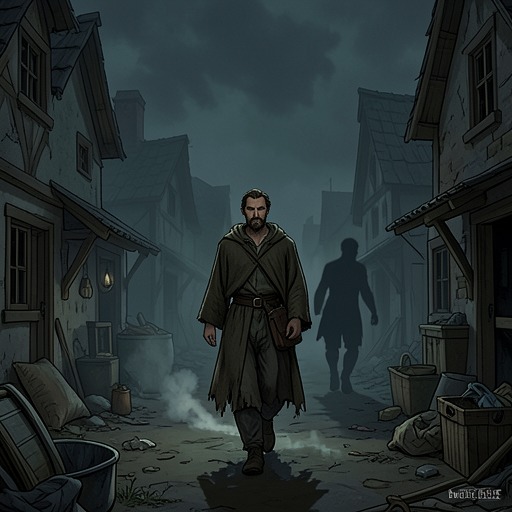
Within Weald of Kent, the Wulfrics ostensibly work as wood-cutters, maintaining a secluded existence under the protection of the ancient forest laws. Their isolation is intensified by the belief that an inherited lycanthropic stain has passed from father to son through several generations. Anglo-Saxon neighbors regard the family as an accursed race of werewolves, refuse them employment on surrounding estates, and blame them for misfortunes ranging from fires and ruined barns to crop disease, dead cattle, childhood illness, and premature childbirth.
The forest thus becomes the setting in which social ostracism is made to appear natural. Because the Wulfrics live apart, their neighbors can treat distance as evidence and silence as confession. The family does little to defend itself, not because the accusations are true, but because it recognizes its powerlessness to overcome them. The priest excludes them from communion, they are absent from Canterbury market and Becket’s shrine, and they are denied participation in sports, harvest work, festivities, and the hostelry. Weald of Kent is consequently not merely a wilderness outside society; it is the enclosure into which society pushes those it has already condemned.
Wolf Lore and Nocturnal Geography
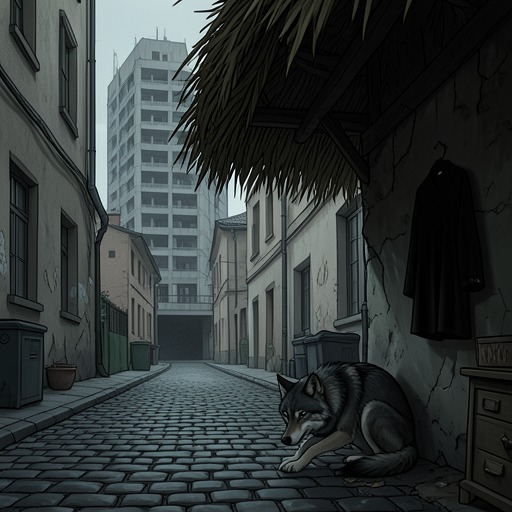
The forest’s reputation is reinforced by actual animal behavior. During severe winters, wolves emerge from their lairs and enter the Ashford cemetery through a breach in its walls, where hunger drives them to disinter the dead. A separate incident stains the Wolf’s Cross with blood when a drunken mendicant falls and fractures his skull against its pointed base. The villagers nevertheless attribute both occurrences to the Wulfrics in their supposed form as werewolves. Natural events are absorbed into a supernatural explanation because the forest has already been assigned a moral menace.
Tradition places the Wulfrics’ alleged nocturnal activity in the Ashford churchyard and around the carved stone cross from which roads diverge toward London, Canterbury, and Ashford. These thresholds between forest, road, town, and burial ground become imagined hunting grounds where the family supposedly feeds on freshly buried bodies or drains the blood of travelers. The setting works through uncertainty: real wolves, accidental violence, and inherited rumor overlap until the landscape itself seems to testify against the family.
Twilight is especially important to this geography. The Wulfrics’ hut, built of chalk and clay with a torn straw thatch and a rotten door full of gaps, stands far enough from other dwellings that neighboring serfs retreat when marsh vapors mingle with the fading light. The period “’tween dog and wolf” marks the hour when categories become unstable and the will-o’-the-wisps begin to glimmer around the dwelling. The family eats, when it has food, and goes to rest as darkness arrives, while the surrounding people interpret that ordinary withdrawal as confirmation of an infernal life.
A Wider Werewolf Landscape
The significance of Weald of Kent belongs to a broader history of werewolf superstition. German tradition describes the werewolf as a sorcerer who applies a devil-inspired ointment and wears an enchanted girdle, gaining both the appearance and perceived nature of a wolf while the girdle remains in use. The French term loup-garou identifies the same feared figure, and an alleged werewolf was executed in the Netherlands as late as 1589. These traditions provide the conceptual vocabulary through which the Kent villagers interpret the Wulfrics.
The legend also depends on the belief that a wolf which has tasted human flesh prefers it thereafter. That belief helps explain why a starving animal, a body disturbed in a cemetery, or a child lost in the countryside can be reimagined as proof of demonic appetite. In parts of Great Britain, superstition even discourages peasants from naming the wolf directly, substituting names such as “the old one,” “the grey one,” or “the great dog.” Weald of Kent therefore operates within a culture in which naming, avoidance, and rumor are themselves methods of managing fear.
Literary and Narrative Function
As a Gothic setting, Weald of Kent joins environmental obscurity to social injustice. The forest offers the visual conditions of terror—impervious cover, marsh vapors, nocturnal paths, cemetery margins, and uncertain lights—but the deepest threat comes from the human willingness to convert misfortune into accusation. The woods possess real agency through weather, hunger, animals, and difficult travel, yet the narrative also shows how people project inherited fears onto that agency.
The location’s importance extends beyond the Kent episode because the book repeatedly returns to forests and remote landscapes as spaces where identities become unstable. Gaspar de Marcanville later chooses the forest surrounding St. Yrieux as a place where he can remain unknown while supporting Adéle; elsewhere, a white wolf lures a hunter upward through a mountain forest, and a tiger carries Krantz away through jungle. These settings differ from Weald of Kent, but they repeat its central pattern: wilderness is both refuge and threat, a place that conceals the persecuted while exposing travelers to forces they cannot control.
Weald of Kent finally stands for the unstable border between animal reality and human interpretation. Wolves may emerge because of severe winters, yet villagers read their actions as witchcraft; a family may withdraw because it has been persecuted, yet that withdrawal becomes evidence of guilt. The forest does not simply contain the werewolf legend. It is the material environment in which fear, exclusion, and natural violence are arranged into that legend.