Werewolf steel-blade vulnerability rule
The Best Werewolf Short Stories 1800-1849The Werewolf steel-blade vulnerability rule is a central mechanism of recognition and resistance in the book’s werewolf tradition. It distinguishes supernatural protection from absolute invulnerability: a werewolf may withstand ordinary weapons, yet remains vulnerable to a deliberately wielded steel edge. The rule therefore turns a seemingly indestructible monster into a creature that can be tested, identified, and potentially driven away.
Definition and Limits
The rule appears most explicitly in the counsel given by the sacristan and gravedigger of St. Michael’s to Willieblud. He explains that a werewolf cannot be slain by ordinary means because its hide is proof against spear or arrow, while remaining vulnerable to the edge of a cutting weapon of steel. The distinction is precise. Projectile weapons and thrusting weapons fail against the hide, but a sharp steel blade can sever it. The rule does not state that every steel wound kills the creature; its immediate function is to establish a reliable physical test and to force the werewolf to retreat once blood is drawn.
This vulnerability belongs to a broader body of werewolf lore in which transformation alters both appearance and nature. Earlier accounts describe sorcerers who use an ointment and an enchanted girdle to assume the shape and disposition of wolves, while medieval poetry develops the bodily consequences of transformation by imagining clothing becoming wolf hair and human limbs becoming the animal’s legs. Against that tradition of total metamorphosis, the steel-blade rule supplies a surviving human weakness: however complete the wolf-form appears, its hide can still be cut.
Use as a Test of Identity
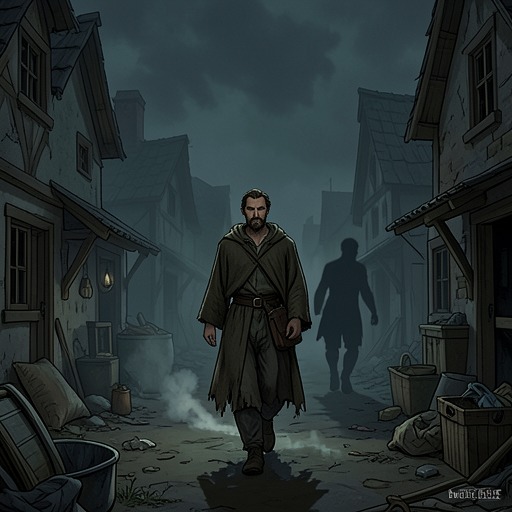
In the Hugues Wulfric episode, Willieblud has reason to suspect that the wolf-man who steals meat from his cart is Hugues. The sacristan advises him not to attempt a straightforward killing, but to make a slight wound or cut over the paw. If the skin is severed, the creature will flee, and the wound will provide certainty about its identity. The rule thus converts folklore into an investigative procedure: the steel blade is not merely a weapon but an instrument of revelation.
Willieblud follows the advice that same evening. He hides a newly sharpened cleaver beneath the meat in his cart and waits for the wolf-man to appear. Because the creature anxiously asks after Branda, Willieblud is given a further opportunity to approach it without immediately provoking suspicion. His proposed act is calculated rather than heroic. The cleaver is meant to produce evidence, and the expected flight after the wound is treated as confirmation that the suspected man and the werewolf are one being.
Relation to Werewolf Protection
The rule gives the werewolf a distinctive defensive profile. The creature is not simply an animal that can be killed by any hunter equipped with a spear or bow; its hide frustrates the conventional tools of pursuit. This helps explain why fear surrounds the werewolf before its identity is established. In the lore associated with Hugues Wulfric, the family is already treated as an accursed race, blamed for fires, ruined barns, failed harvests, diseased cattle, illness, and premature birth. Their reputation is strengthened by the belief that the supposed wer-wolves cannot be dealt with by ordinary force.
At the same time, the steel exception prevents the legend from becoming narratively closed. The Wulfrics are socially isolated, refused work, excluded from church communion and public gatherings, and driven away from ordinary roads and markets. The steel blade introduces a narrow opening in that system of fear. It gives the persecutor a means of converting suspicion into physical proof, although the same mechanism can also intensify persecution when the proof is interpreted within a hostile social order.
Consequences for Recognition and Judgment
The logic of the rule extends beyond the Ashford episode. In the witchcraft case involving Michael Thilouze and Francoise Thilouze, a wolf’s foot becomes material evidence against them after Francoise loses her left hand while escaping a trap. The severed hand retains the wolf-form it had assumed, and the wolf’s foot is presented in court as incontrovertible proof when combined with the missing hand. Although this scene concerns magical transformation rather than the exact wording of the steel-hide doctrine, it shares the same evidentiary structure: a bodily fragment is treated as a stable bridge between human identity and animal form.
That structure reveals the danger of physical tests in a world governed by superstition and unequal power. The commissaire du quartier and a mob from Loques seize Michael Thilouze and his daughter, and a judicial process heavily weighted against the physician and his daughter condemns them to die at the stake. The rule’s underlying promise is that the supernatural can be identified through the body; the surrounding narratives show that bodily evidence does not guarantee justice. Once a hostile community controls the interpretation of the wound or remnant, recognition can become a mechanism of condemnation.
Folkloric and Narrative Significance
The rule belongs to the long movement by which the werewolf passes from superstition and folklore into literary narrative. Early traditions identify werewolves with sorcery, the devil, and the wearing of an enchanted girdle; medieval poems preserve the marvel of transformation; later stories organize the marvel into repeatable rules governing disguise, vulnerability, recognition, and punishment. The steel blade is especially important because it makes the monster legible through action. A reader need not accept an abstract claim that the werewolf is supernatural: the creature’s reaction to a cut supplies a dramatic sign.
As a narrative device, the rule balances terror with conditional knowledge. Spears and arrows promise no protection, so the werewolf remains formidable; the sharp steel edge offers a countermeasure, but only one requiring proximity, precision, and nerve. It also preserves uncertainty until the test is attempted. The result is a recurring pattern in werewolf fiction: a feared figure is watched, approached, wounded, and identified through the contrast between an apparently invulnerable animal body and the sudden evidence of human-like blood. The rule’s lasting significance lies in that contrast, which makes supernatural identity both frighteningly powerful and materially discoverable.