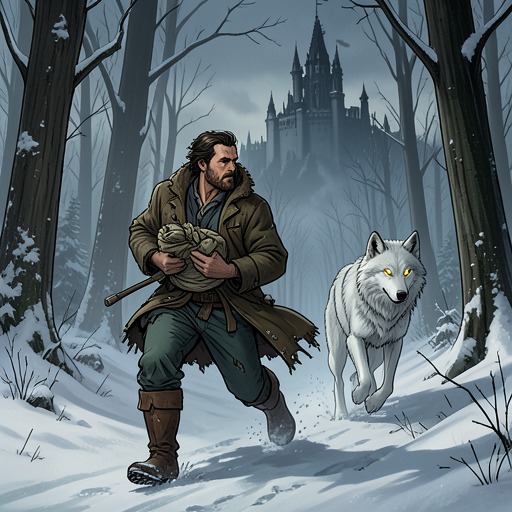
Wilfred’s supernatural judgment of Krantz
The Best Werewolf Short Stories 1800-1849Wilfred’s supernatural judgment of Krantz is the turning point that converts a baffling family tragedy into an intelligible supernatural punishment. In the embedded account, the hunter Wilfred returns after Krantz has killed his wife, exposes the binding force of the marriage oath made in the wilderness, and declares that Krantz’s double murder has placed him under the vengeance of the spirits of the Hartz Mountains. The judgment does not merely threaten a future penalty: it establishes that Krantz’s remaining life is itself the sentence.
The Oath and Its Hidden Terms
The judgment depends on a vow whose full force Krantz had failed, or refused, to recognize. In the remote country where Krantz encountered the supernatural power associated with his bride, there was no priest and no ordinary law, yet a ceremony was required to satisfy her father. The father therefore offered to marry the couple according to his own fashion, and Krantz consented. The oath was not an informal promise but the condition under which the marriage could take place, and its terms included a prohibition against raising his hand to harm his wife.
That prohibition becomes the moral and supernatural hinge of the later scene. Krantz insists that he made no compact with evil spirits, attempting to separate his intention from the consequences of the ceremony. Wilfred rejects that defense. His judgment rests on the claim that the vow was witnessed and registered by powers beyond human courts, so that repudiating the supernatural source of the marriage cannot dissolve its obligations. The event therefore turns a private act of violence into a breach of a sacred and punitive contract.
Wilfred’s Return
Early in the morning, after Krantz and his surviving child have spent the night in shock, Wilfred bursts into the cottage. His first demand is for his daughter, and Krantz answers with rage, declaring that she is where she ought to be—in hell—and ordering the hunter to leave. The exchange immediately places ordinary human anger against an authority that Krantz can neither intimidate nor physically resist.
Wilfred answers with mocking certainty, calling attention to the absurdity of a mortal who has married a weir wolf. When Krantz defies him as a demon, Wilfred declares that Krantz will nevertheless feel the power of the Hartz spirits. He specifically recalls the solemn oath never to harm the woman. The threat is thus not a fresh curse improvised in anger; it is presented as the enforcement of a condition Krantz had accepted when he entered the marriage.
The judgment also reveals the wider scope of the punishment. Wilfred warns that the children named in the oath are to perish through the vulture and the wolf, and that their bones will blanch in the wilderness. This prophecy connects Krantz’s crime to the destruction of his family, making the supernatural penalty hereditary in its effects even though the guilt is his. The promised losses are not abstract symbols: they establish the fate awaiting the children and explain why Krantz’s surviving child fears that the father’s oath may still exact a price.
The Failed Attack
Krantz responds to the sentence as he has responded to every challenge in the cottage: with physical violence. Frantic with rage, he seizes an axe and raises it over Wilfred’s head. The gesture appears to restore the logic of ordinary conflict, in which a weapon can silence an accuser. Instead, the axe passes through the hunter’s form. Krantz loses his balance and falls heavily to the floor, while Wilfred remains untouched.
This failed attack is the scene’s most concrete proof that Wilfred is not merely a human hunter using superstition to terrify a murderer. The weapon cannot reach him, and the apparent body before Krantz is revealed as something insubstantial. The supernatural is consequently no longer left to rumor or interpretation. Wilfred’s incorporeality gives material shape to the authority of the oath: Krantz can strike at a man, but he cannot strike at the power that has come to judge him.
The encounter also reverses the balance of power. Krantz enters it armed with anger and an axe; he leaves it physically fallen, verbally exposed, and unable to alter the sentence. His attempt to destroy the witness becomes another demonstration of his helplessness. The violence that has governed his conduct is turned back upon him as evidence of guilt rather than as a means of escape.
The Sentence of Survival
Standing over Krantz’s body, Wilfred distinguishes between those over whom the spirits possess power and those who have committed murder. He tells Krantz that he has been guilty of a double murder and must pay the penalty attached to his marriage vow. Two of his children are already gone; the third is still to follow, because the oath has been registered. Wilfred adds that it would be kindness to kill Krantz, but that his punishment is to live.
The final formulation gives the judgment its particular cruelty. Death would close the period of fear, grief, and uncertainty; continued life forces Krantz to witness the fulfillment of the curse and to remain conscious of the oath that caused it. The sentence is therefore not simple execution by supernatural means. It is an imposed duration, a life stretched into punishment, in which survival becomes more terrible than death.
After delivering the judgment, Wilfred disappears. Krantz rises, embraces his surviving child, and kneels in prayer, a movement from violent resistance to helpless religious appeal. The change does not undo the judgment. The next morning he leaves the cottage forever, taking the child with him and traveling to Holland. He reaches Amsterdam with a little money, but soon suffers a brain fever and dies raving mad; the child is placed in an asylum and later sent to sea before the mast. The aftermath thus confirms that Wilfred’s sentence operates through prolonged ruin rather than a single spectacular blow.
Narrative Function and Supernatural Certainty
The episode belongs to a story within a story, recalled by the survivor as the history that explains the family’s inherited fear. Its retrospective form delays the meaning of the earlier deaths and transformations, then concentrates recognition in Wilfred’s confrontation with Krantz. What had seemed like isolated violence becomes the consequence of an oath, a double murder, and a supernatural legal order whose penalties extend through the family.
The scene also moves the tale from hesitation toward certainty. The setting is prepared by the haunted calendar of All Souls’ Eve, when the dead are reputed to rise and return home, and by the surrounding imagery of graves, forests, lonely firelight, and fearful voices. Such details initially permit fear to hover between natural and supernatural explanations. Wilfred’s arrival, however, supplies an unmistakable supernatural verdict: the axe passes through him, he invokes the spirits of the Hartz Mountains, and he names the exact structure of the punishment.
As an act of ritual judgment, the encounter inverts the ordinary functions of marriage, law, and execution. The marriage oath, formed without a priest or civil authority, becomes enforceable by spirits; the absence of human law does not produce freedom but exposes Krantz to a harsher tribunal; and the judge who cannot be wounded replaces the earthly executioner. Wilfred’s supernatural judgment of Krantz therefore restores a moral order only by making that order terrifyingly inescapable: the murderer is not released from history, but condemned to live until the vow has consumed what remains of his family and his mind.