Austin and Thomas’s Sixth Birthday Party
The Birthday PartyAustin and Thomas’s Sixth Birthday Party is held at Scott Bowers’s home, where Charlie’s eagerly anticipated day out begins as an exuberant family gathering and becomes inseparable from her disappearance. Through Kathy Hamilton’s observations, the celebration is rendered in specific domestic details: a crowded lawn, children waiting for cotton candy, a pony ride, and gifts for the twins. In retrospect, that lively setting carries a darker significance, as the party marks the point from which the search for Charlie—and the exposure of long-hidden family truths—unfolds.
Background and Setting
The celebration is for Scott and Cindy Bowers’s twin boys, who are turning six. Scott is Mitch Hamilton’s brother, and the boys are Charlie’s cousins. Charlie has been talking about the party for weeks. Earlier in the day, she counts the hours until it begins, giving the gathering a place in her imagination well before Kathy arrives.
The Bowers home is almost twice the size of Kathy’s, with a driveway that can hold six cars and a long path to the front door. Mature trees shade the landscaped front yard. Carnival music and bursts of laughter carry from inside, while the number of cars parked outside is lower than Kathy expects; many guests appear to have come without driving. The contrast between the spacious house and the comparatively sparse parking gives Kathy an early impression of a gathering already well underway, but not quite as she had anticipated.
The Celebration Through Kathy’s Eyes
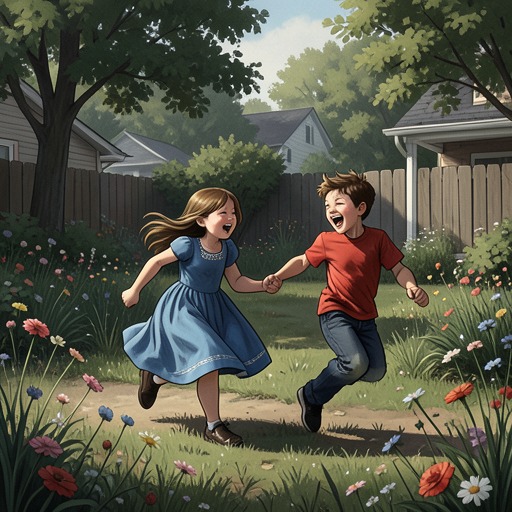
On the lawn, a cotton-candy machine draws a line of children. The pool and sunloungers are still empty in the heat, though Kathy expects someone will soon take advantage of them. At the back of the yard, near the woods, she spots Charlie riding a beautiful white pony as its female handler leads it around the lawn. Kathy’s first reaction is concern that Charlie might fall; seeing her in a secure child’s saddle and under the handler’s close attention reassures her.
The scene establishes the party as a place of activity spread across the property, from the lawn to the wooded edge. Kathy later passes a table covered with presents wrapped in shades of blue, and Scott and Cindy’s boys rush up to her. These details make the occasion legible as a child-centered family celebration, with Charlie moving among relatives, entertainments, and guests rather than being isolated from the gathering.
As the afternoon wears on, the party’s atmosphere changes. The sun shifts behind the woods, adult guests look sunburnt and worse for wear, and the clowns and entertainers have left. Fewer children remain in view. Kathy and the others consider that some might be upstairs in the twins’ rooms playing video games, but this is only a possibility, not a confirmed account of where they are. The party thins out by degrees, its earlier noise giving way to uncertainty about who is still present and where.
Disappearance and the Search
The party is the setting associated with Charlie’s disappearance. Its significance rests in the reversal between what it promises and what follows: a much-anticipated birthday gathering becomes the beginning of a desperate search. The supplied account of the celebration places Charlie among the guests and activities but does not specify the precise moment or circumstances in which she disappears. The gradual reduction in the number of children and the departure of the entertainers form part of the party’s changing scene, not an explanation of what happened to her.
In the aftermath, Kathy remains under pressure as the search proceeds. When Mitch moves toward the door, she stays seated, takes a deep breath, and tells Chase Cooper that Charlie is adopted. Her disclosure shows how the search reaches beyond the immediate question of Charlie’s whereabouts: it forces Kathy to reveal a family fact she had kept concealed. The birthday gathering thus sits at the opening of a chain of events in which the disappearance and the family’s hidden history become entangled.
Revelations and Retrospective Significance
Later revelations deepen the party’s importance without changing what can be observed at the celebration itself. Kathy explains that Mitch had a brief relationship with a younger woman six years earlier and that it resulted in a daughter; he had been visiting that child monthly for five years without Kathy’s knowledge. The disclosure revises the apparent boundaries of the family around Charlie, whose biological parentage had also been concealed.
Megan Carter, herself adopted as a baby, eventually tells Kathy that Megan Carter is not her birth name and that she now knows her name is Hope Hamilton. This later recognition connects the search’s immediate concern with a longer history of adoption and separation. At a cemetery, Kathy considers changing her surname to Carter, an expression of how relationships and names have become newly open to negotiation. These later developments are not events at the twins’ party, but they show the breadth of the consequences set in motion by Charlie’s disappearance there: the celebration becomes the narrative hinge between a child’s eagerly awaited family occasion and the painful recovery of hidden kinship.