Charlie as a Catalyst for Reuniting the Family
The Birthday PartyCharlie as a Catalyst for Reuniting the Family describes how Charlie’s disappearance, and the truths uncovered in its wake, draw estranged people into a new understanding of their family ties. Her role is not to resolve grief or restore the old household unchanged: her absence exposes concealed parentage, old injuries, and Connie Hamilton’s betrayal, while prompting Kathy Hamilton to reconnect with Megan, reconsider the family patterns she inherited, and reopen a relationship with Chase Cooper.
The Crisis That Makes Hidden Ties Visible
Before Charlie disappears, Kathy has learned that Mitch Hamilton secretly fathered a daughter with Megan Carter and arranged for the child to live with the Hamiltons as an adopted daughter. Under pressure during the investigation, Kathy tells Chase that Charlie is adopted and that she has lived with them for only six months. This disclosure shows how the search makes concealment increasingly untenable: Kathy chooses to tell the truth before it is uncovered for her, even as Mitch reacts angrily. The immediate subject is Charlie’s status, but the admission also opens a larger question about who belongs to the family and what its members have kept from one another.
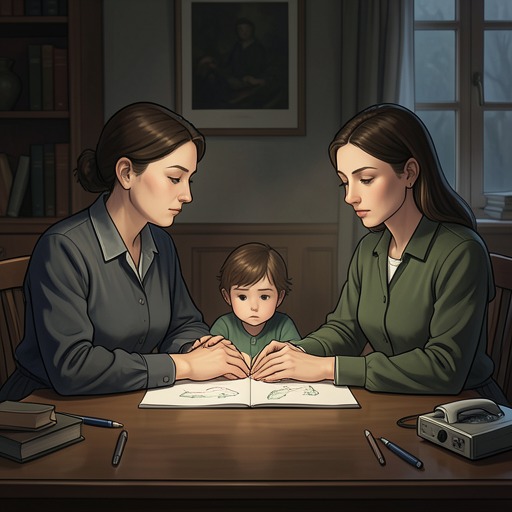
That question reaches back to Kathy’s own history. She tells Megan that Mitch described his affair as a brief fling six years earlier, but that he had been visiting Charlie every month for five years without Kathy’s knowledge. The discovery had made Kathy feel naïve and betrayed. Megan’s response does not erase the deception; it recognizes that a busy life and trust in a spouse can make a concealed history hard to detect. Their exchange begins a relationship grounded in candor about the costs of secrecy rather than in the family’s carefully maintained account of itself.
The decisive reversal comes when Megan explains that she was adopted as a baby and had never known her birth parents. Susan Cartwright discovers the connection between her and Kathy. Megan then identifies her birth name as Hope Hamilton, and Kathy recognizes that the dates fit. This revelation transforms the relationship between the two women: Megan is not only a person Kathy has come to know through Charlie’s case but her long-lost daughter. It also makes Charlie Kathy’s granddaughter. Chase accepts the proof Susan found and responds to the implication, while Kathy is overcome by the knowledge that she had met and spent time with Charlie before her death.
Family Patterns and the Cost of Concealment
The revelations do not begin with Charlie. Kathy has been told that her parents’ arguments during her childhood contributed to her disordered eating, and that counseling could not substitute for a more stable home. Looking at Fay Hamilton’s anxiety and her own choices in marriage, Kathy sees a painful resemblance: she had stayed with Mitch after learning of his affair and concealed the damage, as her parents’ marriage had concealed its own conflicts. She wonders whether her decision contributed to Fay needing therapy. The possibility brings guilt, but also a new resolve to break the pattern rather than pass it on unchanged.
Kathy’s history with Connie gives that pattern a sharper edge. Connie had opposed Kathy’s relationship with Chase and forced her to give up her first daughter. Later, she treats the pregnancy as a threat to the Hamilton family and says that a son could have carried on the family name. Kathy recognizes that the loss was not an unavoidable consequence of her past: Connie took away her choice, shaping the lives of both Kathy and Megan. When Connie admits that she advised Evan Harris to eliminate the problem, Kathy understands that her mother’s protection of family standing has become active betrayal. The reward Connie offered for information about Charlie and Megan takes on a different meaning when Kathy realizes Connie expected the reward never to be claimed.
This history links the family’s secrets across generations without making their effects identical. Kathy’s silence about her past, her parents’ marital conflict, and Connie’s determination to preserve the Hamilton name all contribute to an inheritance of concealed pain. The story’s emphasis is not that one decision explains every later difficulty, but that silence and control constrain the choices available to the next generation. Kathy’s recognition of the pattern gives her a chance to act differently, though it cannot undo what happened to Charlie or restore the years she lost with Megan.
Reunion Without a Return to the Old Family
Charlie’s significance as a catalyst becomes explicit when Kathy tells Chase that, without Charlie’s abduction, she might never have opened up, come to know Megan properly, or brought Susan into the search for their shared history. Charlie has drawn people back into one another’s lives, but the reunion is made possible through painful discoveries, not through an easy reconciliation. Chase had once wanted to raise Kathy’s baby as his own; Connie’s intervention helped keep them apart. Learning that Charlie was his granddaughter gives their separation a new and irreversible dimension, even as Kathy and Chase regain the possibility of closeness.
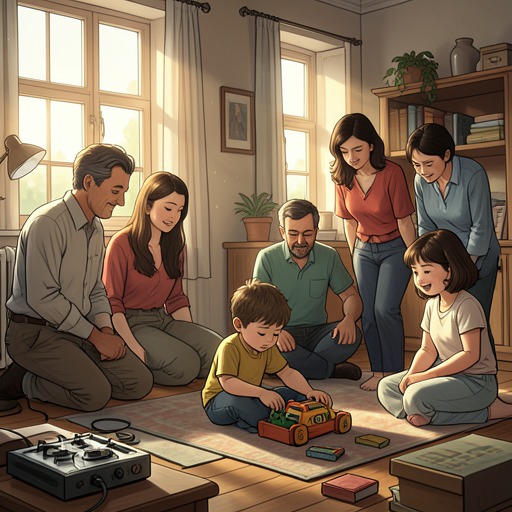
At Charlie’s funeral, flowers and stuffed animals, mainly horses, surround the grave, and a red balloon filled with glitter rises above it. Kathy stands with Megan, and the family shares its grief and memories of Charlie. Megan says she is glad to have a place where she can come and talk to her daughter. Kathy’s imagined picture of Charlie walking with the family in her cowboy hat and boots keeps the child present in memory as the others move away together. The scene makes reunion inseparable from mourning: the family can gather because of Charlie, but cannot turn that gathering into a substitute for her.
The aftermath changes the family’s names and arrangements as well as its understanding of kinship. Kathy asks Megan how she would feel about Kathy taking the surname Carter. Fay, who no longer wants to be a Hamilton, welcomes the possibility of becoming Fay Carter. Mitch is ready to return to the Bowers name and has moved into his own place, with a spare room for Fay. These choices mark a break with the prestige and secrecy associated with the Hamilton name; they do not mean that the family’s difficulties have vanished. Mitch is still grieving and working through the affair and Kathy’s painful history, while Fay spends time with both parents.
Continuing Bonds and a Different Future
The reunion extends beyond the immediate family. Jack supports Kathy’s proposed name change and has begun divorce proceedings from Connie; Connie will not be allowed to see the family, though she has not yet been charged. Kathy’s decision to stop asking about Connie’s legal fate marks a boundary after the betrayal. Christine Stiles, meanwhile, is an important witness in the prosecution of Evan Harris and has agreed to testify. These consequences show that coming together does not require restoring every relationship: the family’s response includes separation, accountability, and new limits as well as care.
Kathy’s reconnection with Chase offers a further, tentative possibility. After the funeral, he approaches her, and she takes his hand. She chooses to kiss him despite briefly considering how others might judge the gesture. The moment recalls their teenage connection by the creek, but it does not erase the intervening years or promise that old losses can be recovered. Charlie’s place in the family is instead carried forward through the relationships her life and death brought into view. In this sense, she reunites the family not by returning it to its former shape, but by compelling its members to acknowledge who they are to one another and to decide what they will carry into the future.