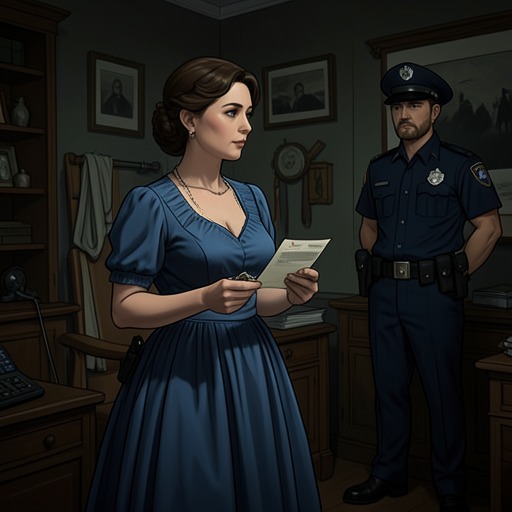
Connie Hamilton
The Birthday PartyConnie Hamilton, Kathy Hamilton’s mother, is a forceful presence whose devotion to the Hamilton name shapes both her family life and the crimes at the center of the story. She helps present her family as respectable and generous, yet privately makes choices for Kathy in the name of reputation and later admits that she advised Evan Harris to eliminate Megan and Charlie. The contrast between civic benefactor and family manipulator makes her late revelations a turning point in the story’s account of concealed parentage, coercive control, and the cost of protecting appearances.
Identity and Public Standing
Connie belongs to a wealthy Maple Falls family whose fortune began with her great-grandfather’s involvement in building local railroads. Subsequent generations expanded that wealth through investments and business acumen, while the family supported the town through philanthropic ventures. Its standing is visible in the buildings bearing the Hamilton name, including the library. Connie and Kathy both kept that surname after marriage, a choice Connie defended as a matter of having no reason to exchange a perfectly good family name for a husband’s.
That civic prominence gives the Hamilton name practical force in Connie’s world. She is concerned not only with what happens within the family but with how church friends and other families might judge it. Her later explanations show that public opinion was not merely an abstract worry: it helped determine what Kathy was allowed to do, what information she received, and which relationships Connie tried to sever. The family’s philanthropy and local respect therefore sit beside a private standard of control, in which protecting its name takes precedence over Kathy’s choices.
Family Life and Social Judgment
Connie is blunt in her judgments of people close to Kathy. She describes Megan Carter as a bad influence on Kathy and Fay Hamilton, objecting to her language and smoking. Kathy points out the hypocrisy in this criticism: she has caught Connie smoking behind her back more than once. Connie nevertheless maintains that Megan does not know how strongly she feels, presenting her own manners as a form of restraint rather than a change of opinion.
Her manner can also be demanding in ostensibly ordinary moments. After a stroke in February, she is only just out of a wheelchair and says that she remains in pain; she complains that her husband, Jack, has gone to the country club for the day to get away from her. At a church service following Charlie Hamilton’s disappearance, she kisses Fay’s cheek but tells her to take off her sunglasses because she is in church. The detail sits alongside a less guarded display of grief: when Mitch Hamilton asks whether he is being punished, Kathy comforts him, and Kathy then notices tears in Connie’s eyes, an unusual sign of how deeply the crisis has affected her.
Kathy’s First Daughter and the Concealed Adoption
Connie’s most consequential exercise of authority over Kathy began when Kathy became pregnant as a teenager. Kathy recalls that she was seventeen, had little experience, and did not tell Mitch about the pregnancy. Connie could not bear the prospect of her unmarried daughter raising a child and the judgment that might bring from church friends. Kathy says that keeping the baby was not presented as a real option; she was told there would be consequences if she refused to give her daughter up. Her father, Jack, was so disappointed that he barely spoke to her until after the birth, after which the family acted as though the baby had never existed.
Years later, Kathy explains to Megan the depth of what that separation cost her. Before she told Connie about the pregnancy, she had felt less alone and had sung to the baby. Connie, however, made the decision on the basis of social respectability, not Kathy’s wishes. In a later argument, Kathy confronts her with the different standard she would have applied had the baby been a boy: Connie says she could have raised a boy as her own and continued the Hamilton name. The exchange exposes how the family’s concern for its legacy shaped even the most intimate decisions.
Connie also withheld the possibility of contact after the adoption. She knew the adopting couple’s names and says that the couple wanted an open adoption, with letters, photographs, and perhaps visits. Kathy had been told that the adoption was closed. Connie admits that she lied, arguing that a complete break would give Kathy closure and keep other people from finding out. She also reveals that the child’s adoptive mother, Jeanette, repeatedly sent photographs as the girl grew up. Kathy’s shock comes from understanding that the separation was not simply an irreversible arrangement: Connie had concealed opportunities to follow her daughter’s life and perhaps remain connected to it.
Knowledge of Evan Harris and the Final Confrontation
Connie says she recognized Evan Harris as the man responsible for Kathy’s pregnancy as soon as Kathy told her about the positive test. She had noticed that Kathy refused to see a therapist again and that Harris had recommended, unexpectedly, that she no longer needed one. Connie says she kept the pregnancy from him, believing he might try to persuade Kathy to keep the baby or might prefer that she end the pregnancy. She also watched his career advance and resented the prospect of his receiving university tenure. These admissions reveal that Connie knew the identity of Kathy’s first child’s father while allowing Kathy to live without that knowledge.
The family confrontation brings Connie’s concern for reputation into direct conflict with Kathy’s account of the damage it caused. Connie says the prospect of scandal—including the judgment of Reverend Stanley and family friends—had been enough to frighten her. Kathy counters that Connie’s decision to make her give up her daughter damaged both her own life and Megan’s. When Kathy learns that Connie had known all along about the connection to Harris, her mother confirms the secret rather than withdrawing it.
Connie then acknowledges a further intervention: she advised Harris to eliminate the problem, while claiming that she did not specify how. Kathy concludes that the advice concerned Megan and Charlie and that Connie’s reward offer for information about Charlie would probably never be claimed. She also suspects Connie wanted Mitch framed, which would have removed Megan and Charlie from the family’s life while exposing Mitch to punishment for crimes he did not commit. Connie does not answer that accusation directly. Instead, she says that she never spoke to Harris again and had made clear that she would deny their conversation.
Character and Narrative Significance
Connie’s role develops through a sequence of disclosures that revise the apparent history of the Hamilton family. The community knows the family as wealthy and generous; Kathy initially understands her daughter’s adoption as closed and her own past with Harris as disconnected from the present. Connie’s admissions reveal that she had access to information at each stage and used concealment to preserve the appearance of order. Her stated concern for closure and family stability is set against the practical result: Kathy was deprived of choices and of knowledge that could have changed her relationship with her daughter.
The same pattern governs Connie’s role in the danger facing Megan and Charlie. She presents herself as someone who merely advised Harris and denies having specified his actions, but her admission confirms that she knowingly encouraged him to remove them as obstacles. When Jack says that being a Hamilton is no longer special, the remark punctures the prestige on which Connie’s decisions have rested. Her significance lies in the gap between inherited respectability and private conduct: the family name she sought to protect becomes the rationale for secrets that endanger the very family it is supposed to represent.