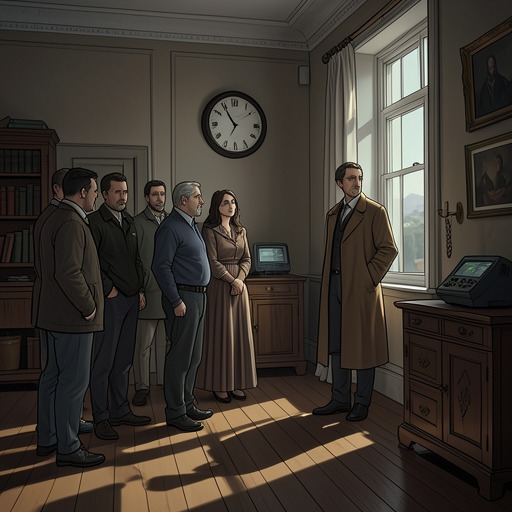
Detective Frank Brown
The Birthday PartyDetective Frank Brown is a detective in Chase Cooper’s department and a practical supporting investigator in the search for Charlie Hamilton. His work is defined by the painstaking limits of an early investigation: guests remember little, search dogs find no trace, and the investigators must turn scattered observations into leads worth checking.
Identity and Introduction
Brown appears as a colleague Cooper can rely on when their work brings them together, although the two are not described as formal partners. They coordinate at the scene of Charlie’s disappearance and later as the search widens. The narrative gives Brown no personal history or private life; it introduces him through his investigative duties and his exchanges with Cooper.
At the party site, Brown is speaking with the last of the guests Cooper has held back for interviews. The officers are trying to preserve fresh recollections before people leave, but no one has yet provided useful information about Charlie’s whereabouts. That lack of progress frames Brown’s early role: collecting testimony is necessary, but the presence of many witnesses does not mean any of them can reconstruct what happened.
Work at the Party Site
When Cooper returns to the large house on Lexington Lane at 10:30 p.m., Brown is still there. The living room is cluttered with empty glasses and crushed potato chips. Cooper recognizes that the mess has investigative value: the glasses and food dishes may yield DNA or fingerprints, so the fact that Scott Bowers and Cindy Bowers have not cleaned up preserves potential evidence. Brown is present as the search moves from questioning people to examining the physical scene.
Brown reports that the guest interviews have produced nothing useful. Alcohol has further undermined their accounts: some of the people he spoke with cannot remember even when they arrived. His dry observation about the guests’ weekend drinking underscores a basic obstacle in the inquiry—witnesses can be present at the party and still be unable to establish a reliable timeline.
Later, Brown gives Cooper another brief status report: the dogs have found no trace, and officers have not yet turned up anything of interest. The report is not a resolution but a measure of how little the search has yielded. Cooper is watching Scott Bowers closely as officers climb the stairs, while Brown’s update keeps the broader investigation in view rather than confirming a suspicion about any one person.
Coordination and Leads
Brown and Cooper also assess the possibility that Charlie was taken through the woods behind the property. Brown says there is no sign of her and begins to doubt that she went that way. Cooper considers how an abductor might have removed her without being seen and notes that the yard backs onto unsecured woods. He also weighs the guests’ accounts: Charlie was last seen taking pony rides near the woods, then waiting in line for another turn before she disappeared. Brown’s skepticism marks a genuine uncertainty in the search; the wooded route is plausible, but the officers have not found evidence to confirm it.
A separate lead prompts more targeted follow-up. After learning that Scott Bowers was at a meat market within thirty minutes of someone hearing a girl scream, Cooper tells Brown to obtain surveillance footage from the meat market and nearby stores. Brown agrees to pursue it. The sighting does not establish Scott’s involvement, and Cooper acknowledges that it may prove to be a false lead; the footage is requested because the timing is specific enough to check.
Narrative Role
Brown’s contribution is procedural rather than revelatory. He interviews witnesses, communicates the results of searches, and takes on an evidence-gathering task when a potentially significant location emerges. Each report narrows what investigators can responsibly claim: the partygoers offer no dependable account, the dogs and officers have found nothing, and the possible route through the woods remains unverified.
The contrast between Cooper’s questions and Brown’s updates gives the investigation a collaborative rhythm without making Brown a source of certainty. His work keeps possibilities open while testing them against what witnesses, search teams, and surveillance might actually establish. In a case surrounded by speculation, Brown’s function is to make the next check concrete.