Evan Harris’s clown mask
The Birthday PartyEvan Harris’s clown mask is a children’s-party costume that becomes a crucial piece of evidence in the search for the person who lured Charlie Hamilton away from her birthday party. Hidden beneath an armchair in Evan Harris’s office, it connects the investigation’s question about an unidentified second clown to a specific object in Evan’s possession. Its significance grows through the way it is found, handled, tested, and finally used to confront him: an unremarkable disguise becomes a material trace of a crime.
Discovery in the Office
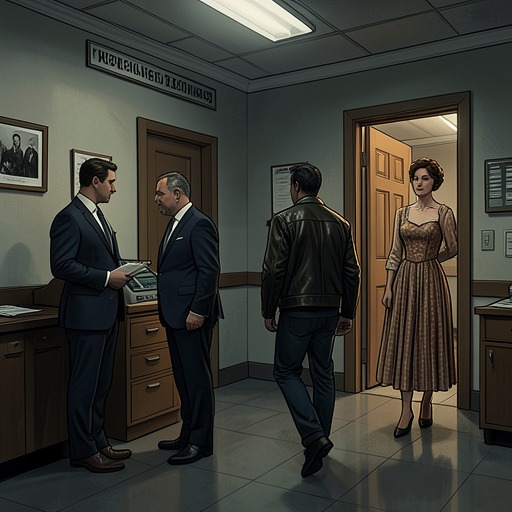
Chase Cooper raises the possibility of a clown costume while questioning a woman who has been cleaning out the office. He asks whether she has found a mask or costume there, prompted by his suspicion that Evan Harris likes dressing up at children’s parties. Her surprise at Chase’s question suggests she has not understood the item as evidence; she also says she did not know Evan had children in his family.
The woman says she found the mask that morning, stuffed beneath the armchair in Evan’s office. The hiding place matters: the mask was not openly displayed as a party prop, but tucked under furniture in a workplace. She has put it in one of several boxes and must search through them before producing it. Her only description is that it is “a little creepy”; the evidence gives no further account of its colors, design, or other physical features. That limited description keeps attention on the mask’s concealed location and what it can establish, rather than on its appearance.
From Costume to Evidence
As the woman searches, Chase waits, his hands sweating as he tries not to hurry her. Once she finds the mask, he focuses on the DNA that may be recovered from it. He also realizes that the woman’s DNA could now be on the object because she has handled it. Without latex gloves, he uses a pen to lift the mask from her and take it. The gesture registers the practical problem of preserving evidence: its meaning depends not just on where it was found, but also on who has touched it since.
The woman initially mistakes Chase’s urgency for a personal fear of clowns. When she recognizes that he is treating the mask as evidence, she asks what Evan has done. Chase does not disclose the investigation’s full concern. He says the collection is precautionary and asks her to keep it to herself, because he wants to avoid alerting Evan to what he has taken. The mask thus has two simultaneous roles: it is an object that may carry forensic traces, and a secret whose removal could warn a suspect if it became known.
The Second Clown Connection
The mask acquires its central significance when Chase connects it to the unresolved figure at the birthday party. The second clown had not been hired by the family and had not asked for payment before disappearing. Chase reasons that this person may have coaxed Charlie away from the party. He does not initially know who wore the mask; the discovery in Evan’s office gives him a concrete lead, not a complete account of the abduction.
Later, when Chase confronts Evan, he identifies the mask as an object found in Evan’s office. Evan first denies owning one, then suggests it must belong to his assistant. Chase counters that she found it hidden under a chair and suggests that Evan forgot to destroy it when he fled that afternoon after being tipped off. These details turn the office discovery into part of a sequence: concealment, removal, and an attempt to escape precede the confrontation. Evan’s denial loses force as Chase lays out the circumstances, and Evan sits down with his knees barely holding out.
Forensic Link and Consequence
Chase tells Evan that Charlie’s DNA is “all over the mask I took from your office” and demands an explanation. Evan visibly slumps. The evidence catalog does not specify what biological material was tested or describe the laboratory procedure, so the mask’s evidentiary force is best stated as the reported DNA match and the way it changes the interrogation. It links Charlie to an object concealed in Evan’s office, while the second-clown theory supplies a possible connection between that object and the party.
Chase follows the DNA revelation by asking whether Evan raped Charlie before killing her. The mask itself does not answer that question; its role is to help place Evan within the chain of events surrounding Charlie’s disappearance and death. In the confrontation, it gives Chase a tangible basis for pressing past Evan’s denial. The costume that might have passed unnoticed among party objects becomes difficult to dismiss once its hiding place, its suspected wearer, and the DNA reported on it converge.
Narrative Significance
The mask’s importance comes from a reversal of function. A disguise ordinarily obscures the person beneath it; here, the object left behind helps expose a suspected participant. Its concealment under an office armchair initially makes it a quiet, easily overlooked thing. Once Chase recognizes its possible connection to the second clown, however, the mask becomes central to the investigation and dangerous to the person who hid it.
The discovery also shows how the investigation advances through material traces rather than confession alone. Chase begins with a hunch about Evan’s interest in dressing as a clown at children’s parties, secures the mask without directly handling it, and later confronts Evan with the reported presence of Charlie’s DNA. Each step narrows the distance between a disguised figure at the party and an object found in Evan’s office. The mask does not narrate the crime or establish every detail of it; its force lies in making a previously elusive suspect answer for a physical link to Charlie.