Fragment of Charlie’s Red Dress
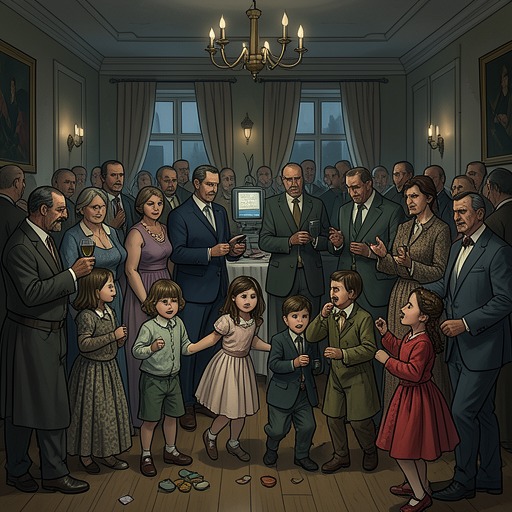
The Birthday PartyThe Fragment of Charlie’s Red Dress is a small piece of fabric found embedded in newly repaired concrete in the basement of a house being inspected during the search for Charlie Hamilton. Its significance emerges in stages: first as an unexplained speck beneath a paint can, then as red material in fresh-looking concrete, and finally as a recognizable piece of Charlie’s party dress. The fragment gives physical form to the possibility that Charlie is buried in the house, but it does not by itself confirm what lies beneath the floor.
Appearance and Material Condition
The fragment is so small that the person searching the basement initially mistakes it for lint. It lies beneath a can of brilliant-white paint in a corner where the concrete is visibly newer and uneven compared with the rest of the floor. When he tries to pick it up, it will not move: the material is submerged in the concrete rather than resting loose on its surface. A closer look reveals its red color, which makes it stand out from the pale paint and the surrounding floor.
That physical entrapment is central to the object’s force. It is not simply a discarded piece of clothing that can be collected and set aside; it has become part of a repaired surface. The searcher’s first effort to remove it fails, and the attempt to understand what he is seeing shifts into dread as he recognizes the possibility that the concrete covers Charlie’s grave. The fabric’s smallness offers no comfort. Precisely because so little of it is visible, the surrounding floor acquires a threatening significance.
Discovery in the Basement
The fragment is found during a methodical search of the house. The basement is dark and has no connected power, so the searcher uses his phone’s flashlight. He sweeps its beam across the largely empty room, where the only objects noted are several unopened paint cans in one corner. What initially draws his attention beneath one can appears to be a bit of lint. When blowing on it does not move it, he shifts the can and tries to lift the speck, only then noticing that the floor around it has been recently repaired.
The sequence turns an ordinary tool of renovation into part of the clue’s setting: the paint suggests finishing work, while the altered concrete marks a concealed intervention beneath the room’s surface. The fragment is not discovered through a dramatic excavation but through close inspection of a tiny irregularity. After recognizing that it is material and that it is red, the searcher remembers that Charlie wore a red dress at the birthday party. His immediate fear remains a possibility rather than a confirmed finding; he is acutely aware that he may be kneeling above her grave, not yet certain that he is.
Identification by Kathy Hamilton
The fragment later reaches Kathy Hamilton as a sample in a small plastic bag. Detective Brown explains that a ground-penetrating radar brought to the house overnight has indicated something buried in the newly poured concrete. The scan does not establish whether the buried object is a body or clothing, and Detective Brown explicitly leaves open the possibility that it could be only clothing. The red sample, taken from material poking out of the floor, is offered to Kathy for recognition.
Kathy initially turns away and says she does not want to look. She also resists the prospect of identifying something that might force her to confront Charlie’s fate. The possibility of asking Megan Carter to identify it is raised, but Kathy knows that the task could become another severe blow for Megan and might threaten her recovery from addiction. When Kathy does look, she recognizes the fragment as part of Charlie’s dress by its zebra-head design: the head is present, but the rest of the pictured body is not. Recognition transforms the sample from suspicious red material into a specific remnant of what Charlie wore.
Evidentiary and Narrative Significance
The fragment connects three otherwise separate facts: Charlie wore the red dress at the birthday party, a piece of red material is embedded in recently poured concrete, and radar indicates that something is buried beneath that concrete. Together they make the house a more urgent focus of the search and make the possibility of Charlie’s death harder for Kathy to hold at a distance. Yet the fragment remains evidence of clothing, not proof of a body; the radar’s uncertainty is still explicit when Kathy examines it.
Its discovery also gives Charlie a physical presence through an object rather than through her appearance. A tiny remnant of the dress becomes a witness to her possible passage through the house, while the missing portion of the zebra design echoes the larger absence that has governed the search. Kathy’s recognition carries a personal cost: she breaks into a sob, retreats to a corner, and buries her face in her hands. Chase Cooper follows and holds her without rushing her as she struggles to bear the implication. The fragment therefore works both as a concrete investigative clue and as the moment when the search’s abstract fear becomes painfully recognizable to Charlie’s mother.